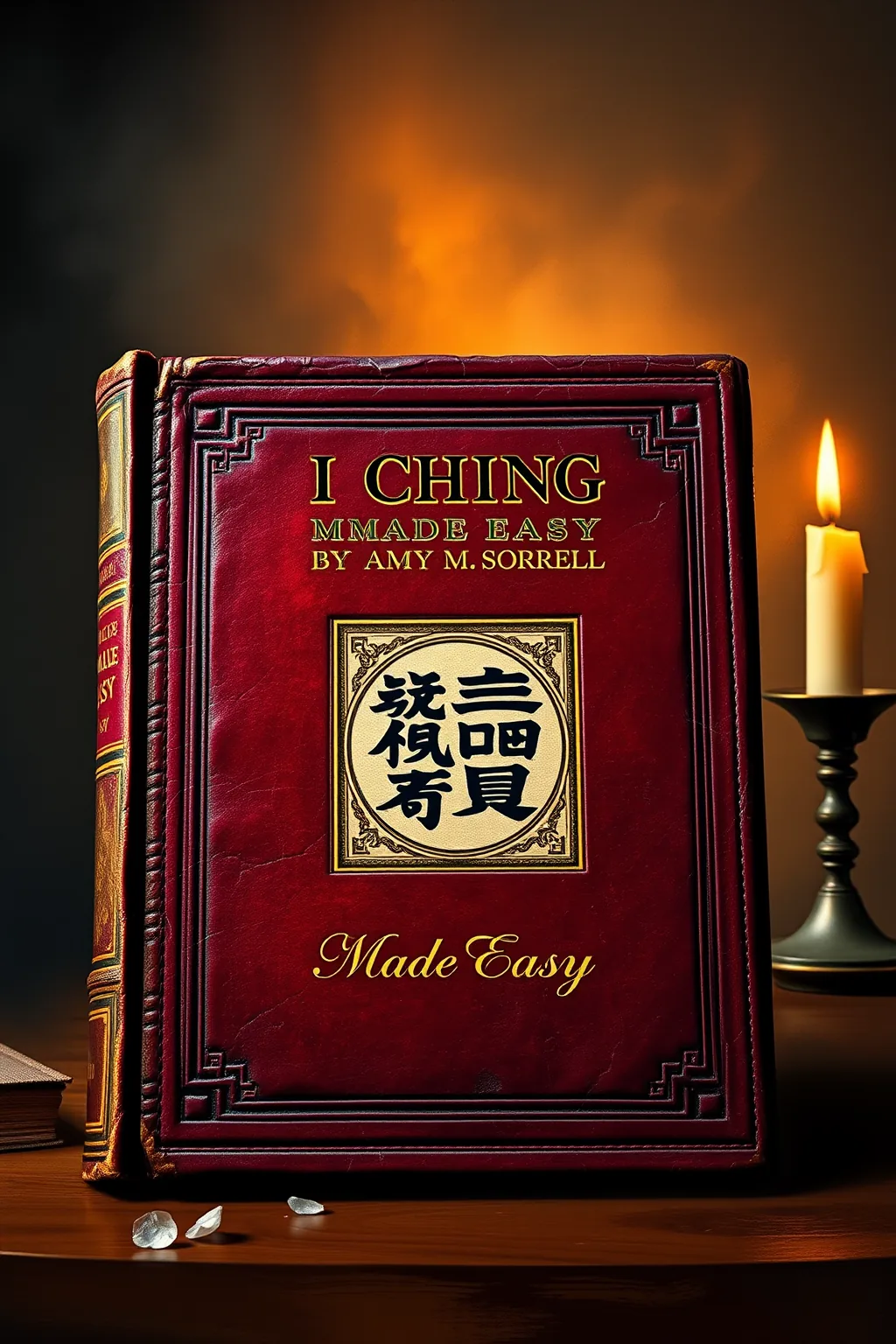
I Ching Made Easy
 62
62

I Ching Made Easy



Silas Hawthorne (Hermetic Studies Editor) — Amy M. Sorrell's 'I Ching Made Easy' is a beacon for those seeking to grasp the profound esoteric depths of the ancient Chinese oracle. Eschewing overly complex academic jargon, Sorrell offers a lucid, yet spiritually potent, exploration of the Eight Trigrams and their evolution into the Sixty-Four Hexagrams. The text breathes with an accessible mysticism, inviting readers to perceive the I Ching as a living system of cosmic correspondence. This work is a vital bridge for practitioners and scholars alike, illuminating the philosophical underpinnings and practical applications of this venerable system of wisdom. A truly valuable addition to the Esoteric Library.
📝 Description
62
Amy M. Sorrell's 'I Ching Made Easy' (2007) explains the sixty-four hexagrams.
This book breaks down the I Ching, the ancient Chinese system of divination and philosophy. Sorrell begins with the basic building blocks, the Eight Trigrams, and shows how they combine to form the sixty-four hexagrams. She explains the symbolism within each hexagram and how it relates to cosmic forces and human life. The author aims to make these complex ideas accessible, presenting each hexagram as a guide for personal understanding and decision-making. The text encourages readers to see the I Ching as more than just a tool for fortune-telling, but as a source of insight into universal patterns.
The I Ching, or 'Book of Changes,' is one of the oldest Chinese classical texts. It is central to Taoism and has influenced East Asian thought for millennia. Its system of hexagrams, derived from combinations of yin and yang lines, is used for both divination and as a framework for understanding the dynamics of change in the universe. Western esoteric traditions have often incorporated the I Ching's philosophical and symbolic structure into their own systems of thought and practice.
💡 Why Read This Book?
Unlock the profound wisdom of the I Ching. 'I Ching Made Easy' offers a clear path to understanding the foundational Eight Trigrams and the sixty-four Hexagrams, revealing their symbolic language and divinatory power. Ideal for beginners seeking an accessible entry point and seasoned practitioners looking for renewed insight into this ancient oracle of change and destiny.
⭐ Reader Reviews
Honest opinions from readers who have explored this book.
❓ Frequently Asked Questions
What are the Eight Trigrams?
The Eight Trigrams (Bagua) are fundamental symbolic representations of eight fundamental natural forces and principles. They form the foundational building blocks for the more complex sixty-four Hexagrams of the I Ching.
How are the Hexagrams formed?
Hexagrams are created by combining two Trigrams, one above the other. This fusion generates 64 unique combinations, each representing a distinct situation, archetype, or phase of change.
Is the I Ching only for divination?
While the I Ching is a powerful divinatory tool, its wisdom extends far beyond simple fortune-telling. It offers profound philosophical insights into the nature of change, human conduct, and cosmic principles.
Who is Amy M. Sorrell?
Amy M. Sorrell is an author and scholar dedicated to making ancient wisdom traditions accessible. Her work focuses on the practical and spiritual applications of esoteric knowledge, particularly from East Asian philosophies.
Can I use this book without prior knowledge?
Absolutely. 'I Ching Made Easy' is specifically designed to guide newcomers through the core concepts and practices of the I Ching, making it an excellent starting point for anyone curious about this ancient system.
🔮 Key Themes & Symbolism
The Genesis of the Hexagrams: From Trigrams to Cosmic Codes
This book meticulously unravels the foundational structure of the I Ching, illustrating how the eight elemental Trigrams serve as the primordial building blocks for the sixty-four complex Hexagrams. It looks at the symbolic language of the Trigrams, revealing their intrinsic connection to natural forces and archetypal energies. Understanding this genesis is crucial for grasping the profound interconnectedness of all phenomena within the I Ching's cosmic framework. This exploration offers a deeper appreciation for the elegant simplicity and profound depth from which the entire system of change emerges.
Working through the Currents of Change: The I Ching as a Mirror to Life
The I Ching is not a static text but a dynamic oracle that reflects the ever-shifting nature of existence. 'I Ching Made Easy' guides readers to perceive the Hexagrams as potent metaphors for life's myriad situations, challenges, and transformations. It emphasizes the cyclical patterns of change, encouraging introspection and adaptation rather than passive acceptance. By understanding the underlying energies and implications of each Hexagram, readers can gain foresight, make informed decisions, and navigate their personal journeys with greater wisdom and equanimity.
The Language of Symbols: Unveiling the Esoteric Meanings
Fundamentally, the I Ching communicates through a rich lexicon of symbols, lines, and archetypes. Amy M. Sorrell masterfully deciphers these esoteric meanings, revealing the hidden knowledge embedded within each Trigram and Hexagram. This section explores the philosophical underpinnings and spiritual significance of these symbols, connecting them to universal principles of balance, harmony, and cosmic order. By learning to interpret this symbolic language, readers can access useful insights into themselves and the world around them, fostering a deeper spiritual awareness.
💬 Memorable Quotes
Direct passages from the work, attributed to the author.
“The Trigrams are the seeds from which the Hexagrams grow, each holding a universe of meaning.”
— This highlights the foundational role of the Eight Trigrams, emphasizing their inherent complexity and the vast potential for wisdom contained within their simple forms, which expand into the sixty-four Hexagrams.
“The Hexagrams are not predictions, but reflections of the present moment's potential.”
— This clarifies the nature of I Ching consultation, positioning it as a tool for self-awareness and strategic guidance rather than deterministic prophecy, empowering the user.
“Wisdom lies not in knowing the future, but in understanding the currents of change.”
— This emphasizes the practical application of the I Ching, suggesting that true insight comes from comprehending the forces at play and adapting accordingly, rather than seeking fixed outcomes.
“Each line of a Hexagram is a whisper from the cosmos, guiding the seeker's path.”
— This poetic statement underscores the divinatory aspect, portraying the individual lines within a Hexagram as subtle, yet significant, messages offering direction and illumination.
💡 Key Ideas
Editorial paraphrase of the work's core concepts — not direct quotes.
In the dance of Yin and Yang, we find the rhythm of all existence.
This quote captures the fundamental duality of the I Ching, illustrating how the interplay of opposing forces creates the dynamic balance and continuous motion that governs the universe.
🌙 Esoteric Significance
Tradition
The I Ching is deeply rooted in ancient Chinese esoteric traditions, particularly Taoism and Confucianism, though its origins predate formal schools. It embodies principles of cosmic harmony, the cyclical nature of existence, and the interconnectedness of all things through the interplay of Yin and Yang. Its esoteric significance lies in its ability to serve as a map of consciousness, reflecting universal archetypes and guiding the practitioner towards self-understanding and alignment with the Tao.
Symbolism
The core symbolism of the I Ching resides in the Eight Trigrams (Bagua) and the Sixty-Four Hexagrams. These are not mere abstract diagrams but potent representations of fundamental forces, elements, and archetypal situations. The broken (Yin) and solid (Yang) lines, their combinations, and the resulting Hexagrams form a complex language that speaks to the dynamic processes of the universe, human relationships, and personal development, offering useful insights into the ebb and flow of life.
Modern Relevance
In the modern era, the I Ching remains remarkably relevant as a profound tool for introspection, ethical guidance, and navigating complexity. Its emphasis on change, adaptation, and understanding underlying patterns offers a valuable counterpoint to the often chaotic and uncertain nature of contemporary life. Practitioners and scholars alike continue to find in its ancient wisdom practical strategies for decision-making, personal growth, and fostering a deeper connection to the universal order.
👥 Who Should Read This Book
This book is an invaluable resource for a diverse range of readers. **Beginners** will find a welcoming and accessible entry point into the profound world of the I Ching, with clear explanations of its foundational concepts. **Spiritual seekers** will discover a rich source of wisdom for personal growth, self-discovery, and aligning with the natural order. **Practitioners of divination** will gain a deeper understanding of the I Ching's symbolic language and divinatory applications. **Scholars and students of Eastern philosophy** will appreciate its clear exposition of the text's historical and philosophical significance, offering a solid foundation for further study.
📜 Historical Context
The I Ching, or 'Book of Changes,' emerged from ancient Chinese shamanic traditions and philosophical inquiries, with its earliest layers dating back to the Western Zhou dynasty (c. 1046–771 BCE). Initially a manual for divination and understanding natural phenomena, it evolved over centuries, incorporating the philosophical insights of Confucianism and Taoism. Key figures like King Wen, Duke of Zhou, and Confucius contributed to its textual development and interpretation, transforming it into a profound philosophical and cosmological text. During the Han Dynasty (206 BCE – 220 CE), the I Ching solidified its status as one of the Five Classics of Chinese literature, influencing not only Chinese thought but also spreading its profound wisdom to Korea, Japan, and Vietnam, shaping East Asian intellectual and spiritual landscapes for millennia.
📔 Journal Prompts
Reflect on a recent challenge: Which Hexagram(s) might represent its underlying energies?
Consider the interplay of Yin and Yang in your daily life. Where do you see balance and imbalance?
If the I Ching were to offer you advice on your current path, what message would it convey?
How can the concept of change, as represented by the Hexagrams, empower you to embrace new beginnings?
Meditate on the symbolism of one of the Eight Trigrams. What personal meaning does it hold for you?
🗂️ Glossary
Trigram
One of the eight fundamental symbolic figures, composed of three lines (solid Yang or broken Yin), forming the basis of the Hexagrams.
Hexagram
A figure composed of two Trigrams, one above the other, representing 64 distinct archetypal situations or phases of change.
Yin
The principle of receptivity, darkness, femininity, and passivity, represented by a broken line (--).
Yang
The principle of activity, light, masculinity, and assertiveness, represented by a solid line (—).
Bagua
The Chinese term for the Eight Trigrams, often depicted in a circular arrangement representing cosmological principles.
This book appears in 2 collections
🔮 Readers Also Liked
Browse all →









From the “I Ching” Collection
View all →









More Free Divination & Tarot Books
View all →