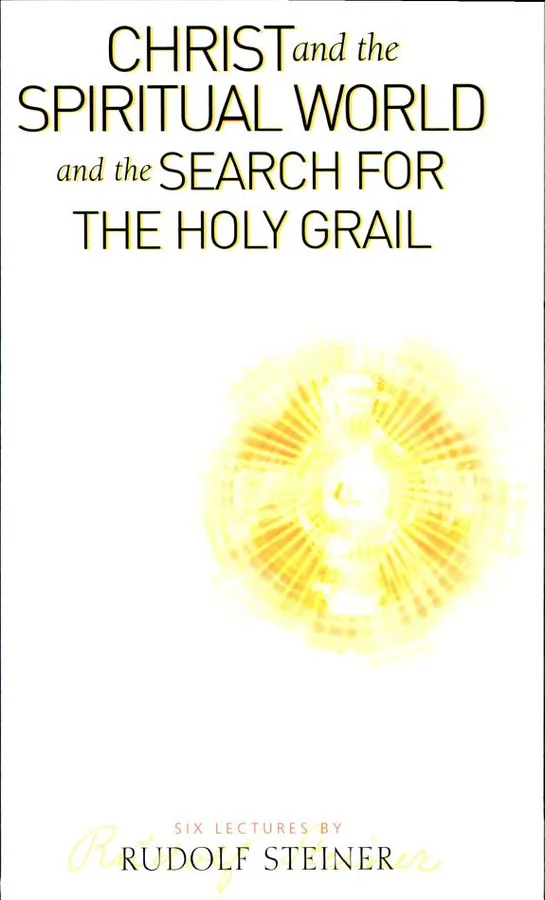
Christ and the Spiritual World and the Search for the Holy Grail
 73
73

Christ and the Spiritual World and the Search for the Holy Grail
Rudolf Steiner’s "Christ and the Spiritual World and the Search for the Holy Grail" confronts the reader with an intricate cosmology that demands deep engagement. Steiner argues compellingly that approaching the Grail requires a transformation of perception, moving beyond mere intellectualism to a felt experience of the holy, as evidenced in his assertion that "The only way is by changing all these words into feeling." This reorientation is central to his unique interpretation of Christ’s cosmic significance. While the depth of his spiritual vision is undeniable, the dense, often metaphorical language can present a considerable barrier to entry for those unfamiliar with Anthroposophical terminology. A particular strength lies in his ability to synthesize disparate traditions—Gnosticism, Arthurian legend, and Christian theology—into a cohesive spiritual history. However, the lack of explicit guidance on *how* to cultivate this 'feeling' aspect, beyond the initial declaration, leaves the practical application somewhat abstract. The work offers a profound, albeit challenging, perspective on the spiritual underpinnings of Western civilization.
📝 Description
73
Rudolf Steiner linked Christ's Incarnation to cosmic and earthly realms in this 1925 work.
Rudolf Steiner's "Christ and the Spiritual World and the Search for the Holy Grail" examines the spiritual significance of Gnostic traditions and Arthurian Grail legends, connecting them to the Incarnation of Christ. Steiner suggests that understanding these narratives requires moving beyond intellectual grasp toward a felt apprehension of the sacred. The book considers the evolution of human consciousness and its connection to spiritual forces, especially in relation to Christ's life and ongoing spiritual presence. He places Christ's life within a larger cosmic history, contrasting it with Gnostic spiritual insights and the symbolic quest for the Grail in medieval romances. This volume emerged from lectures given during a time of increased interest in spiritualism and occult revivals.
This work comes from Rudolf Steiner's Anthroposophy, a spiritual philosophy that emerged from Theosophy. Steiner presented his ideas through a distinct method of spiritual perception. He sought to explain the spiritual realities behind historical events and religious figures, including Christ. His approach differed from contemporary esoteric movements by emphasizing a Christ-centered cosmic and human evolution.
💡 Why Read This Book?
• Gain a unique perspective on the historical Christ, understanding His incarnation not just as a human event but as a pivotal cosmic intervention, as detailed in Steiner's exploration of the spiritual forces behind earthly history. • Understand the Holy Grail legend through an esoteric lens, recognizing its symbolic representation of spiritual attainment and the vessel for divine consciousness, moving beyond literal interpretations. • Explore the spiritual lineage connecting Gnosticism and Arthurian romance to contemporary esoteric Christianity, appreciating Steiner's synthesis of these traditions for a richer understanding of Western spiritual development.
⭐ Reader Reviews
Honest opinions from readers who have explored this book.
❓ Frequently Asked Questions
What is Rudolf Steiner's core argument about the Holy Grail?
Steiner argues the Grail is not a physical object but a symbol for spiritual attainment and a vessel of divine consciousness, accessible not through intellectual speculation but through a transformation of feeling.
How does Steiner connect Christ to the Holy Grail?
He links the Incarnation of Christ to the cosmic and earthly realms, suggesting that the Grail quest represents humanity's search for spiritual connection, which Christ's earthly mission profoundly impacted and continues to influence.
What role does Gnosticism play in Steiner's interpretation?
Steiner examines Gnostic traditions as parallel paths offering spiritual insights that, like the Grail legend, contribute to understanding the deeper spiritual significance of Christ's work and the evolution of human consciousness.
Is "Christ and the Spiritual World" an easy read?
No, the book is based on Steiner's lectures and requires a dedicated reader familiar with Anthroposophy or willing to engage with complex spiritual and philosophical concepts presented in his characteristic style.
When were Rudolf Steiner's lectures on this topic originally given?
While the book was first published in 2016, the lectures themselves were delivered by Rudolf Steiner in the early 20th century, reflecting his mature spiritual-scientific research.
What does Steiner mean by 'changing words into feeling' regarding the Grail?
This emphasizes a direct, intuitive, and experiential apprehension of spiritual realities. It means transcending abstract thought and philosophical analysis to connect with the sacred on an emotional and spiritual level.
🔮 Key Themes & Symbolism
Christ's Cosmic Role
Steiner posits Christ's incarnation as a central event not confined to earthly history but as a cosmic occurrence with ongoing spiritual impact. He moves beyond conventional theological views to present Christ as a living, active spiritual force influencing human evolution. The work examines the spiritual-scientific perspective on Christ's presence in the etheric and astral realms, offering a framework for understanding His continued work in the spiritual world and its effect on humanity's developmental trajectory.
The Grail as Spiritual Attainment
The Holy Grail is reinterpreted from a literal artifact into a profound symbol of spiritual consciousness and achievement. Steiner guides readers to perceive the Grail not as something to be found physically, but as a state of being—an inner vessel capable of holding divine light and wisdom. The quest for the Grail becomes synonymous with the path of inner transformation, requiring a development of spiritual faculties to perceive and connect with the sacred.
Gnosticism and Esoteric Christianity
Steiner analyzes Gnostic movements not as heresies but as significant historical expressions of spiritual knowledge that sought a direct, experiential understanding of the divine. He contrasts their approach with later orthodox Christianity, highlighting how both traditions, along with the Grail legend, offer crucial insights into the spiritual forces at play in human history and the nature of Christ. This theme explores the continuity and divergence of esoteric traditions.
Human Consciousness Evolution
A central theme is the evolution of human consciousness, particularly its relationship with the spiritual world. Steiner traces this development from ancient mystery traditions through the impact of Christ's incarnation and into the modern era. He explains how external events and spiritual impulses shape human perception and spiritual capacity, emphasizing the need for conscious spiritual development to read through the complexities of existence.
💬 Memorable Quotes
Direct passages from the work, attributed to the author.
“The meaning of Christ's life on earth has to be grasped not just historically, but cosmically.”
— Steiner emphasizes that Christ's incarnation was not merely a singular event in human history but a cosmic intervention with enduring spiritual consequences. This perspective invites readers to consider Christ's ongoing influence beyond the physical realm.
“The Grail represents the spiritual nourishment and consciousness that humanity can attain.”
— This interpretation reframes the Grail legend from a quest for a physical object to a symbolic journey toward inner spiritual development and the reception of divine wisdom, achievable through personal transformation.
“Gnostic insights offer a complementary understanding of the spiritual forces at work.”
— Steiner views Gnosticism as a historical current that, alongside Christian and Grail traditions, provides essential perspectives on the hidden spiritual realities and the nature of divine knowledge sought by humanity.
“Spiritual science seeks to reveal the hidden connections between the earthly and the divine.”
— This statement highlights the aim of Steiner's work: to bridge the gap between material observation and spiritual understanding, useful the underlying spiritual laws that govern existence and human development.
💡 Key Ideas
Editorial paraphrase of the work's core concepts — not direct quotes.
‘There is no way of approach to the Grail through words of any kind, or through philosophical speculations. The only way is by changing all these words into feeling, by becoming able to feel in the Grail the sum of all that is holy...’
This quote expresses Steiner's core message: true spiritual understanding, particularly concerning the Grail, transcends intellectual analysis. It calls for a cultivated inner capacity to directly experience the divine, transforming abstract concepts into lived spiritual reality.
🌙 Esoteric Significance
Tradition
This work is deeply rooted in the Western Esoteric tradition, specifically Anthroposophy, which Rudolf Steiner founded. It draws heavily on Christian mysticism, Gnosticism, and Arthurian legend, reinterpreting them through Steiner's unique spiritual-scientific lens. While acknowledging Gnostic traditions, Steiner emphasizes a Christocentric view that diverges from Gnostic dualism, positioning Christ's incarnation as the central event for cosmic and human evolution, offering a path to spiritual renewal distinct from Gnostic salvation concepts.
Symbolism
The primary symbols explored are Christ and the Holy Grail. Christ represents the divine-spiritual impulse entering earthly evolution, a force for transformation and renewal. The Holy Grail is depicted as a symbol of spiritual consciousness and the vessel for divine wisdom, attainable through inner development. Its quest signifies humanity's search for spiritual nourishment and connection to the sacred, a journey profoundly influenced by Christ's spiritual work.
Modern Relevance
Steiner's work continues to influence contemporary Anthroposophists and independent spiritual seekers. His reinterpretation of Christ and the Grail speaks to those exploring alternative spiritualities that seek to integrate historical religious narratives with a modern understanding of consciousness and cosmic evolution. Thinkers and practitioners in fields like spiritual psychology, Waldorf education, and biodynamic agriculture, all stemming from Anthroposophy, engage with these foundational concepts.
👥 Who Should Read This Book
• Students of Rudolf Steiner and Anthroposophy: Those seeking to deepen their understanding of Steiner's core teachings on Christ, spiritual evolution, and the significance of ancient myths and legends. • Comparative religion scholars: Researchers interested in esoteric interpretations of Christianity, Gnosticism, and medieval Arthurian romances, particularly how these traditions are synthesized. • Individuals exploring the spiritual dimensions of history: Readers wishing to comprehend historical events and cultural narratives through a cosmic and spiritual-scientific framework.
📜 Historical Context
Rudolf Steiner delivered the lectures compiled in "Christ and the Spiritual World and the Search for the Holy Grail" during the early 20th century, a period marked by intense spiritual and philosophical inquiry. This era saw the rise of Theosophy, influenced by figures like Helena Blavatsky, and a broader interest in Western esoteric traditions, including Hermeticism and Kabbalah. Steiner, having departed from Theosophy to develop his own spiritual science (Anthroposophy), offered a distinct Christocentric interpretation. He engaged with the spiritual currents of his time, including the prevailing rationalism and materialism, by proposing a view of history and spirituality grounded in cosmic events and spiritual beings. His work provided an alternative to both orthodox religious dogma and purely materialistic scientific viewpoints, positioning Christ's incarnation as a unique, transformative event for Earth and humanity, distinct from Gnostic cosmologies yet acknowledging their spiritual quest.
📔 Journal Prompts
The Grail as a vessel of holy feeling: How might one cultivate this capacity beyond intellectual understanding?
Christ's cosmic significance: Reflect on the implications of viewing His incarnation as a major spiritual-earthly event.
Gnostic versus Anthroposophical Christology: What are the essential differences in their approaches to salvation?
The spiritual journey represented by the Grail Quest: Where does this inner quest align with your own spiritual path?
Connecting historical narratives (Grail, Gnosticism) to present spiritual needs: How do these ancient streams inform contemporary seekers?
🗂️ Glossary
Anthroposophy
A spiritual philosophy founded by Rudolf Steiner, aiming to understand the spiritual nature of the human being and the cosmos through spiritual-scientific research and direct inner experience.
Gnosticism
A diverse set of religious and philosophical movements in the early centuries CE, characterized by a belief in salvation through esoteric knowledge (gnosis) and a dualistic worldview.
Incarnation
The belief that a divine being or spirit takes on a physical human form. In Christianity, it refers specifically to God becoming man in the person of Jesus Christ.
Cosmic
Relating to the universe or cosmos as a whole; pertaining to the grand order and structure of existence beyond Earth.
Etheric Realm
In Anthroposophy, a subtle spiritual realm that interpenetrates the physical world, associated with life forces and organic processes, distinct from the astral realm.
Astral Realm
In Anthroposophy, a spiritual realm associated with consciousness, thoughts, feelings, and desires, lying between the etheric and mental realms.
Spiritual Science
The term Rudolf Steiner used for his method of investigating the spiritual world, emphasizing empirical observation and rigorous thinking applied to supersensible realities.
This book appears in 1 collection
🔮 Readers Also Liked
Browse all →








From the “Holy Grail” Collection
View all →









More Free Occult Philosophy Books
View all →