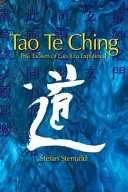
Tao Te Ching
 76
76

Tao Te Ching
Stefan Stenudd’s translation of the Tao Te Ching offers a welcome clarity to a text often burdened by overly complex interpretations. By focusing on simplicity, Stenudd allows Lao Tzu’s core message to shine through, particularly in passages concerning Wu Wei, the concept of effortless action. For instance, the emphasis on acting without acting, as seen in Chapter 3, feels remarkably direct. However, this very simplicity occasionally risks flattening the text's inherent philosophical depth; some readers might yearn for a more extensive exploration of the nuances within the 81 chapters. Despite this, Stenudd’s rendition is a valuable, accessible entry point to one of the world's most significant philosophical works. It successfully distills ancient wisdom for a contemporary audience.
📝 Description
76
Stefan Stenudd's 2015 translation of the Tao Te Ching makes Lao Tzu's ancient text accessible.
This edition presents the Tao Te Ching, attributed to the philosopher Lao Tzu. The text consists of 81 short chapters that describe a worldview centered on the Tao, or 'The Way,' and suggest how human life can align with its principles. Stenudd's translation aims for clarity, seeking to convey Lao Tzu's cosmology and ethical ideas without sacrificing the original simplicity.
It is suited for individuals interested in Eastern philosophy and wisdom traditions. The book appeals to those who practice contemplation, seek ethical living guidance, or consider alternative views on governance and personal conduct. Readers looking for ancient texts that offer practical advice for life's challenges will find this version helpful.
Written around the 5th century BCE during China's Spring and Autumn period, a time of intellectual and political change, the Tao Te Ching became a core text of Taoism. It offered a contrast to other developing philosophies like Confucianism, influencing Chinese thought for centuries.
As the central scripture of Taoism, the Tao Te Ching outlines a path of natural living and cosmic harmony. Its emphasis on the ineffable Tao, the underlying principle of all existence, and the practice of Wu Wei (non-action) positions it within traditions that seek direct experience of reality rather than adherence to dogma. This text offers a counterpoint to more structured or interventionist philosophies, advocating for a return to natural spontaneity and balance.
💡 Why Read This Book?
• Gain a practical framework for understanding Wu Wei, the principle of effortless action, by engaging with its specific articulation across the 81 chapters. • Grasp the concept of the Tao as the fundamental, ineffable 'Way' of existence, as presented by Lao Tzu circa 500 BCE. • Explore the ethical implications of aligning oneself with natural flows, a core tenet of Taoism presented in this 2,500-year-old text.
⭐ Reader Reviews
Honest opinions from readers who have explored this book.
❓ Frequently Asked Questions
Who is Lao Tzu and when was the Tao Te Ching written?
Lao Tzu is the legendary philosopher credited with authoring the Tao Te Ching, a foundational text of Taoism. The work is estimated to have been written around the 6th century BCE, during China's Spring and Autumn period.
What does 'Tao' mean in the context of the Tao Te Ching?
In the Tao Te Ching, 'Tao' (or 'Dao') refers to 'The Way,' the ineffable, fundamental principle that underlies and governs all existence. It is the natural order of the universe.
What is the concept of Wu Wei?
Wu Wei, often translated as 'non-action' or 'effortless action,' is a central principle in the Tao Te Ching. It advocates for acting in accordance with the natural flow of things, without force or undue effort.
How does the Tao Te Ching differ from Confucianism?
While both are major Chinese philosophies, the Tao Te Ching emphasizes naturalness, spontaneity, and yielding (Taoism), whereas Confucianism focuses on social order, ritual, and ethical conduct through structured relationships.
Is Stefan Stenudd's translation of the Tao Te Ching suitable for beginners?
Yes, Stefan Stenudd's translation is specifically designed for clarity and simplicity, making it an accessible and excellent starting point for those new to the Tao Te Ching and Taoist philosophy.
How many chapters are in the Tao Te Ching?
The Tao Te Ching is traditionally divided into 81 short chapters, each offering concise reflections on the Tao and its principles.
🔮 Key Themes & Symbolism
The Ineffable Tao
The central theme is the Tao, described as the unnamable, primordial source and driving force of all reality. It is beyond human comprehension yet intimately present in everything. The text suggests that true wisdom lies in recognizing and aligning with this fundamental principle, understanding its subtle workings rather than attempting to define or control it. This concept underpins the entire philosophical structure of the work.
Effortless Action (Wu Wei)
Wu Wei is presented not as passivity, but as action aligned with the natural course of events. It emphasizes spontaneity, adaptability, and minimal intervention. By acting in accordance with the Tao, one achieves greater effectiveness with less strain. This principle is illustrated through analogies of natural phenomena, suggesting that by yielding and flowing, one can accomplish more than through forceful opposition.
Relativity of Opposites
The text frequently highlights the interdependent nature of seemingly opposing concepts, such as good and evil, beauty and ugliness, being and non-being. It posits that these are not absolute but relative and complementary aspects of the same reality. Understanding this interdependence leads to a more balanced perspective and reduces attachment to fixed judgments, fostering acceptance and wisdom.
Simplicity and Humility
Lao Tzu advocates for a return to simplicity, detachment from worldly desires, and the cultivation of humility. He suggests that societal complexities and artificial distinctions obscure the natural Way. Embracing a simple life and acknowledging one's limitations are presented as paths to inner peace and genuine strength, contrasting with the ambition and striving often valued in society.
💬 Memorable Quotes
Direct passages from the work, attributed to the author.
“The Tao that can be told is not the eternal Tao.”
— This opening statement immediately establishes the ineffable nature of the Tao. It suggests that any attempt to define or articulate the ultimate reality through language is inherently limited and falls short of its true, eternal essence.
“To know one is to be one. To know one is to be innocent. To know one is to love one.”
— This concept highlights the interconnectedness of knowledge and being. True understanding, particularly of the Tao, leads to a state of natural innocence and profound empathy, fostering love and acceptance.
“Nature does not hurry, yet everything is accomplished.”
— This illustrates the principle of Wu Wei. It suggests that the natural order operates with perfect timing and efficiency without apparent effort or rush, providing a model for human action.
“The sage stays behind, and therefore is ahead. He is content with his lot, and therefore is complete.”
— This speaks to the virtue of humility and non-striving. By not seeking the forefront or accumulating possessions, the wise individual achieves a deeper fulfillment and a more enduring influence.
“When people see some things as beautiful, other things acquire ugliness.”
— This exemplifies the relativity of opposites. The creation of value judgments based on perceived beauty inherently leads to the perception of its opposite, demonstrating how concepts are interdependent.
🌙 Esoteric Significance
Tradition
The Tao Te Ching is a cornerstone text for Taoism, an indigenous Chinese tradition often considered esoteric due to its focus on inner cultivation, mystical experience, and alignment with cosmic principles. While distinct from Western esoteric lineages like Hermeticism or Kabbalah, it shares common ground in its exploration of fundamental universal laws and the pursuit of spiritual enlightenment through understanding and harmonizing with these forces.
Symbolism
Key symbols include 'The Way' (Tao) itself, representing the ineffable, ultimate reality and natural order. Water is frequently used as a metaphor for the Tao's properties: yielding, adaptable, and powerful in its persistence. The 'uncarved block' (P'u) symbolizes original simplicity and the state of being before the imposition of artificial distinctions and desires, representing a return to natural essence.
Modern Relevance
Contemporary thinkers and practitioners across various fields, from psychology (e.g., concepts of flow and mindfulness) to leadership studies (e.g., servant leadership and non-hierarchical structures), draw inspiration from the Tao Te Ching. Its emphasis on balance, non-duality, and ecological harmony continues to resonate with those seeking sustainable models for personal well-being and societal organization.
👥 Who Should Read This Book
• Students of comparative philosophy and world religions seeking foundational texts from Eastern traditions. • Individuals interested in practical ethics and contemplative practices, looking for guidance on living a more balanced and harmonious life. • Seekers of esoteric wisdom exploring ancient texts that offer alternative perspectives on reality, governance, and self-cultivation.
📜 Historical Context
The Tao Te Ching emerged from the fertile intellectual range of ancient China's Spring and Autumn period (771–476 BCE), a time marked by widespread social upheaval and philosophical innovation. Lao Tzu, the attributed author, is said to have been a contemporary of Confucius, though the exact historical personage remains debated. This era saw the rise of various schools of thought seeking to restore order and meaning, including Confucianism, which emphasized social hierarchy and ritual propriety. In contrast, the Tao Te Ching offered a radical alternative, advocating for naturalness, simplicity, and a non-interfering approach to governance and life. Its teachings provided a foundational text for Taoism, profoundly influencing Chinese culture, art, and spirituality for over two millennia, often existing in dialogue with, and sometimes in opposition to, Confucian ideals.
📔 Journal Prompts
The Tao's ineffability, as described in the opening lines.
Reflections on Wu Wei, the art of effortless action.
The relativity of opposites, such as beauty and ugliness.
The virtue of simplicity and non-striving.
Nature's unhurried accomplishment, as a model for conduct.
🗂️ Glossary
Tao (Dao)
The fundamental, ineffable principle of the universe; 'The Way.' It represents the natural order, the source, and the driving force behind all existence.
Te (De)
Often translated as 'virtue' or 'power.' It refers to the manifestation or expression of the Tao within individuals and things; the inherent quality or potential that allows something to be itself.
Wu Wei
Literally 'non-action' or 'effortless action.' It signifies acting in accordance with the natural flow of the Tao, without force, striving, or artificiality.
P'u (Pu)
The 'uncarved block.' Symbolizes original simplicity, naturalness, and the state of potential before artificial distinctions and desires are imposed.
Lao Tzu (Laozi)
The legendary ancient Chinese philosopher traditionally credited with authoring the Tao Te Ching. He is considered a central figure in Taoism.
Spring and Autumn period
An era in Chinese history (771–476 BCE) characterized by political fragmentation and intellectual ferment, during which many major philosophical schools, including Taoism and Confucianism, emerged.
Sage
In the context of the Tao Te Ching, the sage is one who embodies and lives in accordance with the Tao, demonstrating wisdom, humility, and effortless action.