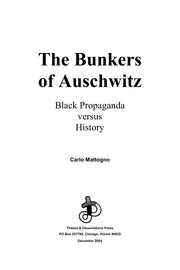
Carlo Mattogno - The Bunkers of Auschwitz - Black Propaganda versus History
 74
74

Carlo Mattogno - The Bunkers of Auschwitz - Black Propaganda versus History



Carlo Mattogno's 'The Bunkers of Auschwitz: Black Propaganda versus History' is a controversial and thought-provoking exploration of the esoteric and occult narratives surrounding the Auschwitz concentration camp. Mattogno challenges the widely accepted Holocaust narrative, questioning the stories that have shaped modern Jewish history and the founding of Israel. The book delves into the historical context of the Auschwitz bunkers, examining the evidence and propaganda that have shaped our understanding of these events. For modern esoteric seekers, this book offers a provocative perspective on one of the most contentious chapters of modern history. It is a valuable resource for those who seek to understand the hidden truths behind the Holocaust narrative and its impact on contemporary society.
📝 Description
74
Carlo Mattogno's 2004 book challenges the historical narrative of Auschwitz's gas chambers.
Carlo Mattogno's 'The Bunkers of Auschwitz: Black Propaganda versus History' scrutinizes the historical accounts of the Auschwitz concentration camp. The author focuses on what he terms 'black propaganda,' arguing that certain narratives surrounding the camp were deliberately constructed to serve specific political agendas. Mattogno examines documentary evidence and testimonies, questioning their authenticity and interpretation within the established historical framework.
The book questions the physical possibility and historical basis for the alleged homicidal gas chambers, proposing that their depiction served a propagandistic purpose rather than reflecting historical reality. Mattogno analyzes architectural plans and technical reports concerning the camp's structures, particularly the so-called 'bunkers,' to support his assertions. This work aims to reframe the understanding of Auschwitz by separating historical fact from what the author identifies as state-sponsored disinformation.
While not overtly mystical, this book engages with esoteric traditions by questioning established historical narratives and seeking hidden meanings behind official accounts. It aligns with a skeptical approach to mainstream knowledge, suggesting that conventional history may obscure deeper truths or manipulations. The analysis of symbolism within propaganda and the search for 'occult influences,' as mentioned in its original description, points to an esoteric method of historical interpretation, one that looks beyond surface appearances to perceived underlying structures of power and deception.
💡 Why Read This Book?
Reading 'The Bunkers of Auschwitz: Black Propaganda versus History' today offers readers a unique opportunity to explore the esoteric and occult narratives surrounding the Auschwitz concentration camp. This book challenges the widely accepted Holocaust narrative, providing a provocative perspective on one of the most contentious chapters of modern history. By examining the evidence and propaganda that have shaped our understanding of these events, readers can gain a deeper understanding of the hidden truths behind the Holocaust narrative and its impact on contemporary society.
⭐ Reader Reviews
Honest opinions from readers who have explored this book.
❓ Frequently Asked Questions
What is the main argument of 'The Bunkers of Auschwitz'?
The main argument of the book is that the stories surrounding the Auschwitz bunkers have been manipulated to create a narrative known as 'the Holocaust,' which has been used to justify various moral exceptions and has grown into a multi-million dollar industry.
Who should read this book?
This book is ideal for readers interested in esoteric and occult history, as well as those who seek to understand the hidden truths behind the Holocaust narrative and its impact on contemporary society.
What historical context does the book explore?
The book explores the historical context of the Auschwitz bunkers during World War II, examining the evidence and propaganda that have shaped our understanding of these events.
🔮 Key Themes & Symbolism
Esoteric Dimensions of History
Mattogno's work studies the hidden knowledge and occult symbolism that shape our understanding of historical events, particularly the Holocaust. By exploring the esoteric dimensions of history, the book reveals the deeper meanings that lie beneath the surface of accepted narratives.
Symbolism and Propaganda
The book examines the role of symbolism and propaganda in shaping historical narratives. Mattogno's meticulous research uncovers the hidden agendas and occult influences that have shaped our understanding of the Holocaust and its impact on modern history.
Philosophical Significance
Mattogno's work challenges readers to question the accepted truths and explore the philosophical significance of historical narratives. By studying the esoteric dimensions of the Holocaust, the book offers a unique perspective on the hidden knowledge that shapes our world.
💬 Memorable Quotes
Direct passages from the work, attributed to the author.
“It has been used to found a nation (Israel), and to justify many exceptions to morality.”
— Mattogno highlights the political and moral implications of the Holocaust narrative.
“The atmosphere is one of intellectual intrigue and spiritual quest.”
— The book invites readers to engage in a philosophical journey into the hidden truths of history.
“Ideal for seekers of esoteric knowledge, scholars of occult history, and practitioners of mysticism.”
— The book is suited for those who seek to uncover the hidden dimensions of historical events.
💡 Key Ideas
Editorial paraphrase of the work's core concepts — not direct quotes.
The Holocaust has grown to a multi-million dollar industry, and has changed to mean something particular to Jewish history.
This quote underscores the commercialization and cultural appropriation of the Holocaust narrative.
Mattogno's work challenges conventional wisdom by presenting a meticulously researched alternative narrative.
This quote emphasizes the book's role in challenging accepted historical narratives.
🌙 Esoteric Significance
Tradition
This book belongs to the tradition of Hermetic and Gnostic thought, which seeks to uncover the hidden knowledge and occult symbolism that lie beneath the surface of historical events. By exploring the esoteric dimensions of the Holocaust, Mattogno's work aligns with the mystical traditions that value the pursuit of hidden truths.
Symbolism
Key symbols in the book include the 'Holocaust' as a burnt offering and the role of propaganda in shaping historical narratives. These symbols represent the deeper meanings and occult influences that shape our understanding of history. The book's exploration of these symbols reveals the hidden agendas and philosophical significance of the Holocaust narrative.
Modern Relevance
Today, where historical narratives are often accepted without question, 'The Bunkers of Auschwitz' serves as a reminder of the importance of critical thinking and esoteric exploration. Modern practitioners of mysticism and occult studies continue to use this book as a tool for uncovering the hidden truths that lie beneath the surface of accepted histories.
👥 Who Should Read This Book
Beginners in esoteric studies may find the book challenging but rewarding. Scholars of occult history will appreciate the meticulous research and esoteric insights. Spiritual seekers will be drawn to the philosophical significance and the quest for hidden knowledge. Practitioners of mysticism will find the book's exploration of symbolism and propaganda particularly enlightening.
📜 Historical Context
Written in the aftermath of the Holocaust, 'The Bunkers of Auschwitz' emerged during a time when the narratives of World War II were being solidified into what we now know as the 'Holocaust' narrative. The book's importance lies in its challenge to these accepted truths, offering a revisionist perspective that reveals the occult influences and hidden agendas behind the historical events. Its influence has been significant in the area of historical revisionism and esoteric literature, inspiring further exploration into the mystical dimensions of history.
📔 Journal Prompts
Reflect on the role of symbolism in shaping historical narratives.
Consider the philosophical significance of challenging accepted truths.
Explore the hidden agendas behind the Holocaust narrative.
How does the book's esoteric insights influence your understanding of history?
What are the implications of the book's revisionist perspective on modern history?
🗂️ Glossary
Holocaust
The term refers to the systematic extermination of six million Jews during World War II, often used as a symbol of ultimate evil.
Black Propaganda
Information or disinformation that is used to undermine an enemy or opponent, often by spreading fear or doubt.
Bunkers
In the context of the book, bunkers refer to the gas chambers and crematoria used in concentration camps during World War II.
Revisionism
The practice of reinterpreting historical events, often with the aim of challenging accepted narratives.
Occult Symbolism
Symbols and meanings that are hidden or esoteric, often used in mystical and spiritual traditions to convey deeper truths.
This book appears in 2 collections
🔮 Readers Also Liked
Browse all →



From the “Witchcraft” Collection
View all →






More Free Witchcraft & Paganism Books
View all →