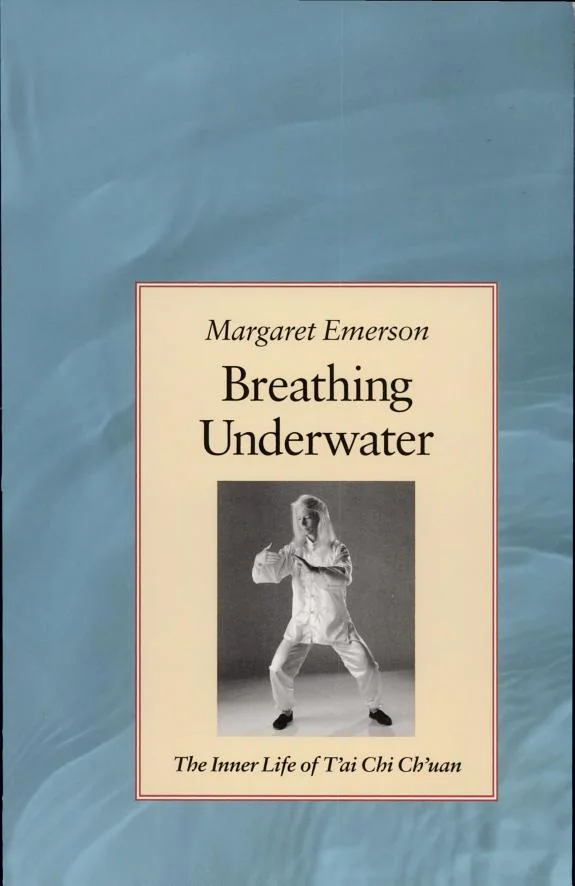
Breathing Underwater
 79
79

Breathing Underwater
Margaret Emerson’s Breathing Underwater offers a refreshing perspective on T’ai Chi Ch’uan, moving beyond the typical focus on physical conditioning or martial prowess. Emerson rightly identifies the practice’s capacity to foster emotional equilibrium and psychological insight, a dimension often overlooked. Her strength lies in clearly articulating how the deliberate cultivation of awareness and flexibility through T’ai Chi’s forms directly translates into tangible benefits in everyday life, enhancing creativity and interpersonal skills. A notable passage details the subtle shift in perception one experiences when moving through the *Push Hands* form with a focus on yielding rather than force. However, the book occasionally leans towards a somewhat generalized presentation of these benefits, lacking deeper dives into specific psychological mechanisms. Despite this, Breathing Underwater is a valuable, grounded exploration of T’ai Chi as a path to inner harmony.
📝 Description
79
Margaret Emerson's 1993 book connects T'ai Chi Ch'uan to emotional health and psychological resilience.
Breathing Underwater, published in 1993, examines T'ai Chi Ch'uan not just as a physical exercise but as a method for improving emotional well-being and mental fortitude. Emerson, an experienced T'ai Chi practitioner and teacher, shows how the martial art's movements relate to its subtle energetic and mental advantages. The book is for anyone who wants to understand T'ai Chi more deeply than its outward forms. It will appeal to those interested in the mind-body link, particularly how deliberate physical training can boost focus, foster emotional balance, and refine relationships. Practitioners of any skill level looking to align their physical practice with a richer inner life will find value here.
Emerson breaks down how fundamental T'ai Chi abilities, like increased awareness, steady concentration, and physical suppleness, directly benefit everyday living. The book discusses the idea of finding 'stillness in motion' and how this inner calm, cultivated through the art, can positively shape interactions with the outside world. These skills help address everything from work-related stress to personal challenges.
Published in 1993, Breathing Underwater arrived as Western interest in Eastern contemplative methods grew. While other books introduced Taoist ideas, Emerson's work offered a direct, practical look at T'ai Chi Ch'uan's psychological uses. It coincided with early academic interest in mindfulness and embodied cognition, acting as a hands-on complement to theoretical studies. The book fits within traditions that view physical discipline as a path to inner development, linking movement to mental and emotional states.
💡 Why Read This Book?
• Gain practical strategies for stress reduction by understanding how T’ai Chi's emphasis on *awareness* and *concentration* can be applied off the mat, as detailed in Emerson's 1993 work. • Discover how cultivating physical *mobility* and *flexibility*, central tenets of T’ai Chi Ch’uan, can unlock new avenues for creative problem-solving in personal and professional contexts. • Learn to enhance interpersonal interactions by integrating the principle of *stillness within movement*, a core concept explored through T’ai Chi practice in Emerson’s guide.
⭐ Reader Reviews
Honest opinions from readers who have explored this book.
❓ Frequently Asked Questions
What is the primary focus of Margaret Emerson's Breathing Underwater?
The book's primary focus is on T’ai Chi Ch’uan as a practice that fosters emotional health and psychological well-being, rather than solely physical benefits. It examines how skills like awareness and concentration developed through T’ai Chi can enrich daily life.
When was Breathing Underwater first published?
Breathing Underwater by Margaret Emerson was first published in 1993, reflecting a growing interest in the psychological applications of Eastern contemplative practices during that era.
How does T'ai Chi Ch'uan help with emotional health according to the book?
Emerson explains that the deliberate practice of T’ai Chi Ch’uan cultivates internal equilibrium. Skills such as heightened awareness and focused concentration, developed through the movements, can lead to greater emotional stability and resilience in the face of life's challenges.
Can the skills learned in T'ai Chi Ch'uan improve creativity?
Yes, the book suggests that enhanced awareness, concentration, and flexibility fostered by T’ai Chi practice can positively influence creativity. By developing a more centered and adaptable mindset, practitioners may find themselves approaching problems with greater ingenuity.
Who is Margaret Emerson?
Margaret Emerson is presented as a longtime student and teacher of T’ai Chi Ch’uan. Her extensive experience informs her examination of the practice's psychological and emotional benefits in Breathing Underwater.
What are the key skills from T'ai Chi discussed in the book?
The book highlights awareness, concentration, mobility, and flexibility as key skills developed through T’ai Chi Ch’uan. Emerson explores how integrating these honed abilities into daily life can enhance overall well-being and interactions.
🔮 Key Themes & Symbolism
Mind-Body Integration
Emerson posits that T’ai Chi Ch’uan is not merely exercise but a sophisticated system for integrating mental and physical states. The book details how the deliberate, flowing movements cultivate a profound sense of embodied awareness. This integration allows practitioners to experience a unified self, where physical sensations inform mental states and vice-versa, leading to a more holistic approach to well-being and problem-solving.
Cultivating Inner Stillness
A central theme is the development of inner stillness amidst external activity, a core principle often referred to as 'stillness within movement'. Emerson explains how the practice of T’ai Chi Ch’uan, with its emphasis on controlled breathing and precise postures, trains the mind to remain centered and calm. This cultivated inner quietude is presented as crucial for managing stress and enhancing clarity in everyday interactions.
Enhanced Interpersonal Dynamics
Breathing Underwater explores how the discipline cultivated through T’ai Chi Ch’uan directly impacts social interactions. Skills like heightened awareness, patience, and the ability to respond rather than react impulsively—all fostered by the practice—are shown to improve relationships with family, friends, and strangers. The book suggests that a more balanced inner state naturally leads to more harmonious external connections.
Flexibility Beyond the Physical
The book argues that the physical flexibility developed through T’ai Chi Ch’uan is a metaphor and a training ground for mental and emotional adaptability. Emerson illustrates how embracing change in bodily form can translate into a greater willingness to adapt to new ideas, circumstances, and perspectives. This broadened flexibility is key to fostering resilience and creativity.
💬 Memorable Quotes
Direct passages from the work, attributed to the author.
“Skills developed in the practice of T’ai Chi Ch’uan—awareness, concentration, mobility, and flexibility—can enrich our personal and professional lives.”
— This statement captures Emerson's core thesis: the benefits of T'ai Chi extend far beyond the practice space. It highlights the transferability of honed physical and mental disciplines to the broader spectrum of human experience.
“When integrated as a daily practice, T’ai Chi Ch’uan can enhance health, creativity, and encounters with friends, family, and strangers.”
— This interpretation emphasizes the cumulative power of consistent engagement with T'ai Chi. It posits that regular practice acts as a catalyst for holistic improvement, touching upon physical vitality, imaginative capacity, and the quality of social connections.
“Apart from its physical benefits, the practice of T’ai Chi Ch’uan can foster emotional health and psychological well-being.”
— This foundational idea asserts that T'ai Chi's value lies significantly in its non-physical contributions. It points towards the art's capacity to serve as a tool for mental and emotional equilibrium, moving beyond mere physical conditioning.
“Author Margaret Emerson, a longtime student and teacher of T’ai Chi, examines how the skills developed... can enrich our personal and professional lives.”
— This highlights Emerson's authority and the practical, life-enriching focus of her analysis. It underscores that her insights stem from deep personal experience and pedagogical practice within the T'ai Chi community.
💡 Key Ideas
Editorial paraphrase of the work's core concepts — not direct quotes.
The practice of T’ai Chi Ch’uan can foster emotional health and psychological well-being.
This paraphrased concept directly links the physical art form to internal states. It suggests T'ai Chi acts as a conduit for achieving a more balanced and resilient psychological constitution through its disciplined movements.
🌙 Esoteric Significance
Tradition
While T'ai Chi Ch'uan has roots in Taoist philosophy and traditional Chinese medicine, Emerson's approach in *Breathing Underwater* aligns with the broader esoteric interest in embodied practices that cultivate inner balance and awareness. It fits within the modern esoteric milieu that seeks practical methods for spiritual development and psychological integration, often drawing parallels between Eastern disciplines and Western contemplative traditions.
Symbolism
The title itself, 'Breathing Underwater,' serves as a potent metaphor for achieving a state of calm and control within challenging or overwhelming circumstances, akin to finding inner peace amidst emotional turmoil. The flowing, circular movements of T’ai Chi symbolize the cycles of nature and the interconnectedness of all things, reflecting Taoist principles of harmony and non-resistance.
Modern Relevance
Emerson's work remains relevant in contemporary discussions around mindfulness, somatic psychology, and the therapeutic applications of movement. Thinkers and practitioners in fields like embodied cognition and trauma-informed care, as well as modern T'ai Chi instructors seeking to articulate the deeper benefits of their art, continue to find value in her foundational insights on cultivating psychological well-being through physical practice.
👥 Who Should Read This Book
• T’ai Chi Ch’uan practitioners seeking to deepen their understanding of the art's psychological and emotional dimensions beyond physical technique. • Individuals interested in mind-body practices for stress reduction and enhanced mental clarity, looking for a practical, grounded approach. • Students of contemplative traditions exploring how embodied disciplines can foster personal growth and improve interpersonal relationships.
📜 Historical Context
Published in 1993, Margaret Emerson's *Breathing Underwater* arrived during a period of burgeoning Western interest in Eastern philosophies and practices, particularly those emphasizing mind-body connection. The early 1990s saw a growing number of books exploring yoga, martial arts, and meditation for holistic wellness, moving beyond niche spiritual communities into mainstream self-help. While figures like Fritjof Capra were exploring the physics of consciousness, Emerson’s work offered a practical, embodied approach rooted in T’ai Chi Ch’uan. This contrasted with the more theoretical or purely philosophical explorations of Taoism prevalent at the time, such as those popularized by Benjamin Hoff. The book contributed to a broader cultural conversation about integrating ancient wisdom traditions into modern life for psychological benefit, appearing before the widespread adoption of mindfulness-based stress reduction (MBSR) techniques in clinical settings.
📔 Journal Prompts
The concept of 'stillness within movement' as applied to daily challenges.
How the cultivation of physical *mobility* impacts mental flexibility.
Reflecting on moments where heightened *awareness* shifted an interaction.
The relationship between T'ai Chi's *concentration* exercises and focus in other life areas.
Exploring the integration of T'ai Chi principles into navigating professional environments.
🗂️ Glossary
T’ai Chi Ch’uan
An ancient Chinese martial art practiced for both its defense training and its health benefits. Characterized by slow, flowing movements, deep breathing, and mental focus, it is often described as 'meditation in motion'.
Awareness
In the context of T’ai Chi, this refers to a heightened state of sensory perception and mindfulness, encompassing both internal bodily sensations and external environmental cues.
Concentration
The ability to direct and sustain mental focus. In T’ai Chi, it involves concentrating on the movements, breath, and internal energy flow, which strengthens cognitive control.
Mobility
The quality or state of being able to move freely and easily. In T’ai Chi, it refers to the suppleness and range of motion in the joints and spine, essential for fluid execution of forms.
Flexibility
The ability of joints and muscles to move through their full range of motion. Emerson extends this concept beyond the physical to include mental and emotional adaptability.
Psychological Well-being
A state of mental health characterized by emotional stability, a sense of purpose, positive relationships, and the ability to cope with life's stresses effectively.
Stillness within Movement
A core principle in T’ai Chi and other contemplative practices, signifying the ability to maintain an inner calm and centeredness while engaged in dynamic activity.
This book appears in 1 collection
🔮 Readers Also Liked
Browse all →








From the “Tai Chi” Collection
View all →







More Free Occult Philosophy Books
View all →