Chi Marathon
 73
73

Chi Marathon
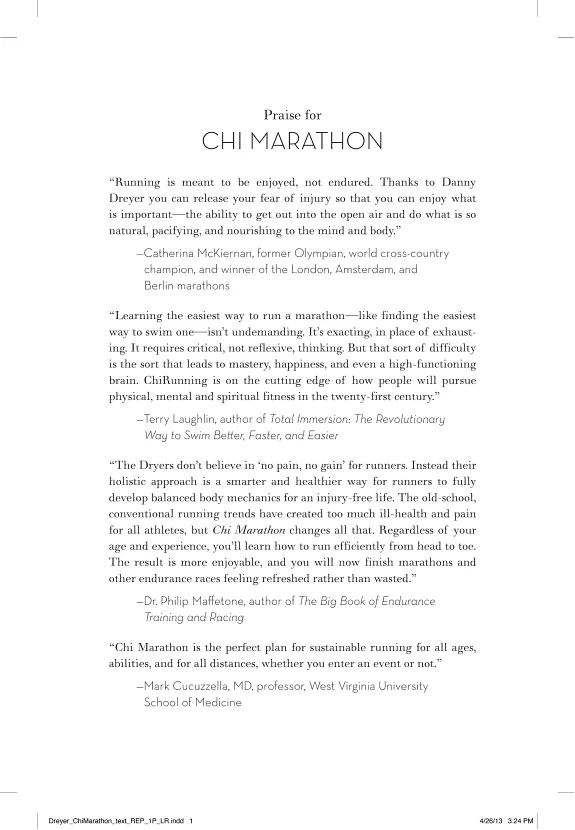
Chi Marathon offers a refreshing counterpoint to the relentless pursuit of mileage that often characterizes marathon training. The Dreyers' insistence on form and efficiency over brute force is a welcome perspective, especially for runners battling chronic injuries. Their integration of Tai Chi principles, particularly the emphasis on a relaxed posture and gravity-assisted lean, provides a tangible framework for improving running mechanics. The book's strength lies in its clear, actionable advice for developing a more mindful and body-aligned approach to distance running. However, some readers might find the initial transition challenging, requiring significant unlearning of ingrained habits. The focus is so intently on technique that it could, for some, overshadow the crucial psychological aspects of marathon preparation. The core concept of the 'mid-foot strike' as a primary goal, while well-explained, may not universally apply to all body types or biomechanics, a point the book could explore further. Overall, Chi Marathon provides a valuable, albeit specific, toolkit for runners seeking a less punishing path to the marathon finish line.
📝 Description
73
Published in 2012, Chi Marathon offers a distinct approach to marathon running.
Danny and Katherine Dreyer's 2012 book presents a training method that moves away from conventional dogma. Instead of solely increasing mileage or intensity, it emphasizes efficiency and biomechanics. The core philosophy is that proper form and mindful execution allow runners to achieve peak performance with less risk of pain and injury.
This work is for runners of all levels who want to improve their marathon performance without common training issues. It will appeal to those who have experienced injuries from traditional methods or who seek personal bests. Beginners looking to build a sustainable foundation, and runners questioning accepted wisdom, will find value in this body-aware path.
Chi Marathon aligns with esoteric traditions that emphasize internal harmony and mindful movement for physical achievement. Its core "Chi Running" philosophy draws parallels with Tai Chi, an ancient Chinese practice focused on cultivating and balancing vital energy (chi) through slow, deliberate movements. This approach suggests a connection between mental focus, relaxed posture, and efficient physical action, reflecting a broader esoteric interest in mind-body integration and the subtle energies that influence performance.
💡 Why Read This Book?
• You will learn to harness gravity for a more efficient stride, as detailed in the "Chi Running" technique, allowing you to conserve energy and run longer with less effort. • You will gain practical methods for reducing impact and preventing common running injuries by focusing on proper form, a core principle advocated by Danny and Katherine Dreyer since the book's first publication in 2012. • You will discover how to cultivate a mind-body connection during your runs, drawing parallels to Tai Chi principles to achieve a more fluid and natural gait, enhancing your overall running experience.
⭐ Reader Reviews
Honest opinions from readers who have explored this book.
❓ Frequently Asked Questions
What is the core philosophy behind Chi Marathon?
The core philosophy of Chi Marathon, also known as Chi Running, is to apply principles of Tai Chi to running form. This focuses on using gravity, maintaining a relaxed posture, and a gentle forward lean to create a more efficient and injury-free running experience.
Is Chi Marathon suitable for beginner runners?
Yes, Chi Marathon is suitable for beginner runners. The book outlines a technique-based program that emphasizes building a strong foundation with proper form, which is crucial for new runners to avoid developing bad habits and potential injuries.
How does Chi Marathon differ from traditional marathon training plans?
Unlike traditional plans that often prioritize high mileage, Chi Marathon focuses on technique and efficiency. It challenges the notion that pain and injury are inevitable parts of marathon training, advocating for a more mindful, body-aware approach.
What specific techniques does the book teach?
The book teaches techniques such as the ankle lean, mid-foot strike, body rotation, and relaxed posture. It provides drills and exercises to help runners develop these biomechanical skills for improved performance and injury prevention.
When was Chi Marathon first published?
Chi Marathon was first published on March 13, 2012. This places its core concepts within the early 2010s, a period where biomechanical approaches to running were gaining wider traction.
Can runners expect to improve their race times with this method?
The book suggests that by improving efficiency and reducing wasted energy through proper technique, runners can indeed improve their race times, particularly in half and full marathons, while also reducing the physical toll of training.
🔮 Key Themes & Symbolism
Mindful Movement
Chi Marathon champions a profound shift from running as a brute-force activity to one of mindful, flowing movement. The core concept borrows heavily from Tai Chi, emphasizing a relaxed posture and the use of gravity. This approach encourages runners to become acutely aware of their body's mechanics, listening to its signals rather than blindly following rigid training schedules. The goal is to achieve a state of effortless motion, reducing the perceived exertion and the physical toll of long-distance running. This theme challenges the common narrative that marathon running must be inherently painful.
Injury Prevention Through Form
A central pillar of the book is the direct correlation drawn between proper running form and the absence of pain and injury. The Dreyers meticulously detail how common running ailments stem from inefficient mechanics – such as overstriding or poor posture. By focusing on techniques like the ankle lean and mid-foot strike, the book provides a practical, preventative strategy. This perspective reframes injury not as an unavoidable consequence of effort, but as a solvable problem addressable through conscious technique refinement, offering a sustainable path for runners.
Efficiency Over Volume
Chi Marathon directly challenges the 'more is better' mentality prevalent in traditional marathon training. The book argues that maximizing running efficiency is a more effective route to high performance than simply accumulating vast amounts of mileage. By optimizing the body's use of energy through improved biomechanics, runners can achieve their goals with less physical stress. This theme promotes a smarter, more strategic approach to training, focusing on the quality of each stride rather than the sheer quantity of miles logged, making marathon running accessible and sustainable.
The Body as a System
This work presents the runner's body not as a collection of isolated parts to be pushed, but as an integrated system where every movement influences the whole. Drawing inspiration from holistic practices, the book emphasizes how a relaxed upper body, core engagement, and efficient foot strike all work in concert. Understanding this interconnectedness allows for a more profound level of control and performance. It encourages a departure from focusing solely on leg turnover or cardiovascular capacity, instead promoting an awareness of the entire kinetic chain in motion.
💬 Memorable Quotes
Direct passages from the work, attributed to the author.
“Relax your shoulders, relax your jaw, relax your whole body.”
— This directive expresses the book's core emphasis on reducing unnecessary tension. It suggests that conscious relaxation is not a passive state but an active technique crucial for efficient movement, allowing the body's natural mechanics to function optimally during the demands of marathon running.
“Run as if you are running downhill, even when you are running uphill.”
— This paradoxical instruction highlights the principle of using gravity and a forward lean. It encourages runners to maintain a slight, controlled forward tilt from the ankles, rather than leaning from the waist, to facilitate a smoother, more propulsive stride, regardless of terrain.
“The goal is to land mid-foot, not on your heel.”
— This is a fundamental technique taught in the book. Landing mid-foot, as opposed to heel-striking, is presented as key to absorbing impact more effectively and promoting a more efficient forward motion, reducing stress on the legs and joints.
“Listen to your body; it will tell you what it needs.”
— This advice underscores the book's departure from rigid training plans. It advocates for an intuitive approach, encouraging runners to pay attention to their body's signals of fatigue or discomfort and adjust their training accordingly, fostering a sustainable practice.
💡 Key Ideas
Editorial paraphrase of the work's core concepts — not direct quotes.
Use your core for stability, not for pushing off.
This quote clarifies the role of the core muscles in running according to the Chi Running philosophy. It emphasizes using the core for maintaining an upright, stable posture and facilitating rotation, rather than for generating forward propulsion, which should come from gravity and efficient limb movement.
🌙 Esoteric Significance
Tradition
Chi Marathon aligns with certain principles found in Taoist and Hermetic philosophies, particularly the emphasis on flowing with natural forces (like gravity) and achieving harmony between mind and body. While not overtly religious, its core tenet of 'Chi Running' draws from the Taoist concept of 'qi' (life force or energy), suggesting that efficient movement allows this energy to flow unimpeded. This departs from more rigid, will-power-focused training regimes, offering a path of least resistance and greater internal alignment, echoing Hermetic ideals of balance and correspondence.
Symbolism
The primary symbolic element is the concept of 'Chi' itself, representing vital energy or life force, which the book seeks to optimize through running. The act of running is transformed from a purely physical exertion into a practice of mindful energy cultivation. Another motif is the 'forward lean from the ankles,' symbolizing a surrender to natural forces and a rejection of rigid, forceful control, akin to the Taoist ideal of 'wu wei' (effortless action). The runner's body in motion becomes a symbol of this dynamic equilibrium.
Modern Relevance
The principles outlined in Chi Marathon continue to influence contemporary running communities and practices. Its emphasis on biomechanics, injury prevention through form, and mindful running appeals to modern trends in holistic health and wellness. Thinkers and practitioners in fields like functional movement, physical therapy, and even disciplines like Feldenkrais or Alexander Technique, often find common ground with the Dreyers' approach. The book's core ideas remain relevant for runners seeking sustainable performance and a deeper connection with their bodies in an era still grappling with over-training and injury.
👥 Who Should Read This Book
• Runners experiencing persistent injuries or pain from traditional training methods: You will gain actionable techniques to modify your stride and reduce physical stress, potentially allowing you to run pain-free. • Athletes seeking to improve marathon or half-marathon performance through efficiency: You will learn how to harness natural body mechanics and gravity to conserve energy and run faster with less effort. • Individuals interested in the mind-body connection in physical activity: You will explore how principles from practices like Tai Chi can be applied to running, fostering a more mindful and integrated approach to exercise.
📜 Historical Context
The early 2010s, when Danny and Katherine Dreyer's Chi Marathon first appeared, represented a period of evolving thought in athletic training. While high-mileage, high-intensity programs were still dominant, there was a growing segment of athletes and coaches exploring biomechanics, mindful movement, and injury prevention strategies. The Dreyers' work built upon earlier explorations into efficient running form, drawing clear parallels with practices like Tai Chi, which had begun to influence Western fitness paradigms. This era saw a rise in gait analysis technology and a greater public awareness of the potential for technique-based improvement. While not facing significant censorship, the book's approach stood in contrast to established methodologies, prompting debate among traditional coaches. Its publication offered a distinct alternative to contemporaries who might have focused more narrowly on physiological conditioning, providing a holistic perspective that gained traction among runners seeking a less injury-prone path.
📔 Journal Prompts
The concept of 'Chi' in running: how does its potential flow relate to your current training mindset?
Reflecting on the ankle lean: describe the sensation of initiating forward motion from your ankles.
Your body's signals: identify one specific instance where you previously ignored discomfort, and how you might approach it differently now.
The 'mid-foot strike' practice: what challenges arise when attempting to consciously land on your mid-foot?
Efficiency versus volume: how can you prioritize stride quality over sheer mileage in your next training cycle?
🗂️ Glossary
Chi Running
A running technique developed by Danny and Katherine Dreyer, inspired by Tai Chi principles. It emphasizes efficient body mechanics, relaxed posture, and using gravity to propel the runner, aiming for pain-free, high-performance running.
Ankle Lean
A core technique in Chi Running where the body maintains a straight line from head to ankle, leaning forward from the ankles rather than the waist, allowing gravity to assist forward motion.
Mid-foot Strike
The act of landing on the middle part of the foot, rather than the heel or forefoot. In Chi Running, this is promoted as a way to improve shock absorption and create a more efficient stride.
Body Rotation
Utilizing a gentle rotation of the torso, driven by the core and hips, to facilitate arm swing and forward momentum. This technique helps maintain balance and efficiency in the running stride.
Postural Alignment
Maintaining a balanced and upright posture while running, with the head, shoulders, hips, and ankles aligned. This reduces strain and optimizes the body's natural mechanics for efficient movement.
Harmonic Effort
The state achieved in Chi Running where effort feels natural and aligned with the body's capabilities, minimizing resistance and tension. It's about running 'with' the body rather than against it.
Energy Conservation
The principle of minimizing wasted energy through efficient form and relaxed muscles. Chi Running aims to help runners conserve energy, allowing them to run longer distances with less fatigue.
This book appears in 1 collection
🔮 Readers Also Liked
Browse all →









From the “Tai Chi” Collection
View all →








More Free Occult Philosophy Books
View all →