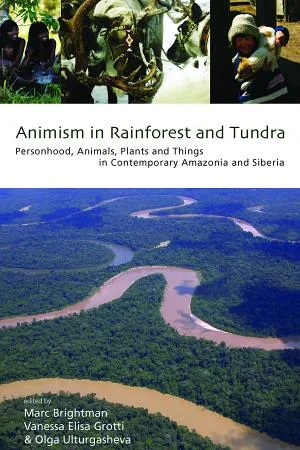
Animism in Rainforest and Tundra
 75
75

Animism in Rainforest and Tundra
Marc Brightman, Vanessa Elisa Grotti, and Olga Ulturgasheva's 'Animism in Rainforest and Tundra' offers a rigorous comparative ethnographic analysis that moves beyond simplistic categorizations of indigenous belief systems. The editors and contributors adeptly challenge the reader to reconsider Western notions of personhood by examining how Amazonian and Siberian peoples attribute agency to a vast array of non-human entities, from animals to artifacts. A particular strength lies in the detailed ethnographies that illustrate the lived experience of these cosmologies. However, the academic density, while valuable for specialists, might present a barrier for the casual reader. The exploration of 'social relations' between humans and mineral resources, for instance, is a particularly striking example of the book's capacity to reveal the limitations of conventional Western thought. This volume serves as a crucial academic resource for understanding diverse ontologies.
📝 Description
75
First published in 2012, 'Animism in Rainforest and Tundra' offers a comparative ethnographic study of Amazonia and Siberia.
This volume examines how human and non-human entities are understood in two regions historically significant for shamanic studies: Amazonia and Siberia. The authors critically assess Western analytical frameworks, showing how they often fail to capture indigenous cosmologies, especially regarding personhood. They investigate the social connections people build with beings perceived to have agency and human-like qualities. These connections extend beyond the usual focus on animals and plants to include inanimate objects and natural phenomena.
The book is aimed at anthropologists, religious studies scholars, and students interested in comparative ethnography, shamanism, and indigenous worldviews. It will be of interest to those seeking to grasp alternative ideas of personhood and humanity's place within broader ecological and spiritual systems. Readers familiar with theories of animism, multispecies studies, and the philosophical implications of non-Western ontologies will find substantial content within its pages.
Emerging from a period of renewed academic attention to animism, this work challenges Eurocentric views of nature and society. It speaks to traditions that question the separation of human and non-human, spirit and matter, and that recognize agency in the natural world. The comparative approach bridges distinct geographical and conceptual divides, seeking common ground in the understanding of human-environment relations across different indigenous traditions. It engages with debates concerning the limits of Western thought in encompassing diverse understandings of existence.
💡 Why Read This Book?
• Gain a nuanced understanding of personhood beyond human exceptionalism, as explored through specific Amazonian and Siberian ethnographic examples, challenging the reader's own ontological assumptions. • Learn how social relations are conceptualized and enacted between humans and non-human entities, including artifacts and natural resources, as detailed in the comparative analyses presented by the authors. • Appreciate the historical context of animism studies since 2012, understanding how this comparative approach contributes to anthropological debates on cosmology and the human place in the world.
⭐ Reader Reviews
Honest opinions from readers who have explored this book.
❓ Frequently Asked Questions
What specific regions are compared in 'Animism in Rainforest and Tundra'?
The book primarily compares indigenous cosmologies and social relations in Amazonia and Siberia. These regions are highlighted for their historical significance in the study of shamanism and animism.
What does the book mean by 'personhood' in non-human entities?
The work defines 'personhood' in this context as the attribution of human-like agency, consciousness, or social capacity to entities that Western thought might consider inanimate or purely biological, such as animals, plants, or even artifacts.
Who are the primary authors of 'Animism in Rainforest and Tundra'?
The book is edited by Marc Brightman, Vanessa Elisa Grotti, and Olga Ulturgasheva. It features contributions from various scholars, presenting a collective ethnographical and theoretical exploration.
When was 'Animism in Rainforest and Tundra' first published?
The initial publication date for 'Animism in Rainforest and Tundra' was August 15, 2012. This places it within a contemporary wave of academic research on animism and ontology.
How does the book challenge Western understandings of man's place in the world?
By presenting detailed ethnographies of Amazonian and Siberian societies, the book demonstrates how these cultures integrate non-human entities into social and relational frameworks, thereby questioning the Western separation of nature and culture, and human and non-human.
What kind of non-human entities are discussed as having personhood?
The book discusses a wide range of entities credited with personhood, including animals, plants, artifacts, trade items, and mineral resources, illustrating the expansive nature of animistic ontologies.
🔮 Key Themes & Symbolism
Extended Personhood
The volume critically examines how personhood is conceptualized and attributed to a vast array of non-human entities in Amazonian and Siberian societies. This extends beyond sentient beings like animals and plants to include objects such as artifacts, trade items, and even mineral resources. The work explores the implications of these cosmologies for understanding social relations and agency within these cultures, directly challenging Western philosophical anthropocentrism and its rigid boundaries between animate and inanimate, or natural and cultural worlds.
Comparative Ontologies
By juxtaposing detailed ethnographies from the rainforests of Amazonia and the tundras of Siberia, the book facilitates a rich comparative analysis of distinct ontologies. It highlights how different cultural frameworks constitute reality, personhood, and the relationships between humans and their environments. This comparative lens is crucial for moving beyond generalizations about 'animism' and appreciating the specific, localized ways in which these cosmologies are lived and understood.
Social Relations Beyond Humans
A core focus is the nature of social relations as understood and practiced within animistic frameworks. The book illustrates how humans engage with non-human entities as social actors, possessing their own intentions and capacities. This perspective reframes human interaction with the world not as a one-sided exploitation of resources, but as a complex web of interdependencies and mutual recognition, fundamentally altering our conception of society and its constituents.
Critique of Western Frameworks
The work implicitly and explicitly critiques the limitations of Western analytical tools and ontological assumptions when applied to non-Western cosmologies. It argues that categories like 'nature' versus 'culture,' or strict divisions between subject and object, are often inadequate for grasping the fluid and relational understandings of existence prevalent in regions like Amazonia and Siberia. The book thus contributes to post-Enlightenment philosophical and anthropological discourse.
💬 Memorable Quotes
Direct passages from the work, attributed to the author.
“Social relations between humans and non-human entities credited with human-like personhood.”
— This phrase expresses the book's central thesis: that indigenous cosmologies often extend the concept of 'sociality' and 'personhood' to a wide range of beings and objects, challenging Western dualisms.
“Amazonia and Siberia, classic regions of shamanism.”
— This identifies the geographical and thematic focus, grounding the comparative study in areas long recognized for their rich shamanic traditions and unique worldviews.
“Explores the constitutions of humanity and personhood characteristic of the two areas.”
— This highlights the book's aim to understand how different cultures define what it means to be human and what constitutes a 'person,' revealing diverse ontological frameworks.
“Includes 'things' such as artifacts, trade items, or mineral resources.”
— This demonstrates the radical expansion of the concept of personhood within the studied cultures, showing that agency and social relevance are not limited to biological life.
“Challenged 'western' understandings of man's place in the world.”
— This points to the book's critical stance, aiming to decenter Western perspectives and offer alternative ways of comprehending human existence within a broader relational cosmos.
🌙 Esoteric Significance
Tradition
While not strictly adhering to a single lineage like Hermeticism or Gnosticism, the work significantly informs esoteric studies by providing rigorous ethnographic grounding for concepts often explored abstractly in Western esotericism. It bridges anthropological inquiry with the esoteric interest in animism, shamanism, and the pervasive presence of spirit in the material world, offering empirical data that can inform or challenge esoteric theories about consciousness and interconnectedness.
Symbolism
The book's symbolism is less about codified symbols and more about the symbolic weight attributed to everyday objects and natural phenomena within animistic frameworks. For example, the 'social relations' with mineral resources symbolize a worldview where the earth itself is animate and relational, challenging the esoteric concept of inert matter. Similarly, the personhood attributed to artifacts suggests a living history and agency within objects that appeals to certain forms of material mysticism.
Modern Relevance
Contemporary practitioners of neoshamanism, animistic psychology, and ecological spirituality draw on works like this to validate and deepen their understanding of interconnectedness with nature and the spirit world. Researchers in multispecies studies and critical ontology also utilize its ethnographic findings to challenge anthropocentrism. The book's insights into non-human agency are particularly relevant for discussions on environmental ethics and the philosophical implications of artificial intelligence and extended cognition.
👥 Who Should Read This Book
• Anthropologists and Religious Studies scholars seeking in-depth comparative ethnography on animism and shamanism, particularly those focusing on Amazonian and Siberian indigenous cultures. • Students of philosophy and ontology interested in non-Western conceptions of personhood, agency, and the human place in the cosmos, moving beyond Eurocentric definitions. • Esoteric practitioners and researchers exploring animism, shamanic traditions, and the spiritual dimensions of the natural world, who require empirically grounded insights into diverse cosmologies.
📜 Historical Context
Published in 2012, 'Animism in Rainforest and Tundra' emerged during a vibrant period of renewed anthropological interest in animism, spurred by scholars like Philippe Descola and Eduardo Viveiros de Castro. This intellectual current challenged the perceived universality of Western ontological divisions between nature and culture. The book's comparative approach, focusing on Amazonia and Siberia, directly engaged with debates on how to translate and understand radically different cosmological systems without imposing Eurocentric assumptions. It built upon earlier ethnographic work while contributing a fresh perspective by examining personhood in relation to a broad spectrum of non-human entities, including material objects. Its publication offered a critical counterpoint to more simplistic or evolutionist accounts of indigenous religions, aligning with a broader trend in the social sciences to decolonize knowledge and embrace ontological diversity.
📔 Journal Prompts
Reflect on the concept of 'personhood' as applied to artifacts and mineral resources in Amazonian and Siberian cosmologies.
Consider the implications of extending 'social relations' to non-human entities for your own worldview.
Analyze how the concept of 'humanity' is constituted differently in the two regions compared in the book.
Explore the challenges of translating indigenous animistic concepts into Western academic language.
How might understanding the 'constitution of personhood' in these regions alter your perception of ecological relationships?
🗂️ Glossary
Animism
A belief system in which natural objects, phenomena, and the universe itself possess a soul or spirit, and are endowed with an active animative or motive force. It often involves social relations with these entities.
Personhood
In this context, the attribution of qualities associated with persons (consciousness, agency, social capacity, intentionality) to non-human entities, extending beyond the typical Western understanding of human beings.
Ontology
The philosophical study of being; the nature of existence and reality. In this book, it refers to the different ways cultures understand what exists and how it is constituted.
Cosmology
A system of beliefs that deals with the origin, structure, and nature of the universe. It encompasses a culture's understanding of the world and its inhabitants.
Shamanism
A religious practice characterized by the belief that shamans can communicate with the spirit world. Often involves altered states of consciousness for healing or divination.
Ethnography
The scientific description of the customs of individual peoples and cultures, typically based on fieldwork and participant observation.
Agency
The capacity of an actor (human or non-human) to act independently and make their own free choices; the ability to effect change in the world.
This book appears in 1 collection
🔮 Readers Also Liked
Browse all →









From the “Shamanism” Collection
View all →




More Free Occult Philosophy Books
View all →