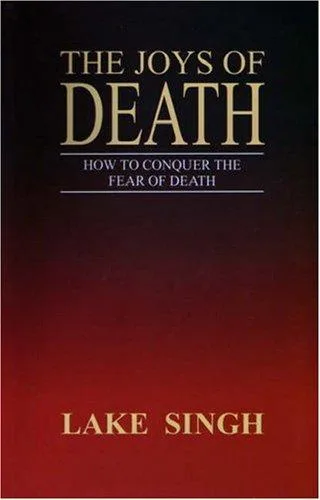
The Joys Of Death
 81
81

The Joys Of Death
Lake Singh's 2005 volume, The Joys Of Death, offers a starkly direct confrontation with mortality, a welcome antidote to the often saccharine or overly academic treatments of the subject. Singh avoids platitudes, instead presenting a case for death as a fundamental, almost generative, force. The strength lies in its unyielding focus on the psychological liberation that can arise from a genuine acceptance of finitude. However, the work's dense philosophical prose can, at times, obscure its more radical propositions. A particularly striking passage interrogates the very notion of 'self' as the primary locus of identity, suggesting its dissolution is not an annihilation but a re-composition. While its directness is admirable, a more robust engagement with comparative mystical traditions might have further anchored its claims. It is a challenging but rewarding exploration for the earnest seeker.
📝 Description
81
Lake Singh's 2005 book, The Joys Of Death, argues death is a catalyst for transformation, not just an end.
Published in 2005, The Joys Of Death by Lake Singh examines mortality from philosophical and psychological viewpoints. Singh moves beyond viewing death solely as an end, suggesting it can spur significant personal change and spiritual awakening. The book guides readers through an intellectual and introspective path, questioning common fears about life's cessation. It is aimed at those pondering existential questions, seeking to align spiritual beliefs with death's certainty, or studying comparative religion and philosophy. Readers who prefer a direct style, free from euphemisms or dogma, will find this work suited to their taste. The book also offers substantial material for those interested in how mortality affects consciousness psychologically.
Singh's central argument is that death is not an adversary but a necessary and even helpful part of the human condition. The work discusses 'ego dissolution' as a prerequisite for spiritual reintegration, asserting that the fear of death arises from identifying too strongly with the temporary self. The book also addresses 'energetic transition,' proposing that a core aspect of consciousness continues after the body ceases to function, though in ways not easily perceived by normal senses. This perspective challenges conventional understandings and invites a deeper consideration of life's ultimate transition.
The Joys Of Death appeared in 2005 amidst a resurgence of interest in existential thought and the connections between psychology and spirituality. While contemporaries like Irvin D. Yalom addressed the therapeutic value of facing mortality, Singh adopted a more clearly esoteric and philosophical approach. The book found its audience among those dissatisfied with purely materialistic or dogmatic explanations for life's final stage, positioning itself within traditions that view death not as an endpoint but as a passage.
💡 Why Read This Book?
• Gain a new perspective on mortality, viewing death not as an endpoint but as a transformative process, drawing from Singh's analysis of 'ego dissolution' presented in the book. • Understand the psychological roots of death anxiety through the lens of misidentification with the transient self, a core concept explored in Singh's 2005 work. • Explore the idea of 'energetic transition' and its implications for consciousness beyond physical decay, as detailed within the book's specific chapters on post-mortem states.
⭐ Reader Reviews
Honest opinions from readers who have explored this book.
❓ Frequently Asked Questions
What is the primary philosophical stance of The Joys Of Death?
The book challenges the negative perception of death, advocating for its role as a catalyst for transformation and spiritual awakening, rather than merely an end.
Who is the author, Lake Singh, and when was this book first published?
Lake Singh authored The Joys Of Death, which was first published in 2005, positioning it within early 21st-century esoteric and philosophical discourse.
Does the book offer practical advice for facing death?
While not a step-by-step guide, the book provides a philosophical framework for reframing one's relationship with mortality, encouraging acceptance and introspection.
What esoteric traditions influence The Joys Of Death?
The work draws from existential philosophy and various mystical concepts, particularly those concerning the nature of consciousness and the self beyond empirical observation.
Is The Joys Of Death suitable for beginners in esoteric literature?
It is best suited for readers already familiar with philosophical inquiry and spiritual concepts, as it engages directly with complex ideas without extensive introductory material.
What does the book mean by 'ego dissolution'?
In Singh's work, 'ego dissolution' refers to the dismantling of the false sense of self, seen as a necessary step towards a more authentic, integrated consciousness.
🔮 Key Themes & Symbolism
Death as Transformation
Singh posits death not as an endpoint but as a crucial generative force. This perspective reframes mortality from a source of dread to a potential catalyst for profound change. The work explores how confronting finitude can liberate individuals from the anxieties of the transient self, leading to a deeper understanding of existence and consciousness.
The Nature of Self
Central to the book is an examination of the 'self' as a constructed identity tied to the physical and temporal. Singh argues that the fear of death arises from this misidentification. The work suggests that true liberation involves moving beyond this limited egoic construct towards a more expansive awareness.
Consciousness Beyond Form
The Joys Of Death engages with the idea that consciousness, or a fundamental aspect of it, possesses a nature independent of the physical body. It discusses 'energetic transition,' proposing that the cessation of biological life initiates a shift in energetic states rather than an absolute void.
Existential Liberation
By confronting the inevitability of death directly, the book aims to facilitate a form of existential liberation. It suggests that a genuine acceptance of mortality can dissolve the psychological barriers that prevent individuals from fully engaging with life and realizing their spiritual potential.
💬 Memorable Quotes
Direct passages from the work, attributed to the author.
“The terror of dying is a projection of our clinging to the illusion of a permanent self.”
— This statement captures the book's core argument that our fear of death is rooted in a misunderstanding of identity. It suggests that liberation comes from recognizing the impermanent nature of the ego.
“Death is not the antagonist, but the ultimate architect of spiritual evolution.”
— This provocative assertion reframes mortality as a constructive force. It implies that the process of dying, and the acceptance of it, is essential for growth beyond ordinary human limitations.
“The dissolution of the ego is not an end, but a liberation into a vaster reality.”
— Here, 'ego dissolution' is presented not as annihilation but as a release from confinement. It points towards the possibility of a expanded consciousness that transcends the limitations of individual identity.
“Fear of the unknown is merely the shadow of attachment to the known.”
— This aphorism directly addresses the root of existential anxiety. It posits that our apprehension about what lies beyond death stems from an unwillingness to relinquish our current, familiar state of being.
💡 Key Ideas
Editorial paraphrase of the work's core concepts — not direct quotes.
To truly live is to acknowledge the void from which we arise and to which we return.
This quote emphasizes the interconnectedness of life and death. It suggests that a full embrace of existence requires an understanding of its ultimate origin and destination, often conceptualized as a primordial state.
🌙 Esoteric Significance
Tradition
The Joys Of Death aligns with perennialist philosophies and certain Gnostic undercurrents, emphasizing the illusory nature of the material world and the ego. It departs from traditional religious frameworks by focusing on individual experiential realization rather than adherence to dogma or divine intermediation. Its lineage can be traced through existentialist thought and modern esoteric movements that explore consciousness beyond the physical.
Symbolism
The book frequently employs the symbol of the 'void' or 'emptiness' not as a negative absence, but as a primordial state of potentiality from which all existence arises and to which it returns. Another motif is the 'dissolving self,' representing the shedding of egoic identity, akin to the alchemical concept of 'solve et coagula' where dissolution precedes reformation.
Modern Relevance
Contemporary thinkers in consciousness studies and transpersonal psychology, particularly those exploring non-ordinary states of consciousness and the nature of self, find resonance in Singh's work. Its ideas echo in discussions around psychedelic-assisted therapy for end-of-life anxiety and in modern interpretations of Buddhist emptiness (sunyata) within Western esoteric contexts.
👥 Who Should Read This Book
• Individuals seeking a non-dogmatic exploration of death and dying, particularly those interested in philosophical and psychological perspectives beyond conventional religious or secular views. • Students of comparative mysticism and existential philosophy who wish to understand how different traditions approach mortality as a catalyst for spiritual growth. • Those experiencing existential unease or a fear of death, looking for a framework that reframes mortality not as an end but as a potential for profound personal transformation.
📜 Historical Context
Lake Singh's The Joys Of Death, published in 2005, entered a literary landscape where discussions of mortality were often confined to therapeutic psychology or religious doctrine. While figures like Elisabeth Kübler-Ross had popularized stages of dying, and existentialist thinkers like Albert Camus grappled with the absurd, Singh's work carved a niche by integrating these concerns with a more direct, esoteric examination of consciousness. It emerged in an era where New Age thought was evolving, moving beyond simpler self-help to more complex philosophical inquiries. The book's reception was largely within niche spiritual and philosophical circles, distinct from mainstream academic philosophy or comparative religion, which at the time was heavily influenced by scholars like Karen Armstrong focusing on religious history. Singh's approach, emphasizing the transformative rather than solely the terminal aspects of death, offered a counterpoint to both secular nihilism and traditional religious consolations.
📔 Journal Prompts
The concept of 'ego dissolution' as presented by Singh, and its potential implications for identity.
Reflections on the 'fear of the unknown' versus attachment to the 'known' self.
Analyzing the symbolism of the 'void' in relation to personal experiences of transition.
How does the idea of death as an 'architect of spiritual evolution' challenge your current beliefs?
Exploring 'energetic transition' and its potential meaning beyond physical cessation.
🗂️ Glossary
Ego Dissolution
A state of profound ego loss where the sense of a separate, individual self diminishes or vanishes, often leading to feelings of unity and expanded awareness.
Energetic Transition
The concept that consciousness or a vital life force shifts in form or state upon physical death, rather than ceasing to exist entirely.
Transient Self
The perceived individual identity, characterized by its impermanence and dependence on physical and mental phenomena, often contrasted with a more fundamental or eternal consciousness.
The Void
In this context, not an absence but a primordial state of pure potentiality and undifferentiated consciousness preceding manifest existence.
Existential Liberation
A state of freedom from the burdens of existential anxiety, achieved through a profound acceptance of life's inherent uncertainties and finitude.
Architect of Spiritual Evolution
A metaphor describing death's role not as an end, but as a necessary force that propels consciousness towards higher states of development.
Misidentification
The psychological error of mistaking the temporary ego or physical form for one's true, deeper identity or consciousness.
🔮 Readers Also Liked
Browse all →









More by Lake Singh
All books →
More Free Occult Philosophy Books
View all →