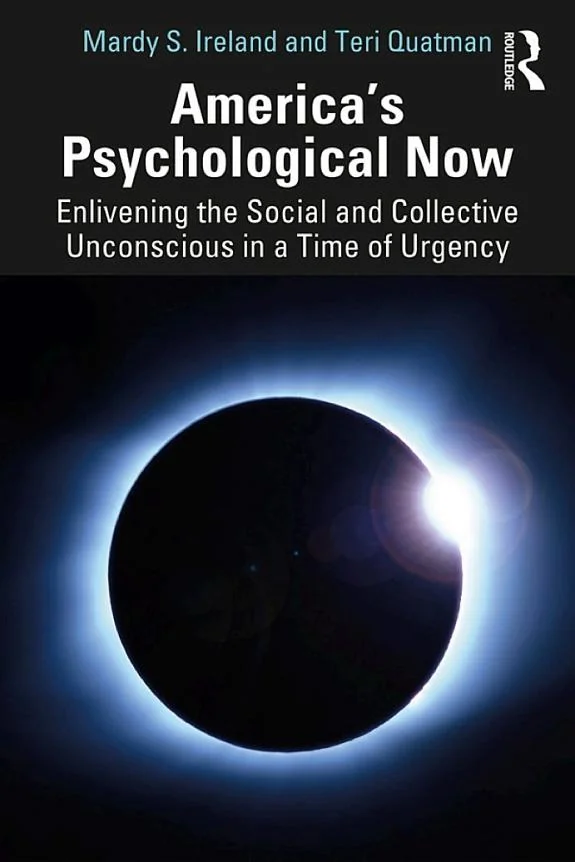
America’s Psychological Now
 73
73

America’s Psychological Now
Mardy Ireland and Teri Quatman's America's Psychological Now offers a refreshingly analytical approach to the seismic shifts in American politics, moving beyond surface-level commentary to explore the collective unconscious. The authors compellingly argue that understanding the "now" of American culture requires psychoanalytic scrutiny, particularly in the context of the 2016 election. Their examination of Trump as an archetypal figure embodying American excess is particularly sharp, shedding light on deeper cultural anxieties. However, the work occasionally becomes dense, requiring a dedicated reader to fully grasp its theoretical underpinnings. A strength lies in its precise dissection of the "social/psychological threads" that define the contemporary moment. The book offers a vital, albeit challenging, perspective on national identity and political psychology. It is a significant contribution for those willing to engage with its complex psychoanalytic framework.
📝 Description
73
Mardy Ireland and Teri Quatman's 2024 book analyzes the 2016 election through a psychoanalytic lens.
America's Psychological Now, published in 2024, examines the socio-psychological forces behind the 2016 US presidential election results. The authors propose that a psychoanalytic perspective, particularly one that considers the social unconscious, provides valuable insights into current American culture and its future direction. The book is aimed at readers interested in the connections between psychology, politics, and cultural analysis. It speaks to scholars, students, and citizens who want to better grasp national identity, political events, and the collective psyche. Those already familiar with psychoanalytic theory will find practical applications discussed within the text.
The work is situated in the period following the divisive 2016 election, a time of significant political polarization and a reassessment of American values. It uses psychoanalytic ideas to interpret the events and cultural undercurrents that shaped the national mood and political climate. The book offers a way to understand the present by looking closely at the past.
This work engages with psychoanalytic traditions that consider the deeper, often unseen, psychological currents influencing collective behavior and societal trends. It draws on concepts that move beyond individual psychology to address a shared, unconscious dimension of cultural experience. By applying these ideas to contemporary political and cultural phenomena, the book positions itself within a lineage of thought that seeks to understand societal dynamics through the lens of the psyche, particularly the collective or social unconscious.
💡 Why Read This Book?
• Understand the psychoanalytic roots of political phenomena, gaining insights into collective behaviors that standard political science might overlook, specifically by examining the concept of the "social unconscious" as discussed in the book. • Gain a framework for analyzing cultural "excess" as a national identifier, learning how archetypal figures like Trump can represent deeper societal currents, as explored through the book's analysis. • Discover potential pathways for future political direction by comprehending the psychological underpinnings of current events, informed by the book's examination of the "now" of American culture.
⭐ Reader Reviews
Honest opinions from readers who have explored this book.
❓ Frequently Asked Questions
What is the primary psychoanalytic concept explored in America's Psychological Now regarding the 2016 election?
The book primarily explores the concept of the "social unconscious." It suggests that unconscious psychological forces and shared anxieties within society significantly influenced the outcomes of the 2016 US presidential election, rather than solely rational political decisions.
How does the book interpret the figure of Donald Trump within American culture?
America's Psychological Now interprets Donald Trump as an "archetypal figure" representing "excess" within American culture. This symbolic role is examined as a manifestation of deeper societal currents and desires that contributed to his electoral victory.
What is the publication year of America's Psychological Now?
America's Psychological Now was first published on March 21, 2024. This recent publication date places its analysis directly within the context of contemporary American political and cultural discourse.
Who are the authors of America's Psychological Now?
The authors of America's Psychological Now are Mardy Ireland and Teri Quatman. They bring their expertise to bear on the complex intersection of psychology and national politics.
What kind of "future direction" does the book suggest for US politics?
The book suggests that by understanding the psychoanalytic roots of current political phenomena and cultural undercurrents, a more conscious and potentially healthier future direction for US politics can be plotted, moving beyond surface-level analyses.
Is this book suitable for someone without a background in psychoanalysis?
While the book utilizes psychoanalytic concepts, it aims to make them accessible for understanding broader cultural and political issues. Readers with an interest in psychology and social dynamics will find it valuable, though some concepts may require careful attention.
🔮 Key Themes & Symbolism
The Social Unconscious
This theme examines the collective, often unacknowledged, psychological forces shaping societal behavior and political outcomes. The book argues that understanding these shared, unconscious currents is paramount to interpreting events like the 2016 US presidential election. It moves beyond individual psychology to examine how shared anxieties, desires, and cultural narratives operate beneath the surface of public discourse, influencing national mood and decision-making processes.
Archetypes of Excess
The work identifies and analyzes archetypal figures within American culture, with a particular focus on Donald Trump as a representation of "excess." This is not merely a biographical critique but an exploration of how such figures embody and amplify deeply ingrained cultural tendencies. The concept of excess is examined as a potent symbol within the American psyche, revealing societal values, contradictions, and aspirations that manifest powerfully in the political arena.
The 'Now' of American Culture
This theme addresses the immediate, lived experience of contemporary American society, framed through a psychological lens. It seeks to define the specific socio-psychological threads that constitute the present moment, moving beyond historical analysis to capture the current zeitgeist. By understanding this "now," the book aims to provide a foundation for contemplating the future, suggesting that conscious engagement with these psychological realities is key to charting a new course.
Psychoanalysis and Political Future
The book posits psychoanalytic understanding not just as an interpretive tool but as a crucial element for future planning. It suggests that by applying psychoanalytic frameworks to social and political phenomena, a more insightful and potentially constructive path forward can be identified. This involves recognizing how unconscious dynamics continue to influence political landscapes and how awareness can lead to more deliberate societal evolution.
💬 Memorable Quotes
Direct passages from the work, attributed to the author.
“The social unconscious offers a lens through which to understand the roots of political phenomena.”
— This interpretation highlights the book's central thesis: that collective, unconscious psychological forces, rather than purely rational or surface-level factors, are critical for comprehending major political events and trends in contemporary society.
“American culture's fascination with excess found an archetypal expression.”
— This statement points to the idea that the cultural value or obsession with 'excess' in America, a recurring theme in the nation's history, found a powerful symbolic embodiment in a figure like Trump, resonating with a segment of the population.
“A psychoanalytic perspective is essential for plotting a new direction for the future.”
— This emphasizes the practical application of psychoanalytic theory proposed by the book. It argues that without understanding the unconscious psychological dynamics at play in society, any attempts to guide the future politically or culturally will be superficial and likely ineffective.
“The 'now' of American culture is defined by specific social/psychological threads.”
— This highlights the book's focus on the contemporary moment. It asserts that the current state of American culture can be understood by identifying and examining the particular psychological and social factors that are actively shaping collective experience and identity today.
💡 Key Ideas
Editorial paraphrase of the work's core concepts — not direct quotes.
Trump’s victory was fueled by deeper psychological currents within the American populace.
This paraphrased concept suggests that the authors believe the 2016 election outcome was not solely due to policy or campaign strategy, but was significantly influenced by underlying psychological needs, anxieties, and archetypal resonances within the electorate.
🌙 Esoteric Significance
Tradition
While not strictly an esoteric text in the vein of Hermeticism or Kabbalah, America's Psychological Now draws heavily from depth psychology, particularly the psychoanalytic tradition initiated by Sigmund Freud and expanded by Carl Jung. Its exploration of the "social unconscious" and "archetypes" aligns with Jungian psychology's interest in collective mythologies and symbolic patterns that transcend individual experience, finding resonance within broader esoteric explorations of the psyche.
Symbolism
The book's primary symbolic motif is the concept of "excess" itself, often embodied by archetypal figures like Trump. This excess can be seen as symbolizing the shadow aspects of a culture—its unacknowledged desires, its overreach, or its departure from perceived norms. The "social unconscious" also functions symbolically, representing the less-obvious layers of collective consciousness, akin to the collective unconscious in Jungian thought, where primal energies and patterns reside.
Modern Relevance
Contemporary thinkers and movements exploring political psychology, the impact of social media on collective consciousness, and the resurgence of archetypal analysis in understanding cultural phenomena can find significant relevance in Ireland and Quatman's work. It speaks to current discussions about national identity, polarization, and the search for meaning in a rapidly changing world, offering a framework for understanding the psychological dimensions of modern crises.
👥 Who Should Read This Book
• Students of political psychology and cultural studies seeking to understand the deeper psychological factors behind major political events. • Readers interested in psychoanalytic theory who wish to see its application to contemporary social and national issues beyond clinical practice. • Engaged citizens who desire a more nuanced, analytical perspective on American politics and culture, moving beyond mainstream media narratives.
📜 Historical Context
Published in 2024, America's Psychological Now emerged in a period still grappling with the repercussions of the 2016 US presidential election. The intellectual climate was marked by intense debate over identity politics, the role of media, and the nature of truth itself. Psychoanalytic thought, while having a complex history in American intellectual life, saw renewed interest in applications beyond clinical settings, particularly in cultural and political critique. This work engages with a tradition that includes thinkers like Christopher Lasch, who critiqued American culture, and applies a distinctly psychoanalytic framework. It arrived at a time when other fields, such as sociology and political science, were also dissecting the election's causes, but Ireland and Quatman's focus on the social unconscious offered a more subterranean analysis. The reception was likely within academic and specialized circles interested in depth psychology and political theory.
📔 Journal Prompts
The social unconscious as a driver of political events.
America's cultural idea of excess.
Archetypal figures in contemporary politics.
The psychological threads defining the 'now' of American culture.
Psychoanalytic interpretation of political shifts.
🗂️ Glossary
Social Unconscious
A concept suggesting that collective, often unacknowledged, psychological forces, shared anxieties, and cultural narratives operate within a society, influencing behavior and decision-making beyond individual consciousness.
Archetypal Figure
An individual or symbol that embodies fundamental patterns of human experience and cultural narratives, resonating deeply with the collective psyche and representing universal themes or qualities.
Excess
In the context of the book, this refers to a cultural tendency or characteristic that is perceived as extreme, unbounded, or beyond normal limits, often associated with a specific national identity or historical moment.
Psychoanalytic Understanding
The application of theories and methods derived from psychoanalysis, focusing on unconscious processes, internal conflicts, and the symbolic meaning of behavior and cultural phenomena.
Social/Psychological Threads
The interconnected psychological dynamics, cultural beliefs, and societal factors that collectively define the character and experience of a specific time period or national culture.
The 'Now'
Refers to the immediate, contemporary state of American culture, analyzed through its dominant psychological and social undercurrents, rather than solely through historical precedent or future projection.
2016 US Presidential Election
The specific political event serving as a primary case study for the book's psychoanalytic exploration of American culture and its underlying psychological dynamics.
This book appears in 1 collection
🔮 Readers Also Liked
Browse all →









From the “Collective Unconscious” Collection
View all →





More Free Occult Philosophy Books
View all →