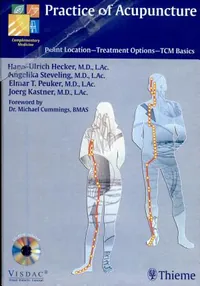
Akupunktur

 73
73

Akupunktur
The Stux, Stiller, and Berman textbook on acupuncture offers a commendably clear and practical approach to a complex subject. Its strength lies in the meticulous organization and the detail of its anatomical illustrations, which are indeed as precise as claimed. The emphasis on experience-based diagnostic selection is a significant asset, moving the text beyond rote memorization of points to a more clinical understanding. However, the work occasionally suffers from a slightly dry presentation that, while didactic, can sometimes feel detached from the more subtle energetic principles at play. The section detailing the eight diagnostic methods, while thorough, could benefit from more case-study examples to illustrate their application in differential diagnosis. Despite this minor limitation, Akupunktur remains a highly functional and valuable reference for serious students and practitioners.
📝 Description
73
Akupunktur, first published in 2003, details acupuncture's diagnostic methods and therapeutic applications.
Authored by Gabriel Stux, Niklas Stiller, and Brian Berman, Akupunktur functions as both a textbook and an atlas for acupuncture. Since its initial release in 2003, the book has undergone several revisions, solidifying its position as a standard reference in the field. The text is designed to lead readers through the system of acupuncture, clearly outlining its diagnostic approaches and treatment uses. It aims to be accessible for newcomers to the practice as well as experienced practitioners looking for a dependable guide.
This manual is intended for anyone involved with acupuncture. Students beginning their studies will find it a useful introduction to fundamental concepts and methods. Practicing acupuncturists can use its detailed atlas and diagnostic summaries to clarify challenging cases and reinforce their understanding. Educators may also find its structured approach helpful for teaching. Its focus on practical application makes it relevant for those working clinically with acupuncture.
Akupunktur emerged in 2003 during a time of growing international interest in Traditional Chinese Medicine. As Western medicine began examining alternative therapies, books like this offered a structured way to understand TCM diagnostics and treatments. The book met a demand for clear, illustrated educational materials that could explain the complexities of TCM in a practical manner. Its continued editions show it successfully addressed this need within a changing global healthcare environment.
💡 Why Read This Book?
• Gain a clear understanding of the diagnostic criteria central to acupuncture, as outlined in the experience-based selection of key Chinese diagnoses detailed in the book. • Master the precise anatomical locations of acupuncture points through the book's highly detailed, clear illustrations, referencing the atlas section. • Comprehend the fundamental flow of Qi and its relationship to energetic balance, as presented through the systematic explanation of meridians and point functions.
⭐ Reader Reviews
Honest opinions from readers who have explored this book.
❓ Frequently Asked Questions
When was Akupunktur first published?
Akupunktur was first published in 2003, with subsequent editions building upon its foundational content.
Who are the primary authors of Akupunktur?
The primary authors are Gabriel Stux, Niklas Stiller, and Brian Berman.
What makes the illustrations in Akupunktur stand out?
The illustrations are noted for their exceptional detail and clarity, serving as a precise atlas for practitioners and students.
Is Akupunktur suitable for beginners?
Yes, the book's didactic structure and clear presentation make it highly suitable for beginners in acupuncture.
What is the advantage of the book's selection of diagnoses?
The book features an experience-based selection of the most important Chinese diagnoses, making it a practical and clinically relevant resource.
What is the main focus of the text's didactic approach?
The didactic approach focuses on making the diagnostic and therapeutic logic of acupuncture transparent and accessible to the reader.
🔮 Key Themes & Symbolism
Meridian Theory and Qi Flow
Akupunktur meticulously details the network of meridians, the energetic pathways through which Qi (vital energy) is understood to flow in Traditional Chinese Medicine. The text explains how blockages or imbalances in Qi within these meridians can manifest as illness. It provides a systematic mapping of these channels and their associated points, crucial for understanding the theoretical underpinnings of acupuncture treatments and their potential to restore energetic harmony.
Diagnostic Framework
A core element of the book is its emphasis on an experience-based selection of key Chinese diagnoses. Rather than presenting an exhaustive list, it focuses on the most clinically relevant diagnostic patterns. This approach guides practitioners in identifying the root causes of imbalances by observing symptoms, pulse, and tongue, thereby informing the selection of appropriate acupuncture points for effective treatment.
Acupuncture Point Anatomy
The textbook provides highly detailed and precise anatomical illustrations of acupuncture points. Each point is depicted in its correct location relative to anatomical landmarks, ensuring accuracy in needle insertion. This visual component is critical for practitioners to avoid errors and maximize therapeutic efficacy, serving as a vital reference for both learning and clinical practice.
Therapeutic Application
Beyond diagnosis and point location, Akupunktur outlines the therapeutic applications of acupuncture. It connects specific points and meridian pathways to the treatment of various conditions, emphasizing a holistic approach to healing. The text educates on how to select points to address both symptoms and underlying energetic disharmonies, facilitating a comprehensive treatment strategy.
💬 Memorable Quotes
Direct passages from the work, attributed to the author.
“Die A1/4bersichtliche Gliederung, der didaktische Textaufbau und die Detailgenauigkeit der klaren Abbildungen machen das Werk fA1/4r Einsteiger und Fortgeschrittene der Akupunktur zu einem unverzichtbaren Arbeitsmittel.”
— This statement highlights the textbook's core strengths: its clear structure, pedagogical design, and the precise detail of its illustrations, positioning it as an essential tool for practitioners of all levels.
“GegenA1/4ber anderen AkupunkturbA1/4chern zeichnet sich das Buch durch eine erfahrungsbasierte Auswahl der wichtigsten chinesischen Diagnosen aus.”
— This emphasizes a key differentiator of the book – its focus on clinically proven diagnostic methods derived from practical experience, setting it apart from more theoretical or encyclopedic approaches.
“The work's didactically sound approach aims to clarify complex concepts.”
— Interpretation: The textbook's structure and presentation are designed to simplify the intricate theories and practices of acupuncture, making them more understandable and actionable for the reader.
“Detailed anatomical illustrations guide needle placement.”
— Interpretation: The visual aids within the book are crucial for practitioners, offering precise guidance on where to insert acupuncture needles, thereby enhancing safety and effectiveness.
“It serves as a comprehensive textbook and atlas.”
— Interpretation: This phrase expresses the dual nature of the book, serving both as a detailed educational text and a visual reference guide for acupuncture.
🌙 Esoteric Significance
Tradition
While Akupunktur primarily functions as a clinical textbook for Traditional Chinese Medicine, its underlying principles of Qi flow and energetic meridians connect it to broader esoteric traditions that explore vital life force. It aligns with concepts found in Taoism and ancient Chinese philosophies that posit interconnected energetic systems within the body and cosmos. It departs from purely spiritual or mystical interpretations by grounding these concepts in anatomical and diagnostic specificity, making it a practical bridge between esoteric energetic theories and their physiological manifestation.
Symbolism
The primary 'symbols' within Akupunktur are the acupuncture points themselves, each representing a specific locus on the body's energetic map. The meridians function as symbolic pathways, representing the flow and distribution of vital energy (Qi). These are not decorative symbols but functional ones, mapped onto the physical body to represent a non-physical energetic landscape. The precise anatomical location of each point can be seen as a symbolic anchor, connecting the practitioner's intention and the body's energetic state.
Modern Relevance
Contemporary practitioners of acupuncture, especially those trained in Western academic settings, frequently draw upon textbooks like Akupunktur. Its systematic approach informs modern clinical practice, research into the physiological effects of acupuncture, and the development of standardized training programs. Thinkers and practitioners exploring the interface of mind-body medicine, psychosomatic conditions, and integrative healthcare often reference the foundational principles of Qi and meridian theory presented in such works.
👥 Who Should Read This Book
• Aspiring acupuncturists and TCM students seeking a foundational text that clearly explains diagnostic methods and point locations. • Practicing acupuncturists looking for a detailed atlas and reference guide to refresh their knowledge of meridian pathways and therapeutic point selection. • Healthcare professionals interested in understanding the theoretical and practical underpinnings of acupuncture as a complementary therapy.
📜 Historical Context
The publication of Akupunktur in 2003 occurred during a period of significant growth and integration for Traditional Chinese Medicine (TCM) in Western academic and clinical settings. As acupuncture moved from the periphery towards mainstream acceptance, there was a burgeoning demand for high-quality, structured educational materials. This textbook emerged to meet that need, offering a systematic and visually detailed approach that contrasted with earlier, often more esoteric or less clinically focused, Western introductions to the practice. It arrived in an era where practitioners like those in the acupuncture field sought to bridge the gap between ancient theory and modern medical understanding. The work's reception was bolstered by its clear didactic design, addressing a common challenge in translating TCM's complex energetic concepts. While not facing overt censorship, its success reflected the growing institutionalization of acupuncture education, which was increasingly influenced by comprehensive texts that provided a standardized curriculum, unlike the more diverse and sometimes fragmented approaches prevalent in earlier decades.
📔 Journal Prompts
The relationship between Qi flow and diagnostic patterns.
Mapping the meridians from the text onto personal anatomical understanding.
Experience-based diagnosis and its application.
The precise anatomical location of acupuncture points.
Bridging esoteric energetic concepts with physiological manifestations.
🗂️ Glossary
Qi
The fundamental concept of vital life force or energy in Traditional Chinese Medicine, believed to flow through meridians and maintain health.
Meridians
Specific pathways or channels in the body through which Qi is understood to circulate, connecting acupuncture points and internal organs.
Acupuncture Points
Specific locations on the body, typically along meridians, where needles are inserted or pressure is applied to influence the flow of Qi.
Diagnosis
The process of identifying the nature of an illness or imbalance, based on symptoms, pulse, tongue, and other indicators in TCM.
Didactic
Intended to teach or instruct, referring to the pedagogical approach and structure of the textbook.
Atlas
A collection of detailed maps or illustrations, in this context, depicting acupuncture points and meridians on the human body.
Therapeutic
Relating to the healing of disease or disorders; concerned with the treatment of illness.
This book appears in 1 collection
🔮 Readers Also Liked
Browse all →









From the “Acupuncture” Collection
View all →







More Free Occult Philosophy Books
View all →