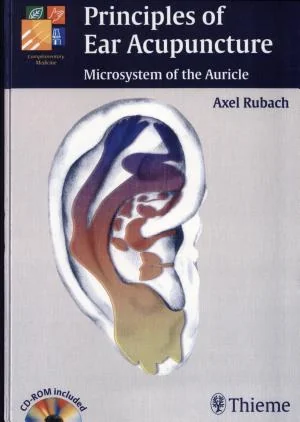
Principles of Ear Acupuncture
 72
72

Principles of Ear Acupuncture
Axel Rubach’s Principles of Ear Acupuncture offers a commendably thorough survey of auricular therapy, a domain often fragmented by differing traditions. Rubach, drawing on his extensive experience from 2001 onwards, succeeds in presenting a coherent framework that bridges the French (Nogier-influenced) and Chinese schools. The book's strength lies in its granular detail regarding ear anatomy and the precise localization of points, supported by clear diagrams. A notable passage details the specific correspondences for points related to the digestive system, which is exceptionally practical. However, for readers entirely new to acupuncture, the sheer density of information might present a steep initial learning curve, as it assumes a foundational understanding of meridian theory. Nevertheless, it stands as a rigorous academic text for dedicated practitioners.
📝 Description
72
Axel Rubach's 2001 book maps the ear as a microsystem for diagnosis and treatment.
Principles of Ear Acupuncture by Axel Rubach provides a detailed look at auricular therapy, bringing together different global practices. Published in 2001, it offers practitioners a thorough anatomical and topographical map of the ear, treating it as a microsystem for identifying and addressing health issues. The book carefully explains how to locate acupoints, differentiating between the French and Chinese approaches.
This volume is written for those studying or practicing ear acupuncture. It is particularly useful for individuals wanting a solid grasp of both the French school, which stems from Paul Nogier's research, and the traditional Chinese perspective. Readers will find it helps them sharpen their diagnostic abilities and improve the accuracy of their treatments using auricular points.
Emerging in the early 2000s, a time of growing interest in alternative medicine, Rubach's work addressed a specific need within the esoteric healing arts. It sought to unify disparate auricular acupuncture traditions, offering a structured reference for a practice that had previously been less codified. The book details the ear's function as a complex somatotopic map, a concept that aligns with esoteric views of the body as a microcosm reflecting the whole.
💡 Why Read This Book?
• Gain a precise understanding of ear anatomy and point localization, crucial for effective auricular therapy, as detailed in the book's specific anatomical diagrams. • Integrate distinct therapeutic approaches by learning about both the French auriculo-therapy and Chinese auricular acupuncture schools, as presented in the text's comparative sections. • Refine diagnostic acumen through the detailed descriptions of how auricular points correlate to specific organs and bodily systems, a core tenet explored by Dr. Rubach.
⭐ Reader Reviews
Honest opinions from readers who have explored this book.
❓ Frequently Asked Questions
What is the primary difference between the French and Chinese schools of ear acupuncture discussed in Rubach's book?
The book explains that the French school, pioneered by Paul Nogier, often utilizes a somatic mapping system where points on the ear correspond to the inverted fetus. The Chinese school tends to integrate auricular points with the broader meridian system and traditional diagnostic patterns.
When was Principles of Ear Acupuncture first published, and who is the author?
Principles of Ear Acupuncture was first published in 2001. The author is Axel Rubach, a practitioner and teacher with over two decades of experience in the field.
Does the book provide illustrations of ear acupoints?
Yes, the book offers detailed descriptions and likely includes illustrations for the localization of acupoints on the ear, serving as a visual guide for practitioners.
Is this book suitable for beginners in acupuncture?
While comprehensive, the book's detailed nature might be best suited for those with some foundational knowledge of acupuncture. Beginners might benefit from introductory texts first, then use this as an advanced reference.
What kind of experience does Axel Rubach bring to this subject?
Dr. Axel Rubach possesses over twenty years of experience as both a practitioner and a teacher of ear acupuncture, lending significant authority and practical insight to the text.
Can this book help in diagnosing conditions using the ear?
Yes, the book explores the diagnostic aspects of ear acupuncture by detailing how specific points and their sensitivities can indicate imbalances or conditions in corresponding parts of the body.
🔮 Key Themes & Symbolism
Auricular Microsystems
The text meticulously details the ear as a sophisticated microsystem, a concept central to auricular therapy. It explores how the entire body is represented on the ear's surface, a principle utilized in both French and Chinese traditions. Rubach elucidates the precise anatomical locations for these points, distinguishing between the somatic representations favored by Nogier's school and the meridian-integrated approach of Chinese practice, offering practitioners a dual lens for diagnosis and treatment.
Comparative Acupuncture Schools
A core strength of Principles of Ear Acupuncture is its comparative analysis of the French (auriculotherapy) and Chinese (auricular acupuncture) schools. Published in 2001, the book addresses the need to synthesize these often-distinct methodologies. It outlines how each tradition maps the ear, its diagnostic indicators, and therapeutic strategies, allowing practitioners to understand the nuances and potential synergies between these influential approaches.
Point Localization and Anatomy
The book provides an in-depth examination of the ear's morphology and the precise localization of its acupoints. This focus on anatomical accuracy is critical for effective treatment. Rubach’s detailed descriptions ensure practitioners can identify points reliably, a foundational skill for applying auricular acupuncture techniques derived from both Western and Eastern traditions.
Diagnostic Correlates
Principles of Ear Acupuncture emphasizes the diagnostic value inherent in auricular points. The work explains how specific points on the ear can reveal the state of internal organs and musculoskeletal structures. By correlating auricular findings with systemic health, practitioners can utilize the ear as a diagnostic map to guide their therapeutic interventions effectively.
💬 Memorable Quotes
Direct passages from the work, attributed to the author.
“The book offers a detailed description of the anatomy and morphology of the ear, acupoints on the ear and their localizations.”
— This statement highlights the text's primary function as a precise anatomical atlas for the ear, focusing on the practical identification of therapeutic points crucial for practitioners.
“A comprehensive review of both the French (after Nogier) and Chinese schools of acupuncture.”
— This indicates the book's unique value in bridging distinct traditions, offering a comparative perspective that synthesizes different theoretical frameworks and practical applications within auricular therapy.
“Dr. Rubach, with over twenty years experience as a practitioner and teacher, provides”
— This highlights the author's deep practical and pedagogical background, assuring readers of the text's authority and its ability to convey complex information effectively.
“An invaluable reference and textbook for ear acupuncturists!”
— This emphasizes the book's utility as a primary resource for professionals and students in the field, underscoring its comprehensive nature and practical applicability.
“Specific points for ear acupuncture.”
— This points to the book's focus on actionable techniques, detailing specific auricular points that can be targeted for therapeutic outcomes, making it a practical guide.
🌙 Esoteric Significance
Tradition
While ear acupuncture has roots in traditional Chinese medicine, which itself possesses esoteric dimensions, Rubach's work primarily operates within a framework of somatic mapping and physiological correspondence, particularly when discussing the French school influenced by Paul Nogier. It can be seen as a bridge between empirical observation and the more subtle energetic systems found in esoteric traditions, offering a tangible, anatomical approach to energetic diagnostics.
Symbolism
The ear itself serves as a potent symbol in this context, representing the microcosm that reflects the macrocosm of the entire human body. The specific points on the ear can be viewed as symbolic loci, each containing a condensed representation of a larger anatomical or functional entity. The act of stimulating these points symbolizes the practitioner's ability to influence distant parts of the body through targeted energetic interventions.
Modern Relevance
Contemporary practices in pain management, stress reduction, and addiction therapy frequently incorporate auricular acupuncture techniques. Thinkers and practitioners exploring psychosomatic connections and mind-body medicine find value in Rubach's detailed mapping of the ear's correspondences, seeing it as a practical tool for accessing and influencing the body's regulatory systems through a non-invasive modality.
👥 Who Should Read This Book
['• Acupuncturists and auriculotherapists seeking to deepen their understanding of point localization and integrate French and Chinese approaches.', '• Medical students and practitioners exploring complementary therapies who require a structured, anatomical reference for auricular diagnostics and treatment.', "• Researchers investigating the efficacy and mechanisms of microsystem therapies, benefiting from the book's detailed theoretical and practical framework."]
📜 Historical Context
Published in 2001, Axel Rubach's "Principles of Ear Acupuncture" emerged during a period of burgeoning acceptance for complementary therapies within Western medical discourse. The early 2000s saw increased academic interest and clinical trials for practices like acupuncture. Rubach's work arrived as a significant attempt to codify and integrate the distinct methodologies of the French school, largely influenced by Paul Nogier's work from the mid-20th century, and the more ancient Chinese tradition of auricular acupuncture. While figures like Nogier had already established auriculotherapy in Europe, and Chinese acupuncture had gained traction globally, a comprehensive text that explicitly bridged these two major streams was less common. The book’s publication provided practitioners with a structured reference that acknowledged both the anatomical correspondences emphasized in the French tradition and the energetic pathways central to Chinese medicine, helping to consolidate understanding in a field that was rapidly evolving beyond its more esoteric origins.
📔 Journal Prompts
Auricular point localization and its relationship to diagnosis.
The comparative strengths of French versus Chinese auricular acupuncture schools.
Mapping the ear: understanding the body as a microcosm.
Dr. Rubach's twenty years of experience and its impact on the text.
The ear as a diagnostic tool: correlating points to bodily structures.
🗂️ Glossary
Auricular Acupuncture
A practice within Traditional Chinese Medicine that involves stimulating specific points on the external ear to treat various conditions throughout the body, based on the principle that the ear is a microsystem.
Auriculotherapy
A therapeutic modality, largely developed by Dr. Paul Nogier, that uses the ear as a diagnostic and treatment tool, often employing a somatic map of the body on the ear's surface.
Paul Nogier
A French physician credited with developing auriculotherapy in the mid-20th century, proposing that the ear represents a pharmacologically active microsystem corresponding to the human body.
Microsystem
A concept in alternative medicine where a small area of the body (like the ear, hand, or foot) is believed to reflect the entire organism, allowing for diagnosis and treatment of distant parts.
Somatotopic Mapping
The principle of representing the body's anatomical regions or functional systems in a specific, ordered location on another surface, such as the ear in auriculotherapy.
Meridian System
In Traditional Chinese Medicine, a network of pathways through which Qi (vital energy) flows, connecting different organs and bodily functions. Auricular points are often integrated with these meridians.
Qi
In Traditional Chinese Medicine, the fundamental life force or vital energy believed to circulate throughout the body, influencing health and well-being.
This book appears in 1 collection
🔮 Readers Also Liked
Browse all →









From the “Acupuncture” Collection
View all →





More Free Occult Philosophy Books
View all →