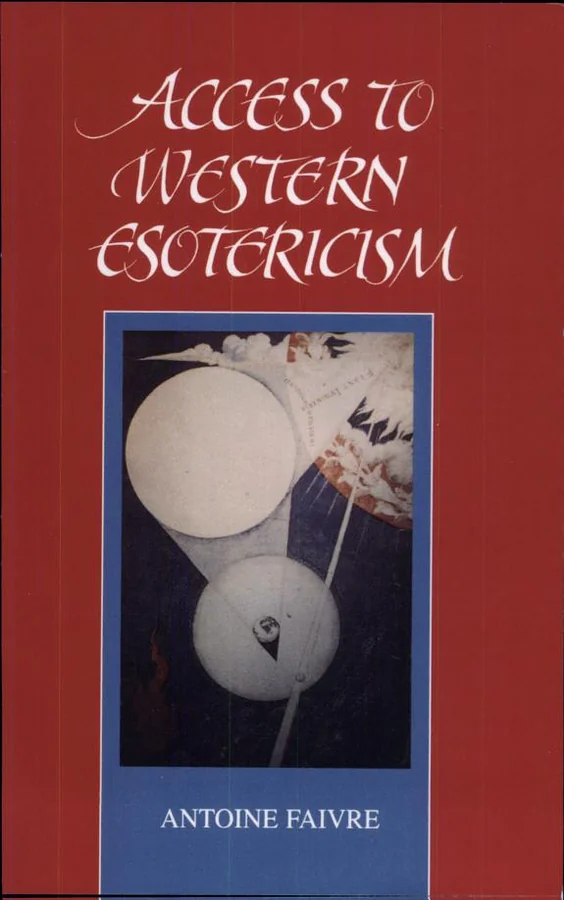
Access to Western Esotericism
 73
73

Access to Western Esotericism
Antoine Faivre's "Access to Western Esotericism" remains a pivotal text, distinguishing itself by its systematic approach and historical breadth. The strength lies in its clear demarcation of esoteric currents, providing a much-needed academic scaffolding. Faivre's insistence on defining terms like "gno" (gnosis) and his exploration of concepts like universal interdependency offer a solid foundation for study. However, the sheer scope, while ambitious, means some traditions receive less depth than a dedicated specialist might desire. A particular passage discussing the concept of the "spiritual body" within Hermeticism, though brief, exemplifies the book's capacity to distill complex ideas. This work is a foundational scholarly resource for understanding Western esotericism.
📝 Description
73
Antoine Faivre published "Access to Western Esotericism" in 1994, the first systematic English study of esoteric traditions.
Antoine Faivre's "Access to Western Esotericism," first published in English in 1994, provides a structured approach to understanding esoteric traditions. The book traces the historical development of movements like Christian Kabbalah, Theosophy, Alchemy, Rosicrucianism, and Hermeticism, showing their origins as far back as the Alexandrian Period. Faivre created a framework for academic study of these often overlooked fields.
This work is important for students of comparative religion, the history of ideas, and cultural studies. It is also valuable for those involved with Western esoteric practices who want to learn about their history and core ideas. Anyone interested in philosophical and spiritual currents that have influenced Western thought outside the mainstream will find this book useful.
Faivre's book appeared as academic interest in esotericism grew, moving it from occult studies into serious scholarship. Before its publication, systematic English texts on the subject were rare. The book offered essential definitions and a historical map, implicitly engaging with figures like Pico della Mirandola and Paracelsus through the movements they inspired. It addressed the need for clarity in a field known for varied interpretations and ambiguity.
💡 Why Read This Book?
• Understand the historical lineage of movements like Hermeticism and Christian Kabbalah, as Faivre traces their development from the Alexandrian Period. • Grasp the core esoteric principle of universal interdependency, a concept Faivre identifies as common across diverse traditions. • Acquire a rigorous methodology for studying esotericism, distinguishing it from mere philosophy or religion, as outlined in Faivre's framework.
⭐ Reader Reviews
Honest opinions from readers who have explored this book.
❓ Frequently Asked Questions
What is the primary definition of esotericism proposed by Antoine Faivre?
Faivre defines Western esotericism as forms of thought and practice characterized by the pursuit of spiritual transformation and the experience of the real, often involving symbolic language and initiatory paths.
Which historical periods does "Access to Western Esotericism" cover?
The book begins its historical survey with the Alexandrian Period (roughly 300 BCE to 300 CE) and extends through the various developments of esoteric traditions up to the early modern era.
What are some of the key esoteric currents discussed in the book?
Faivre examines major currents such as Hermeticism, Alchemy, Rosicrucianism, Christian Kabbalah, Gnosticism, and Theosophy, providing historical context and thematic analysis for each.
What does Faivre mean by 'universal interdependency'?
This is a core concept Faivre identifies in many esoteric traditions, referring to the belief that all things in the cosmos are interconnected and influence one another, forming a unified whole.
Is "Access to Western Esotericism" suitable for beginners?
Yes, it is designed as a systematic introduction, making it suitable for beginners seeking a scholarly overview, though its depth also appeals to advanced students and academics.
What is the significance of the Alexandrian Period in the study of esotericism according to Faivre?
Faivre highlights the Alexandrian Period as a crucial crucible where various philosophical, religious, and mystical traditions converged, laying the groundwork for many subsequent Western esoteric movements.
🔮 Key Themes & Symbolism
Spiritual Transformation
Faivre emphasizes that a central characteristic of Western esotericism is the pursuit of profound inner change. This isn't merely intellectual assent but a lived experience aimed at realizing a higher spiritual state or reconnecting with the divine. The book explores how traditions like Alchemy and Rosicrucianism frame this transformation through symbolic processes and initiatory practices, viewing it as the ultimate goal of esoteric study and practice.
Universal Interdependency
A recurring theme across the esoteric currents Faivre examines is the notion that the cosmos is an interconnected web of relationships. This principle, often rooted in Neoplatonic and Hermetic thought, suggests that macrocosmic events mirror microcosmic ones and vice versa. The book illustrates how this belief underpins practices like astrology and magic, where understanding these connections is key to navigating and influencing reality.
Methodology for Esotericism
Recognizing the challenges in studying esoteric traditions, Faivre proposes a rigorous academic methodology. He stresses the need for precise definitions of key terms and the distinction between esoteric thought and other systems like philosophy or mainstream religion. This analytical framework allows for comparative study and helps identify common characteristics across diverse traditions, moving the subject into a verifiable scholarly domain.
Historical Currents
The work provides a historical survey of major Western esoteric streams, starting from the Alexandrian Period. Faivre meticulously outlines the development and interrelations of movements such as Hermeticism, Alchemy, Christian Kabbalah, Gnosticism, and Theosophy. This historical mapping is crucial for understanding how these traditions evolved, influenced each other, and contributed to the broader intellectual field of the West.
💬 Memorable Quotes
Direct passages from the work, attributed to the author.
“The experience of spiritual transformation is central.”
— This concisely captures Faivre's assertion that esotericism is not just theoretical but experiential, focused on profound personal change and the realization of a spiritual dimension.
“The Alexandrian Period marks a crucial origin point.”
— Faivre identifies this era as a fertile ground where diverse philosophical and religious ideas converged, seeding many later esoteric traditions discussed in the book.
“Universal interdependency connects all things.”
— This highlights a core esoteric doctrine Faivre presents: the belief in a cosmic network where every element is linked and influences every other element.
“A rigorous methodology is needed for study.”
— Faivre argues for an academic approach, emphasizing clear definitions and systematic analysis to understand the distinct nature of esoteric thought and practice.
“Esotericism involves the experience of the real.”
— This suggests that esoteric traditions aim not just for abstract knowledge but for direct, experiential contact with a deeper or spiritual reality.
🌙 Esoteric Significance
Tradition
Faivre's work is firmly situated within the study of Western Esotericism as a distinct field. It engages deeply with the Hermetic, Gnostic, Kabbalistic, and Alchemical traditions, viewing them not as isolated curiosities but as interconnected currents within a larger Western esoteric lineage. The book seeks to establish the autonomy and intellectual integrity of these traditions, differentiating them from both mainstream religion and secular philosophy.
Symbolism
The text implicitly engages with numerous symbols but explicitly focuses on concepts like "universal interdependency." This idea itself functions symbolically, representing the interconnectedness of the cosmos. Other symbolic motifs, such as the "spiritual body" or the process of transformation found in Alchemy, are discussed in relation to their role in achieving esoteric knowledge and spiritual realization.
Modern Relevance
Faivre's rigorous methodology and historical surveys continue to inform contemporary scholarship on esotericism. Thinkers and researchers in comparative religion, history of philosophy, and cultural studies build upon his foundational work. Contemporary esoteric practitioners, particularly those in revived Hermetic or Rosicrucian orders, often reference Faivre's definitions and historical analyses to understand their own traditions within a broader context.
👥 Who Should Read This Book
• Students of comparative religion and history of ideas seeking a structured introduction to esoteric traditions. • Scholars of Western philosophy and culture needing to understand the historical influence of non-mainstream thought. • Practitioners of Hermeticism, Alchemy, or Kabbalah who desire a scholarly grounding in their historical roots and theoretical frameworks.
📜 Historical Context
Published in 1994, Antoine Faivre's "Access to Western Esotericism" arrived at a central moment in the academic study of the subject. While figures like Carl Jung had previously explored esoteric themes, Faivre's work provided a systematic, historical, and methodological framework that professionalized the field. It addressed a scholarly gap, offering a comprehensive overview previously unavailable in English. Unlike purely philosophical or theological analyses, Faivre's approach distinguished esoteric traditions by their emphasis on spiritual transformation and specific modes of knowledge transmission. His work engaged with ongoing debates in religious studies and the history of ideas, providing a much-needed lexicon and historical map for scholars like Frances Yates who had previously explored related areas like Hermeticism and the Rosicrucians.
📔 Journal Prompts
The concept of universal interdependency across traditions.
Faivre's definition of spiritual transformation.
The historical significance of the Alexandrian Period.
Defining key terms like "gnosis" in esoteric contexts.
The methodological challenges in studying esoteric movements.
🗂️ Glossary
Esotericism
Forms of thought and practice characterized by the pursuit of spiritual transformation and the experience of the real, often involving symbolic language and initiatory paths.
Alexandrian Period
A historical era (c. 300 BCE – 300 CE) centered in Alexandria, Egypt, known for the confluence of Hellenistic, Egyptian, Jewish, and early Christian thought, which significantly influenced later esoteric traditions.
Hermeticism
An esoteric tradition rooted in the writings attributed to Hermes Trismegistus, emphasizing divine wisdom, the correspondences between the microcosm and macrocosm, and spiritual transformation.
Christian Kabbalah
A form of Jewish mysticism adapted by Christian scholars, seeking to find Christian theological meanings within the Zohar and other Kabbalistic texts, particularly prominent in the Renaissance.
Theosophy
A diverse set of mystical philosophies, particularly associated with the movement founded by Helena Blavatsky in the late 19th century, aiming to understand divine mysteries and the nature of the universe.
Alchemy
An ancient tradition involving the study of matter and its transformations, often encompassing spiritual and psychological dimensions alongside the pursuit of the philosopher's stone and transmutation of metals.
Rosicrucianism
A mystical and esoteric movement that emerged in Europe in the early 17th century, associated with secret societies, spiritual knowledge, and symbolic teachings, often linked to figures like Christian Rosenkreuz.
This book appears in 1 collection
🔮 Readers Also Liked
Browse all →






From the “Western Esotericism” Collection
View all →





More Free Sacred Texts & Gnosticism Books
View all →