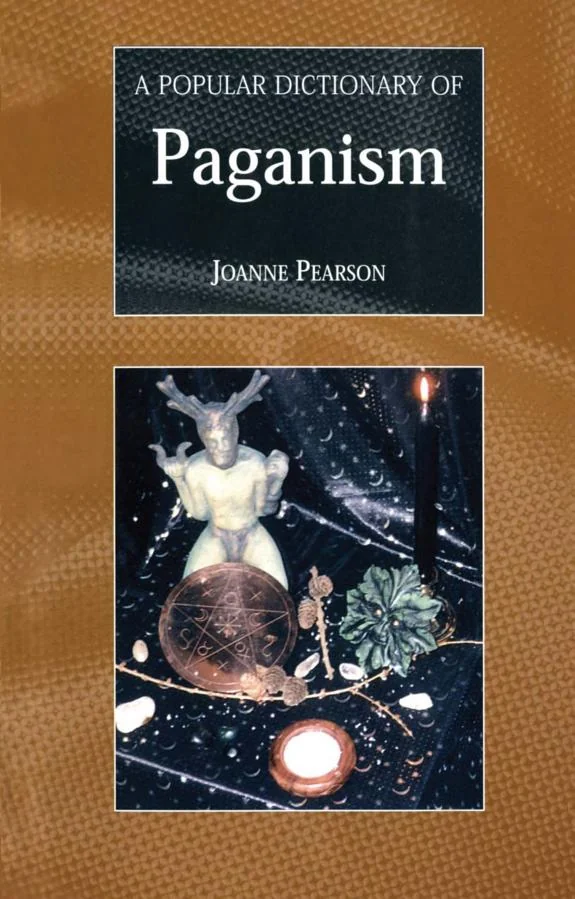
A Popular Dictionary of Paganism
 76
76

A Popular Dictionary of Paganism
Joanne Pearson's *A Popular Dictionary of Paganism* arrives not with a flourish, but with the quiet authority of a well-ordered library. Its strength lies in its systematic approach to a subject often characterized by its fluid boundaries and diverse manifestations. The alphabetical arrangement provides immediate access to terms ranging from specific deities to broader philosophical concepts, making it a practical tool for students. A noticeable limitation, however, is the work's academic tone, which, while valuable for scholarly engagement, might feel somewhat dry for those seeking a more experiential guide to Pagan paths. The entry on 'Ecofeminism,' for instance, accurately traces its theoretical development and connections to Pagan thought but could benefit from more explicit links to contemporary practice. Pearson's contribution is ultimately a solid, if unexciting, reference that clarifies the lexicon of a significant spiritual movement.
📝 Description
76
Published in 2013, Joanne Pearson's dictionary clarifies contemporary Pagan terminology.
A Popular Dictionary of Paganism, by Joanne Pearson, acts as a detailed glossary and reference for modern Pagan beliefs and practices. First released in October 2013, it provides an academic look at the varied traditions, rituals, and historical influences that shape contemporary Paganism. The book aims to clear up common misunderstandings by defining terms and offering context for a wide range of subjects. It is useful for students, academics, and practitioners who need to grasp the specifics of current Paganism, especially those studying religion and spirituality. Beginners will also find it a good starting point to learn about the different Pagan expressions.
Pearson places modern Paganism within its historical and intellectual setting, recognizing the growth and changes in pre-Christian religious revivals. By listing and explaining key terms, the book supports the scholarly study of Pagan movements that grew in the late 20th century. This work engages with the discussions started by figures like Margot Adler and Aidan Kelly, who were important in analyzing and defining these traditions.
This dictionary addresses the academic study of modern Pagan traditions, which often draw upon reconstructed or revived pre-Christian European religions. It catalogs terms central to movements like Wicca, Druidry, and Asatru, placing them within a historical and conceptual framework. The work acknowledges the scholarly engagement with these spiritual paths that gained prominence in the late 20th century, contributing to a clearer understanding of their diversity and development.
💡 Why Read This Book?
• Gain clarity on the specific terminology used within contemporary Paganism, such as 'reconstructionism' and 'neopaganism', enabling a more precise understanding of academic and practitioner discourse. • Understand the historical roots and modern adaptations of various Pagan traditions, including Wicca and Asatru, as documented in the book's detailed entries. • Utilize a structured reference to differentiate between the myriad of Pagan paths and their associated concepts, enhancing your ability to engage with scholarly works published around the book's 2013 release.
⭐ Reader Reviews
Honest opinions from readers who have explored this book.
❓ Frequently Asked Questions
What is the primary purpose of Joanne Pearson's "A Popular Dictionary of Paganism"?
The book functions as a glossary and reference work, aiming to define and explain the diverse terms, concepts, and practices associated with contemporary Paganism for academic and general audiences.
Who is the intended audience for this dictionary?
It is primarily for students, scholars, and practitioners of Paganism or related religious studies, offering a structured overview of its terminology and historical context.
When was "A Popular Dictionary of Paganism" first published?
The book was first published on October 18, 2013, positioning it as a relatively recent academic compilation of information on the subject.
Does the dictionary cover historical Paganism or only modern forms?
While focusing on contemporary Paganism, the dictionary often explores the historical roots and influences that inform modern practices and beliefs, providing context.
What kind of terms can I expect to find in the dictionary?
Entries cover a wide range, including specific deities, rituals, philosophical concepts (like animism), types of Paganism (Wicca, Druidry), and significant figures or movements within the field.
Is this book suitable for someone completely new to Paganism?
Yes, its structured, alphabetical format makes it a valuable starting point for newcomers seeking to understand the foundational language and concepts of modern Paganism.
🔮 Key Themes & Symbolism
Defining Contemporary Paganism
This work meticulously defines the scope and terminology of contemporary Paganism, distinguishing it from earlier forms and academic misinterpretations. It highlights the movement's diversity, cataloging terms related to various traditions like Wicca, Druidry, and Asatru. The dictionary acts as a crucial tool for understanding the self-identification and practices of modern adherents, moving beyond simplistic or stereotypical representations prevalent in popular culture.
Reconstructionism and Revival
A significant theme explored is the concept of Pagan 'reconstructionism' – the effort to revive ancient, pre-Christian European religious traditions. Pearson's dictionary provides entries that clarify the methodologies, challenges, and theological considerations involved in such revivals. It distinguishes between reconstructionist efforts and other forms of Neopaganism, offering a nuanced perspective on the scholarly and practical approaches to historical religious continuity.
Ecological and Feminist Connections
The dictionary illuminates the strong links between many contemporary Pagan paths and ecological consciousness, often termed 'ecopaganism' or 'ecofeminism.' Entries explain how these traditions often foster a deep reverence for nature, viewing the Earth as sacred. This perspective is explored through concepts like animism and earth-centered spirituality, demonstrating how Paganism often integrates environmental ethics into its worldview and practices.
Spirituality and Academia
Pearson's work navigates the intersection of lived spiritual practice and academic study. By providing clear, definitional entries, the book bridges the gap between the esoteric world of Paganism and the analytical framework of religious studies. It aims to legitimize Paganism as a subject of serious scholarly inquiry, offering accessible definitions that can be used by both insiders and outsiders to the tradition.
💬 Memorable Quotes
Direct passages from the work, attributed to the author.
“Entries cover a spectrum from specific deities to broader philosophical stances.”
— This highlights the dictionary's scope, indicating that it addresses both particular figures of worship (like ancient gods) and overarching belief systems (such as animism or pantheism) within Paganism.
“Distinguishing between historical revivalism and modern innovation is key.”
— This points to a core analytical challenge within Pagan studies, emphasizing the book's role in clarifying the often-blurred lines between genuine attempts to reconstruct ancient practices and newer, creative spiritual developments.
“Academic literature on Paganism has grown significantly since the late 20th century.”
— This statement contextualizes the dictionary's publication, noting the increasing scholarly interest and output concerning Pagan movements, for which Pearson's work serves as a valuable resource.
“Understanding the terminology is the first step towards comprehending the phenomenon.”
— This emphasizes the foundational importance of lexicography in the study of any complex subject, particularly a relatively new and diverse religious movement like contemporary Paganism.
💡 Key Ideas
Editorial paraphrase of the work's core concepts — not direct quotes.
The complexity of contemporary Paganism is such that a single definition is insufficient.
This paraphrased concept underscores the necessity of a dictionary like Pearson's, acknowledging that the broad and varied nature of modern Pagan movements requires a comprehensive reference to grasp their distinct elements and shared characteristics.
🌙 Esoteric Significance
Tradition
While not strictly adhering to a single esoteric lineage, this work engages with traditions that often draw from Hermeticism, Gnosticism, and ancient polytheistic systems. It functions as a bridge, translating complex spiritual and philosophical concepts associated with these broader esoteric currents into the specific context of modern Pagan practice, thereby making them more accessible to a wider audience.
Symbolism
The dictionary implicitly engages with various symbols central to Paganism. Concepts like the 'Wheel of the Year' represent cyclical time and seasonal festivals, common in Wicca and other traditions. 'Thealogy,' the study of female divinity, highlights the significance of goddesses in many Pagan paths. The frequent mention of nature-based symbols underscores the animistic and earth-honoring aspects prevalent across diverse Pagan expressions.
Modern Relevance
Contemporary thinkers and practitioners involved in ecospirituality, feminist theology, and comparative religion studies frequently utilize reference works like Pearson's. Modern Pagan leaders and academics often cite such dictionaries to ground discussions about tradition, innovation, and the diversity within movements like Druidry, Asatru, and various forms of witchcraft and Hellenismos.
👥 Who Should Read This Book
["• Beginning students of comparative religion or new religious movements who need a clear glossary for understanding terms like 'Neopaganism' and 'reconstructionism'.", '• Practitioners of Wicca, Druidry, or Asatru seeking to deepen their understanding of the academic discourse surrounding their traditions and related concepts.', '• Researchers in folklore, mythology, and cultural studies who require precise definitions for terms related to pre-Christian European religions and their modern revivals.']
📜 Historical Context
Published in 2013, *A Popular Dictionary of Paganism* emerged during a period of significant growth and academic scrutiny of contemporary Pagan movements. The late 20th and early 21st centuries saw a proliferation of scholarly works analyzing Neopaganism, moving beyond earlier, often sensationalized, accounts. Pearson's dictionary fits within this trend, providing a structured lexicon for a field increasingly populated by scholars like Graham Harvey, whose work on shamanism and Paganism often engages with similar themes of practice and belief. The book's academic approach contrasts with more devotional or experiential literature, positioning itself as a tool for objective study. Its publication also coincided with the rise of online communities and resources, making accessible reference works like this particularly valuable for both researchers and the growing number of practitioners seeking clear definitions.
📔 Journal Prompts
The concept of 'reconstructionism' in Paganism: How does it differ from simple revivalism?
Reflect on the meaning of 'animism' within the context of nature-venerating Pagan paths.
Explore the significance of 'thealogy' in understanding goddess-centered spiritualities.
Consider the historical threads that lead to the diverse practices cataloged in the dictionary.
Analyze the term 'ecofeminism' and its relationship to contemporary earth-centered spiritualities.
🗂️ Glossary
Neopaganism
A broad term for modern spiritual or religious movements that seek to revive or re-interpret pre-Christian, indigenous, or folk traditions of Europe and North America, often with an emphasis on nature and polytheism.
Reconstructionism
A subset of Neopaganism focused on accurately reconstructing ancient religious practices, beliefs, and social structures based on historical and archaeological evidence, often with a specific cultural or ethnic focus.
Thealogy
The study of divinity, often from a feminist perspective, focusing on the divine feminine and goddess traditions, which is a significant element within many contemporary Pagan spiritualities.
Animism
The belief that natural objects, phenomena, and the universe itself possess souls or consciousness; a common worldview within many Pagan traditions that emphasizes the sacredness of the natural world.
Wicca
A modern, nature-based religion with roots in the mid-20th century, often characterized by polytheistic beliefs, ritual magic, and the veneration of a God and Goddess.
Druidry
A spiritual path drawing inspiration from the ancient Druids of Celtic Europe, typically emphasizing reverence for nature, ancestral wisdom, and personal growth.
Asatru
A modern religious movement based on the worship of the Norse gods and goddesses of the pre-Christian Germanic peoples, emphasizing honor, community, and traditional values.
This book appears in 1 collection
🔮 Readers Also Liked
Browse all →






From the “Paganism” Collection
View all →






More Free Witchcraft & Paganism Books
View all →

![Faith in America [3 volumes]](/img/thumb/faith-in-america-3-volumes-charles-h-lippy-986056.webp)