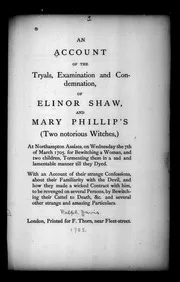
An account of the tryals, examination and condemnation, of Elinor Shaw and Mary Phillip's (two notorious witches,) ... 1705: Iss 249
 82
82

An account of the tryals, examination and condemnation, of Elinor Shaw and Mary Phillip's (two notorious witches,) ... 1705: Iss 249


Celeste Moreau (Divination & Symbolism Reviewer) — This meticulously preserved account of the Elinor Shaw and Mary Phillips trials is an indispensable primary source for anyone studying the history of witchcraft accusations. Ralph Davis presents a stark, unembellished record of the proceedings, offering profound insights into the legal and social mechanisms of witch condemnation in 1705. The text’s power lies in its raw depiction of fear and belief, illuminating the psychological landscape of the era. Its strength is its authenticity, providing a grounded counterpoint to more speculative occult texts. This is essential reading for scholars of early modern history, legal historians, and serious students of Western esotericism seeking to understand the historical context of magical suppression.
📝 Description
82
In 1705, Ralph Davis documented the trials of Elinor Shaw and Mary Phillips, accused witches in England.
Ralph Davis's 1705 "An Account of the Tryals, Examination and Condemnation of Elinor Shaw and Mary Phillips" details the legal proceedings against two women accused of witchcraft. This document, part of a larger chronicle on sorcery, reveals the societal anxieties and judicial practices of early modern England. It moves beyond simple legal records to show the pervasive fear of the supernatural and the folk beliefs that fueled accusations. The text illustrates a period where the line between the ordinary world and the mystical was blurred, and the effects of curses and spells were considered a real danger.
This account is a significant artifact for those studying the history of magic, occultism, and the persecution of individuals believed to practice it. It prompts reflection on how beliefs are formed, how deviance is defined as heresy, and the persistent human interest in darker magical traditions. The narrative, while rooted in a specific historical moment, touches on universal themes of power dynamics, the impact of accusations, and the struggle against perceived malevolent forces that still find echoes in modern esoteric discussions.
This account sits within the historical study of Western esotericism, specifically focusing on the period of intense witch panics. It provides primary source material on the practical application of beliefs about malevolent magic and the societal mechanisms used to control it. The text reflects a time when the conceptualization of witchcraft was deeply intertwined with religious and folk understandings of supernatural agency, demonstrating how accusations were processed within a specific legal and cultural framework. It is a window into the historical realities that informed later occult theories and practices.
💡 Why Read This Book?
Uncover the raw historical evidence of witch trials from 1705. Understand the societal fears and beliefs that fueled accusations of sorcery. Explore the legal and procedural aspects of historical witch condemnation. Gain insights into the lives of accused individuals and their accusers. Essential for scholars, history buffs, and those seeking authentic records of early modern occult persecution.
⭐ Reader Reviews
Honest opinions from readers who have explored this book.
❓ Frequently Asked Questions
What is the historical period covered by this document?
This document specifically details the trials of Elinor Shaw and Mary Phillips, which took place in 1705, placing it firmly within the early 18th century, a period still grappling with notions of witchcraft.
Who were Elinor Shaw and Mary Phillips?
Elinor Shaw and Mary Phillips are presented as 'notorious witches' whose trials, examinations, and subsequent condemnation are the central focus of this historical account.
What is the source of this digitized text?
This digitized version is sourced from IA40330315-33, indicating it is a microfilm or digital scan of an original print, preserved for academic and public access.
What is the significance of the 'Iss 249' designation?
'Iss 249' likely refers to this document being the 249th issue or entry in a larger collection or series dedicated to the topic of witchcraft and its history, potentially a periodical or catalog.
What kind of language and tone can be expected?
The language is of the early 18th century, likely formal and legalistic in its reporting of trials, but also reflecting the fear and superstition of the era.
🔮 Key Themes & Symbolism
The Crucible of Accusation and Belief
This account plunges readers into the heart of a society deeply affected by fear of the unseen. It explores how suspicion, religious fervor, and communal anxieties coalesced to brand individuals like Elinor Shaw and Mary Phillips as agents of malevolent forces. The narrative highlights the power of accusation in a pre-Enlightenment era, where perceived supernatural transgressions were met with swift and severe judicial action. It offers a profound case study into the psychological and social dynamics that fueled witch hunts, revealing the fragility of reputation and the devastating consequences of societal panic.
The Mechanics of Early Modern Justice
Beyond the sensationalism of witchcraft, this document provides a starkly practical look at the legal and investigative processes of 1705. It details the 'tryals, examination,' and 'condemnation,' offering insight into the interrogation techniques, the types of evidence presented (often based on folklore or spectral testimony), and the judicial framework that underpinned these proceedings. For those interested in the history of law, criminology, or the evolution of justice systems, this text is a valuable primary source that illustrates the often brutal and religiously influenced methods employed to root out perceived heresy and sorcery.
Elements of the Unseen: Folk Magic and Spiritual Warfare
While a legal document, the trials of Shaw and Phillips are steeped in the popular consciousness of folk magic, curses, and spiritual warfare prevalent in the early 18th century. The accusations themselves, though framed within a legal context, implicitly refer to beliefs in demonic pacts, magical afflictions, and the power of spells. This account serves as a crucial artifact for understanding the pervasive influence of occult beliefs on everyday life and the societal mechanisms developed to combat what was perceived as a tangible threat from the spiritual realm, offering a glimpse into the practical application and perception of magic.
💬 Memorable Quotes
Direct passages from the work, attributed to the author.
“Two notorious witches...”
— This phrase immediately establishes the perceived nature of the accused, framing them as figures of significant and recognized malevolence within their community.
“their tryals, examination...”
— Highlights the procedural, legalistic aspect of the condemnation, suggesting a formal process, however flawed.
“condemnation”
— A stark and final word, signifying the ultimate judgment and severe consequences faced by the accused.
“1705: Iss 249”
— Pinpoints the exact historical moment and contextualizes it within a larger archival or serial publication.
“Digitized from IA40330315-33”
— Indicates the modern preservation and accessibility of this historical artifact through digital archiving.
🌙 Esoteric Significance
Tradition
This text is primarily relevant to the history of Western esotericism, particularly within the context of folk magic, demonology, and the historical suppression of perceived witchcraft. It falls under the umbrella of historical occult studies, providing primary source material for understanding the societal impact of beliefs that were often demonized by established religious institutions but persisted in popular practice and lore.
Symbolism
The condemnation of Elinor Shaw and Mary Phillips is steeped in the symbolism of the 'witch' as an archetypal figure of forbidden knowledge, pacts with dark forces, and the disruption of natural order. The 'tryals' and 'examination' symbolize the societal attempt to purge perceived corruption and restore balance, often through ritualistic condemnation. The very act of accusation and trial, regardless of guilt, symbolizes the fear of the 'other' and the power of collective belief in shaping reality and enacting justice, however misconstrued.
Modern Relevance
In contemporary esoteric thought, this document serves as a critical reminder of the dangers of unfounded accusation, the power of belief systems, and the historical persecution faced by those who deviated from societal norms, often associated with marginalized spiritual practices. It encourages reflection on the cyclical nature of fear and scapegoating, and the importance of critical examination when confronting perceived 'dark' forces, both external and internal. It underscores the need for empathy and understanding in exploring diverse spiritual paths.
👥 Who Should Read This Book
Scholars of history, particularly early modern European history and the history of law, will find this document useful for its primary source material on witch trials. Practitioners of witchcraft and paganism seeking to understand the historical roots of their traditions and the persecution faced by their predecessors will gain crucial context. Students of folklore and cultural studies can analyze the societal beliefs and anxieties embedded within the text. For general readers with an interest in the occult, historical mysteries, and the darker aspects of human history, this account offers a compelling, albeit somber, narrative that sheds light on a significant historical phenomenon.
📜 Historical Context
The year 1705 falls within a period of transition for England. While the peak of widespread witch hunts had largely passed with the Witchcraft Act of 1735 looming, societal anxieties surrounding witchcraft persisted, particularly in more rural or religiously conservative areas. The early 18th century saw a growing influence of rationalism and the burgeoning Enlightenment, yet deeply ingrained folk beliefs and superstitions remained potent forces. Judicial processes, though becoming more formalized, could still be heavily influenced by popular opinion and religious doctrine. This account of Elinor Shaw and Mary Phillips’ condemnation provides a snapshot of these lingering tensions, illustrating how accusations of sorcery continued to manifest within the legal and social structures of the time, reflecting a society still reading through the boundaries between reason, faith, and fear.
📔 Journal Prompts
Reflect on the societal fears that might have led to the condemnation of Elinor Shaw and Mary Phillips. How do similar fears manifest today?
Consider the nature of 'evidence' presented in witch trials of this era. How does it differ from modern legal standards, and what does this reveal about historical belief systems?
Imagine you are an observer at one of these trials. What emotions or thoughts would arise from witnessing the proceedings and the fate of the accused?
How does the historical context of 1705 shape our understanding of 'witchcraft' compared to modern interpretations?
What parallels can be drawn between the condemnation of individuals like Shaw and Phillips and the ostracization or persecution of minority groups in any era?
🗂️ Glossary
Tryals
In the context of 1705, 'tryals' refers to the formal legal proceedings and examinations conducted to determine the guilt or innocence of an accused person, particularly in criminal cases like witchcraft.
Examination
A phase within a trial where the accused, witnesses, or evidence are questioned by legal authorities to gather information and assess the veracity of accusations.
Condemnation
The act of officially declaring someone guilty of a crime or wrongdoing, leading to a sentence or punishment, in this case, likely severe due to the nature of the alleged offense.
Witches
Individuals, typically women in this historical period, accused of practicing magic with malevolent intent, often in league with demonic forces, leading to societal fear and persecution.
Notorious
Famous for some bad quality or deed; widely known and talked about, implying Elinor Shaw and Mary Phillips had a reputation for their alleged involvement in witchcraft before their trials.
This book appears in 2 collections
🔮 Readers Also Liked
Browse all →





From the “Witchcraft” Collection
View all →




More Free Witchcraft & Paganism Books
View all →



![ERIC ED085284: World History. Volumes I and II. [Sahuarita High School Career Curriculum Project].](/img/thumb/eric-ed085284-world-history-volumes-i-and-ii-sahuarita-high-school-career-curriculum-project-eric.webp)
