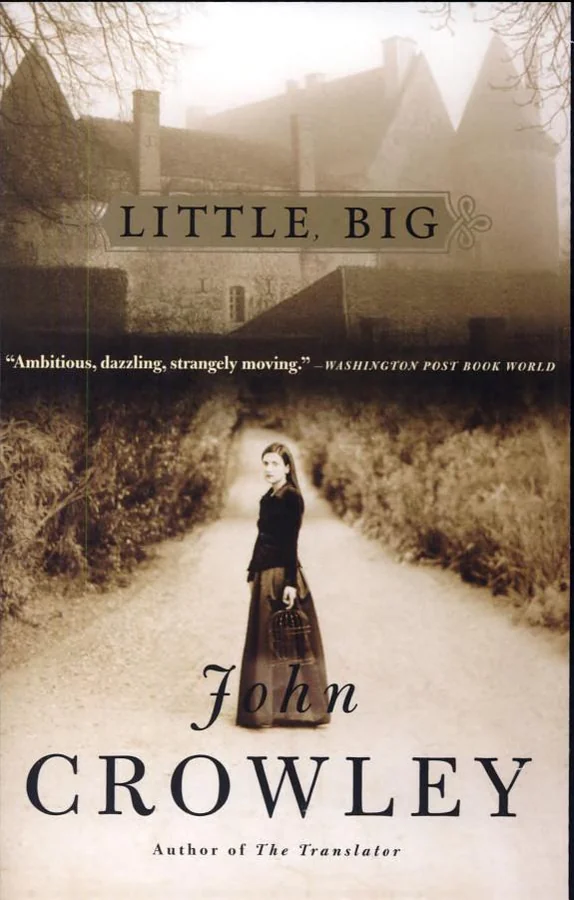
Little, Big
 78
78

Little, Big
John Crowley’s *Little, Big* is less a novel and more a carefully constructed mythos, a domestic epic woven from the threads of the uncanny. The premise—Smoky Barnable’s journey to Edgewood—is deceptively simple, a fairy tale opening that belies the intricate familial histories and the strange, shifting architecture of the Drinkawater house. Crowley’s prose possesses a singular quality, a measured, almost archaic cadence that lends the fantastical elements an undeniable weight. The sheer scope, charting four generations against the backdrop of a world bordering on magic, is breathtaking. However, the novel’s density can also be its challenge; the narrative sometimes meanders, and the sheer number of characters and their interconnectedness requires dedicated attention. The depiction of the house itself, a character as much as a setting, and its porous relationship with the 'Otherworld' is a masterstroke. Ultimately, *Little, Big* offers a unique, deeply felt exploration of belonging and the hidden currents that shape our lives.
📝 Description
78
John Crowley's 2002 novel, *Little, Big*, begins with an ordinary man's journey to a hidden family.
The narrative follows Smoky Barnable as he travels from the City to Edgewood to marry Daily Alice Drinkawater. This journey is an entry into the world of the Drinkawater family, whose ancestral home is a nexus between our reality and another. The house itself is a character, a place that is many places, existing on the boundary of the mundane and the magical.
Crowley's prose details the lives and histories of the Drinkawater clan, a family bound to this liminal space and its strange properties. The novel examines the nature of reality, the persistence of myth, and the deep connections that bind people across generations and across worlds. It is a literary work that rewards close attention, blending the familiar with the uncanny in its depiction of a hidden domesticity.
Published in 2002, *Little, Big* engages with traditions that explore hidden realities coexisting with our own. It echoes the mythopoeic fantasy that seeks to weave myth and meaning into contemporary settings, and shares a sensibility with magical realism's blurring of the everyday and the supernatural. The novel's focus on a family connected to a secret, permeable world positions it within a lineage of literature that treats the domestic sphere as a site for profound, often uncanny, revelations.
💡 Why Read This Book?
• Gain an understanding of the 'Otherworld' as a concept, specifically how its presence in *Little, Big* influences the Drinkawater family's everyday lives and their ancestral home, Edgewood. • Experience the narrative structure that traces four generations, understanding how Crowley uses this scope to explore the nature of 'destiny' and familial inheritance. • Appreciate Crowley's unique prose style, which imbues the magical elements and the concept of the 'Great Tale' with a sense of profound reality and literary depth.
⭐ Reader Reviews
Honest opinions from readers who have explored this book.
❓ Frequently Asked Questions
What is the significance of Smoky Barnable's journey in Little, Big?
Smoky Barnable's journey from the City to Edgewood is a foundational act, initiating his marriage to Daily Alice Drinkawater and his integration into the Drinkawater family's unique world, setting the stage for the multi-generational saga.
How does the house in Little, Big function as more than just a setting?
The Drinkawater house is depicted as 'many houses,' a liminal space that exists on the border of the 'Otherworld.' It acts as a nexus, reflecting the family's history and the permeable boundary between the mundane and the magical.
What does the 'Great Tale' represent in John Crowley's Little, Big?
The 'Great Tale' suggests an overarching, perhaps cosmic, narrative or destiny that influences the lives of the characters, hinting at a deeper order or mythic structure within which their individual stories unfold.
Is Little, Big considered a fantasy novel?
While it contains significant fantastical and magical elements, *Little, Big* is often categorized as literary fiction or magical realism due to its focus on character, family, and prose style, rather than overt genre tropes.
When was John Crowley's Little, Big first published?
John Crowley's *Little, Big* was first published in March 2002, marking a significant work in his bibliography.
What are the primary themes explored in Little, Big?
The novel explores themes of family, destiny, love, loss, the boundary between worlds, the nature of reality, and the overarching 'Great Tale' that connects individual lives.
🔮 Key Themes & Symbolism
The Border of Worlds
The novel masterfully renders the concept of the 'Otherworld' not as a distant realm, but as a constant, subtle presence bordering our own reality. The Drinkawater house in Edgewood serves as the primary locus for this phenomenon, a dwelling that is paradoxically 'many houses' and a threshold. This liminality shapes the lives of the family members, influencing their perceptions, relationships, and destinies. Crowley explores how the mundane and the magical are not separate but intricately interwoven, with the magical often bleeding into the everyday in quiet, profound ways, challenging conventional notions of what is real.
Familial Destiny and the Great Tale
Central to *Little, Big* is the exploration of destiny, particularly as it pertains to the Drinkawater lineage. The narrative follows four generations, illustrating how familial legacies and an overarching 'Great Tale' profoundly impact individual lives. This 'Great Tale' functions as a mythic framework, suggesting a grand, perhaps predetermined, narrative that the characters inhabit and, to varying degrees, attempt to understand or fulfill. The novel questions whether individuals are merely actors within this tale or possess agency to shape their own paths within its broad contours, highlighting the complex interplay between inherited fate and personal choice.
The Nature of Home and Belonging
The concept of 'home' is rendered with extraordinary depth in *Little, Big*. The Drinkawater house is more than a physical structure; it is a living entity, a repository of history, and a spiritual anchor that defines belonging. Smoky Barnable's journey is, in essence, a quest for this home and for his place within the intricate range of the Drinkawater family. The novel examines how 'home' is constructed not just from bricks and mortar, but from relationships, shared histories, and an often-unseen connection to a place that speaks to a deeper, perhaps magical, significance.
Love and Loss Across Worlds
The narrative is steeped in profound emotions, particularly love and loss, experienced across the permeable boundaries of existence. The love between Smoky and Daily Alice, and among the extended family, forms the emotional core. Yet, this love is often tested by the unique circumstances of their lives, influenced by the proximity of the 'Otherworld' and the unfolding of the 'Great Tale.' Loss is presented not just as the absence of loved ones but as the fading of connection to the magical or the sense of belonging, prompting a deep contemplation of what it means to hold onto what is precious in a world of shifting realities.
💬 Memorable Quotes
Direct passages from the work, attributed to the author.
“Smoky Barnable, an anonymous young man, traveled by foot from the City to a place called Edgewood.”
— This opening sets the stage for a classic quest narrative, grounding the extraordinary journey in the ordinary actions of a seemingly unremarkable protagonist, hinting at the less-obvious layers within the mundane.
“It is a story of fantastic love and heartrending loss; of impossible things and unshakable destinies.”
— This highlights the emotional and thematic weight of the narrative, promising explorations of powerful human emotions set against a backdrop of supernatural elements and the concept of fate.
“And of the great Tale that is told.”
— This phrase introduces the concept of a meta-narrative or cosmic story that encompasses the lives of the characters, suggesting a layer of mythic significance or destiny operating beyond individual comprehension.
“The house itself was a place where the ordinary and the extraordinary were not merely adjacent but interpenetrating.”
— This interpretation emphasizes the central theme of liminality, portraying the Drinkawater home not as a separate magical space, but as a nexus where the boundaries between worlds are dissolved, creating a unique mode of existence.
💡 Key Ideas
Editorial paraphrase of the work's core concepts — not direct quotes.
It is the story of four generations of a singular family, living in a house that is many houses on the magical border of an otherworld.
This passage expresses the novel's core premise: a multi-generational saga intertwined with a unique, liminal dwelling that exists between realities, defining the family's existence and their relationship with the magical.
🌙 Esoteric Significance
Tradition
While not explicitly tied to a single esoteric lineage, *Little, Big* speaks to Gnostic and Hermetic undercurrents. The concept of an 'Otherworld' coexisting with our own, and the idea that certain individuals or places act as conduits, echoes Gnostic cosmologies concerning hidden realms and divine sparks trapped in the material. The 'Great Tale' can be interpreted as a form of cosmic narrative or divine plan, reminiscent of Kabbalistic concepts of emanation and destiny. Crowley's work departs from dogmatic adherence, instead using these archetypal structures to explore human experience with a profound sense of wonder and intricate detail.
Symbolism
The 'House that is many houses' is a potent symbol of the complex nature of reality and consciousness, a dwelling that expands to contain multiple dimensions and timelines, reflecting the labyrinthine nature of the psyche and the interconnectedness of generations. Edgewood itself symbolizes a threshold, a liminal space where the veil between the mundane and the magical is thin, representing a state of potentiality or spiritual awakening. Smoky Barnable's journey embodies the soul's quest for integration, a pilgrimage from the perceived limitations of the 'City' (material existence) towards a more complete, albeit challenging, understanding of self and reality.
Modern Relevance
Contemporary practitioners of animism and certain branches of neo-paganism might find resonance in Crowley's depiction of the 'Otherworld' as an immanent, rather than transcendent, force interwoven with the fabric of everyday life and place. The novel's exploration of deep time and familial connection also speaks to modern interests in ancestral healing and the cyclical nature of existence. Thinkers and writers exploring the boundaries of consciousness and the power of narrative to shape reality can draw inspiration from the 'Great Tale' concept and the fluid nature of the Drinkawater home, offering a literary model for understanding interconnectedness beyond conventional frameworks.
👥 Who Should Read This Book
• Readers of literary fiction interested in magical realism and intricate, character-driven narratives that explore profound themes. • Students of comparative mythology and folklore seeking a modern, unique interpretation of archetypal journeys and the concept of the 'Otherworld.' • Individuals drawn to explorations of family sagas, destiny, and the subtle ways in which the unseen influences our lives.
📜 Historical Context
Published in 2002, *Little, Big* emerged in a literary landscape where speculative fiction was increasingly exploring nuanced themes and complex characterizations. John Crowley, already known for works like *Engine Summer* (1979), was not part of a specific literary movement but contributed to a broader trend of thoughtful, imaginative fiction. While it shares sensibilities with magical realism, particularly its seamless integration of the fantastical into domestic life, *Little, Big* stands apart with its unique mythopoeic scope and intricate prose. Its reception was generally positive, though its dense, literary style meant it appealed to a dedicated readership rather than mass-market fantasy audiences. Contemporary authors like Ursula K. Le Guin, with her own explorations of societal structures and mythic undertones, represent a similar intellectual and imaginative spirit, though Crowley’s focus on the hidden magic within the ordinary familial structure is distinct.
📔 Journal Prompts
The concept of Edgewood as a house that is many houses.
Smoky Barnable's journey from the City to Edgewood.
The influence of the 'Great Tale' on the Drinkawater family.
Daily Alice Drinkawater's unique position within her family and the narrative.
The representation of the 'Otherworld' in everyday settings.
🗂️ Glossary
Edgewood
The primary setting for much of the novel, Edgewood is a place that exists on the border of the 'Otherworld,' home to the Drinkawater family and characterized by its unique, expansive house.
The City
Represents the mundane, ordinary world from which Smoky Barnable originates. It stands in contrast to Edgewood and the subtle magic that permeates the latter.
The Otherworld
A parallel or adjacent reality that subtly influences and interpenetrates the world inhabited by the characters, particularly evident in Edgewood and around the Drinkawater house.
The Great Tale
An overarching narrative or cosmic destiny that seems to shape the lives and choices of the characters, suggesting a mythic structure to existence.
Smoky Barnable
The central protagonist who undertakes a journey to Edgewood to marry Daily Alice Drinkawater, serving as the reader's entry point into the complex world of the novel.
Daily Alice Drinkawater
A key figure in the Drinkawater family, whose prophesied marriage to Smoky Barnable initiates much of the novel's action and exploration of familial destiny.
Liminality
The state of being on a threshold, existing between two worlds or states of being, a concept central to the setting of Edgewood and the nature of the Drinkawater house.
This book appears in 1 collection
🔮 Readers Also Liked
Browse all →








From the “Fairies” Collection
View all →







More Free Occult Philosophy Books
View all →