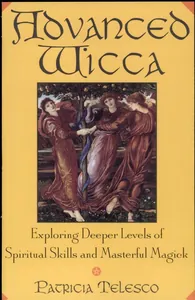
A Book of Pagan Prayer
 72
72

A Book of Pagan Prayer
Ceisiwr Serith's A Book of Pagan Prayer offers a welcome corrective to the often unstructured or absent devotional practices found in some contemporary Pagan circles. Serith’s meticulous research, spanning over a quarter-century, is evident in the grounded nature of the prayers presented. The strength of this work lies in its clear articulation of prayer as a skill, one that can be learned and refined through intention and historical awareness. A particularly striking passage involves the structured invocation of elemental forces, demonstrating a practical application of esoteric principles. However, the book occasionally leans towards a didactic tone that might feel somewhat prescriptive for those accustomed to more fluid, intuitive spiritual expression. Despite this, the overall value for serious practitioners seeking to connect with ancestral forms of devotion is considerable. It serves as a robust guide for reclaiming a vital spiritual technology.
📝 Description
72
Ceisiwr Serith's 2014 A Book of Pagan Prayer offers practical methods for contemporary Pagan prayer.
This book aims to reawaken the practice of prayer among modern Pagans. It draws from historical religious practices to provide adaptable templates and guidance for creating personal and group prayers. The author stresses the connection between ancestral traditions and current spiritual needs, moving beyond general spirituality to structured forms of worship.
It is written for Pagans who want to enrich their spiritual lives through prayer. The work is for those who feel disconnected from traditional prayer or who are interested in forms of prayer rooted in pre-Christian European beliefs. It suits both solitary practitioners and those in communal settings, offering versatile material. Both newcomers to structured prayer and experienced devotees will find useful content.
This work is situated within the modern Pagan revival, which gained momentum in the mid-20th century. It acknowledges earlier efforts by scholars and adherents to reconstruct pre-Christian European religions. Serith's research, spanning over two decades, contributes to a growing body of literature that seeks to revive and adapt ancient spiritual practices for contemporary contexts. It appears in a period where various Pagan paths, including Wicca and Heathenry, are actively developing their unique devotional expressions.
💡 Why Read This Book?
• Learn to formulate prayers that honor specific ancestral traditions, moving beyond generic invocations by understanding the historical context of pre-Christian European religious practices, as detailed in the book's foundational research. • Develop a more intentional and structured approach to devotional practice by engaging with the book's method of prayer construction, which emphasizes clarity and purpose in addressing the sacred. • Discover how to connect with the immanence of the divine through formalized prayer, utilizing concepts and techniques rooted in historical Paganism, thereby deepening your personal spiritual engagement.
⭐ Reader Reviews
Honest opinions from readers who have explored this book.
❓ Frequently Asked Questions
What historical periods does A Book of Pagan Prayer draw inspiration from?
The book draws inspiration from a broad spectrum of pre-Christian European religious practices, aiming to reconstruct and adapt ancestral prayer forms for modern use. It focuses on traditions that predate the widespread influence of Christianity in Europe.
Is this book suitable for beginners in Paganism?
Yes, the book is designed to be accessible to beginners seeking to establish a prayer practice rooted in historical Paganism. It provides foundational knowledge and practical examples.
Does the book focus on a specific Pagan tradition, like Heathenry or Celtic Paganism?
While drawing from various European ancestral traditions, the book aims for broader applicability rather than focusing exclusively on one specific path. It encourages adaptation to individual traditions.
What is the author's background related to this work?
Ceisiwr Serith is an author and researcher with over twenty-five years dedicated to studying and practicing Pagan traditions. This book is a product of that extensive research and lived experience.
How does this book differ from other books on Pagan spirituality?
This book specifically addresses the practice of prayer, a component sometimes less emphasized in other Pagan literature. It provides structured, historically informed methods for devotional expression.
Can the prayers in this book be used for personal devotion as well as group rituals?
Absolutely. The book offers guidance and examples that can be adapted for both solitary, personal prayer and for use in communal or group ritual settings.
🔮 Key Themes & Symbolism
Ancestral Devotion
The book champions the revitalization of prayer forms connected to pre-Christian European heritage. It posits that by engaging with the devotional practices of ancestors, modern Pagans can establish a more profound and grounded spiritual connection. This theme emphasizes lineage, historical continuity, and the idea that ancient ways of addressing the divine hold relevance and power for contemporary practitioners seeking authentic spiritual expression. The work provides practical tools for this reclamation.
Prayer as Practice
Moving beyond a passive or purely emotional understanding, 'Prayer as Practice' frames prayer as an active, learned skill. The book details methods for constructing prayers, focusing on intentionality, structure, and the precise articulation of intent and address. This approach views prayer as a technology for spiritual engagement, requiring discipline and thoughtful formulation, much like any other craft or art form. It encourages practitioners to see prayer as a dynamic part of their spiritual work.
Immanence and Connection
A core concept is the pervasive presence of the sacred or divine within the natural world and human existence. Prayer, in this context, becomes a means of consciously connecting with this immanent divinity. The book guides readers to find and address sacredness in various aspects of life and nature, fostering a sense of unity and participation in the cosmos. This theme encourages a holistic view of spirituality, where the divine is not distant but intimately interwoven with reality.
Modern Adaptation of Ancient Forms
This theme addresses the challenge of applying ancient spiritual technologies to contemporary life. The book does not advocate for a literal, uncritical replication of past practices but rather for their thoughtful adaptation. It explores how to translate the spirit and efficacy of ancestral prayers into forms that resonate with modern concerns, beliefs, and social contexts, ensuring the continued vitality of these traditions.
💬 Memorable Quotes
Direct passages from the work, attributed to the author.
“We owe a debt to all those who came before us.”
— This statement underscores the book's foundational principle: honoring the spiritual heritage of ancestors. It suggests that contemporary Pagan practice is enriched by acknowledging and integrating the wisdom and devotional forms of past generations.
“Pray in the ways of our ancestors for very modern times and concerns.”
— This highlights the book's central objective: bridging the gap between ancient devotional methods and contemporary life. It suggests that historical prayer practices are not relics but valuable tools applicable to current spiritual and personal challenges.
“Based on more than a quarter century of research and practice.”
— This emphasizes the author's extensive dedication to the subject matter. It implies a depth of knowledge and practical experience underpinning the book's guidance, lending credibility to its methods.
“Steeped in tradition.”
— This phrase indicates that the content is deeply rooted in established historical religious customs and beliefs. It signals an approach that values historical accuracy and continuity in spiritual practice.
“A Book of Pagan Prayer teaches us to pray.”
— This straightforward declaration defines the book's primary function: to instruct readers in the art and practice of prayer within a Pagan framework. It positions the work as a pedagogical resource.
🌙 Esoteric Significance
Tradition
This work fits within the broader Neo-Pagan and esoteric traditions that seek to reconstruct and revitalize pre-Christian European religious practices. It aligns with movements focused on Heathenry, Kemeticism, and Hellenic polytheism, which often emphasize direct engagement with ancestral deities and spirits. Unlike purely academic reconstructions, Serith's approach is explicitly practical, aiming to provide usable devotional tools. It departs from more syncretic or Wiccan-influenced Paganism by focusing on specific ancestral lineages and structured prayer forms.
Symbolism
Key symbols often invoked in ancestral Pagan traditions, and likely explored in the book, include elemental forces (Earth, Air, Fire, Water) representing the fundamental aspects of existence and divine manifestation. The concept of the 'ancestors' themselves functions as a powerful symbol of lineage, wisdom, and connection to the past. Additionally, motifs related to sacred groves, hearths, and natural cycles (solstices, equinoxes) serve as focal points for devotion, symbolizing the cyclical nature of life and the immanence of the divine in the natural world.
Modern Relevance
Contemporary thinkers and practitioners within reconstructionist Paganism, particularly Heathenry and Hellenic polytheism, find significant value in Serith's work. It addresses a growing demand for practical, historically grounded devotional techniques that move beyond generalized spiritual practices. Scholars and practitioners interested in comparative religion and the evolution of ritual will also find its approach relevant. The book's emphasis on structured prayer provides a counterpoint to more spontaneous or emotionally driven forms of worship, offering a stable framework for consistent spiritual engagement.
👥 Who Should Read This Book
• Practitioners of Heathenry or Hellenic Reconstructionism seeking to deepen their devotional practices with historically informed prayer methods. • Individuals new to Paganism who desire a structured, accessible introduction to prayer rooted in ancestral European traditions. • Comparative religion scholars or students of esoteric history interested in the practical application of ancient devotional forms in contemporary spirituality.
📜 Historical Context
Published in 2018, A Book of Pagan Prayer emerges within the dynamic range of the modern Pagan revival, a movement that gained significant momentum from the mid-20th century onwards. This revival saw a resurgence of interest in pre-Christian European religions, including various forms of Heathenry, Druidry, and Hellenic reconstructionism. The work draws upon a deep well of research, reportedly spanning over twenty-five years, aiming to provide practitioners with historically informed methods for prayer. It implicitly engages with a lineage of scholars and practitioners like George Coffey and Miriam Robbins Dexter, who have worked to reconstruct ancient religious practices. The book's emphasis on ancestral prayer can be seen as a response to earlier Pagan movements that sometimes focused more on generalized nature spirituality or syncretic forms. Its publication year places it in an era where digital communication and globalized spirituality coexist with a strong desire for localized, ancestral roots, offering a tangible practice amidst abstract trends.
📔 Journal Prompts
Formulating an invocation for the Hearth Ancestors based on familial lineage.
Crafting a prayer to the elemental spirits of a specific natural location.
Reflecting on the concept of divine immanence in daily routines.
Developing a supplication that acknowledges the debt to pre-Christian European traditions.
Structuring a plea for guidance that mirrors ancient forms of address.
🗂️ Glossary
Ancestral Prayer
Prayer forms and practices derived from or inspired by the religious traditions of one's historical ancestors, particularly pre-Christian European cultures. It emphasizes lineage and continuity.
Paganism
A broad term encompassing modern nature-based and polytheistic religions, often drawing inspiration from pre-Christian European spiritual traditions. It values reverence for the natural world and cyclical time.
Devotion
The act of expressing profound love, reverence, and commitment towards a deity, spirit, or sacred principle. In this context, it often involves prayer, ritual, and offerings.
Reconstructionism
A branch of modern Paganism focused on accurately reconstructing ancient, pre-Christian religions based on historical and archaeological evidence, aiming for authentic practice.
Immanence
The philosophical or theological concept that the divine is present within the physical world and human experience, rather than being solely transcendent or external.
Invocation
A formal or solemn request for divine aid or presence, often involving calling upon a deity or spirit to attend or assist in a ritual or prayer.
Supplication
A humble or earnest entreaty or petition made to a deity or higher power, typically asking for a favor or assistance.
This book appears in 1 collection
🔮 Readers Also Liked
Browse all →






From the “Neopaganism” Collection
View all →







More Free Witchcraft & Paganism Books
View all →