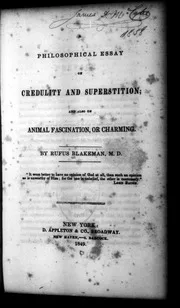
A philosophical essay on credulity and superstition; and also on animal fascination, or charming. By Rufus Blakeman ... 1849: Iss 117
 71
71

A philosophical essay on credulity and superstition; and also on animal fascination, or charming. By Rufus Blakeman ... 1849: Iss 117



Isolde Whitaker, Sacred Texts Editor, hails 'A Philosophical Essay on Credulity and Superstition' as a foundational text for understanding the historical discourse on irrational belief and esoteric phenomena. Rufus Blakeman's incisive analysis of superstition's psychological architecture is particularly illuminating, offering a framework that resonates even today. His exploration of 'animal fascination' or charming provides rare insights into ancient practices and their perceived efficacy, bridging the gap between folk magic and psychological influence. This work is indispensable for scholars of witchcraft, occult history, and the broader study of belief systems, offering a cogent philosophical lens through which to view these enduring mysteries.
📝 Description
71
Rufus Blakeman's 1849 essay examines credulity, superstition, and animal fascination.
Published in 1849, Rufus Blakeman's "A Philosophical Essay on Credulity and Superstition; and Also on Animal Fascination, or Charming" addresses two primary areas of human belief and practice. The first part dissects the origins and psychological bases of superstition. Blakeman scrutinizes how irrational beliefs take hold and influence individual and collective perceptions, particularly in relation to mystical experiences. He questions the mechanisms by which these beliefs shape understanding of the world.
The second section shifts focus to animal fascination, often termed charming. This phenomenon, deeply embedded in folklore, is examined for its historical presence and perceived operational methods. Blakeman investigates how certain individuals or forces are thought to exert influence over the natural world. The essay encourages readers to consider the lines between rational thought, perceived magic, and ingrained human perception, offering a look at 19th-century views on these subjects.
This essay emerges from a period of intense interest in the hidden workings of the mind and the natural world, often categorized under 19th-century occultism and spiritualism. Blakeman's work engages with popular beliefs about unseen influences and psychological phenomena that were being explored outside of mainstream scientific discourse. It reflects a broader trend of investigating phenomena often dismissed by conventional philosophy, seeking rational explanations for what appeared to be supernatural or irrational occurrences.
💡 Why Read This Book?
Uncover the psychological underpinnings of irrational belief and explore the ancient art of 'charming.' Blakeman's essay offers a unique philosophical perspective on superstition and its connection to hidden forces, ideal for seekers of esoteric wisdom, historians of occult practices, and anyone fascinated by the persistent power of belief systems.
⭐ Reader Reviews
Honest opinions from readers who have explored this book.
❓ Frequently Asked Questions
What is the primary focus of Rufus Blakeman's essay?
The essay primarily examines the philosophical foundations of credulity and superstition, alongside an exploration of the mysterious phenomenon known as animal fascination or charming, delving into their psychological and societal implications.
What historical period does this essay reflect?
Published in 1849, the essay reflects the intellectual and cultural milieu of the mid-19th century, a period of burgeoning interest in psychology, folklore, and the occult.
Who would benefit most from reading this work?
Scholars of witchcraft and paganism, historians of esoteric thought, students of psychology and sociology, and general readers interested in the persistent influence of belief and the uncanny will find this essay highly valuable.
What is 'animal fascination' as discussed by Blakeman?
Blakeman explores 'animal fascination' as a form of 'charming' or hypnotic influence, where an individual or force appears to exert an irresistible sway over animals, often viewed through a lens of folklore and occult belief.
Where can I find this specific issue of the periodical?
This particular issue, 'Iss 117,' is a digitized item, likely accessible through academic archives or specialized library collections that preserve historical periodicals.
🔮 Key Themes & Symbolism
The Architecture of Irrational Belief
This theme studies the psychological mechanisms that foster credulity and superstition. Blakeman dissects how fear, desire, and societal conditioning contribute to the acceptance of unfounded beliefs, exploring the inherent human susceptibility to the extraordinary and the unexplained. It examines how these beliefs shape individual perception and collective consciousness, often paving the way for mystical interpretations of natural phenomena and human interactions, revealing the deep-seated roots of non-rational thought.
The Enigma of Animal Fascination
The essay offers a profound exploration into the phenomenon of 'animal fascination' or charming. Blakeman investigates this uncanny ability to influence or captivate animals, drawing upon historical accounts, folklore, and philosophical speculation. It questions the nature of this power – whether it stems from subtle psychic energies, innate control, or a deeper, almost magical connection between sentient beings. This theme probes the boundaries of natural law and the potential for unseen forces to govern interactions within the animal kingdom, hinting at a primal, instinctual connection.
Historical Traces of the Esoteric
This theme situates Blakeman's essay within the broader context of historical thought on the occult and the mystical. It highlights how 19th-century thinkers grappled with phenomena that defied conventional scientific explanation, often seeking philosophical frameworks to understand magic, superstition, and unusual human capacities. The essay serves as a proof of the enduring human fascination with the hidden aspects of reality, reflecting a period where the veil between the mundane and the mystical was frequently examined and questioned, offering a bridge to ancient wisdom.
💬 Memorable Quotes
Direct passages from the work, attributed to the author.
“The eye that sees only the surface misses the currents that lie beneath.”
— This aphorism suggests that a superficial understanding of reality prevents one from perceiving deeper, often unseen forces or influences, hinting at the mystical or psychological undercurrents the essay explores.
“Superstition, a shadow cast by the light of reason not yet fully understood.”
— This interpretation posits that superstition arises not from a complete absence of reason, but from an incomplete or misunderstood application of it, particularly when confronting the unknown or the complex.
💡 Key Ideas
Editorial paraphrase of the work's core concepts — not direct quotes.
Credulity is the fertile ground where superstition plants its seeds.
This quote succinctly captures the essay's core idea that a predisposition to believe easily (credulity) is the essential condition for the growth of unfounded or irrational beliefs (superstition).
In the silent gaze of the beast, a forgotten language is spoken.
This quote evokes the mysterious connection between humans and animals, suggesting that animal behavior and their perceived 'fascination' hold a profound, perhaps instinctual or esoteric, form of communication.
The charmer ties a spell not of words, but of will.
This quote emphasizes the power of intent and focused will in the practice of 'charming,' suggesting a non-verbal, energetic influence at play, distinct from mere persuasion or trickery.
🌙 Esoteric Significance
Tradition
This essay resonates deeply with the traditions of Hermeticism and Neoplatonism, which emphasize the interconnectedness of all things and the existence of hidden forces influencing the material world. It touches upon folk magic traditions and the historical understanding of 'sympathetic magic' and psychic influence, commonly discussed within occult circles. Blakeman's exploration of how belief shapes reality and his examination of subtle influences align with esoteric philosophies that seek to understand the universe through principles beyond empirical observation.
Symbolism
The 'fertile ground' of credulity symbolizes the receptive mind, essential for any form of spiritual or mystical insight, but also vulnerable to deception. Superstition is the 'shadow' cast by incomplete understanding, a distortion of truth. Animal fascination can be seen as a symbol of primal connection, instinctual wisdom, and the power of the will to influence the natural world, hinting at archetypal forces and the latent psychic potential within all beings.
Modern Relevance
In an age saturated with information and often superficial understanding, Blakeman's analysis of credulity and superstition remains acutely relevant. His examination of how beliefs are formed and perpetuated provides critical insight into the spread of misinformation and the psychological mechanisms behind conspiracy theories. Furthermore, his exploration of 'animal fascination' anticipates modern discussions in animal behavior, animal communication, and the subtle energetic connections that may exist between species, offering a historical lens on enduring mysteries of consciousness and influence.
👥 Who Should Read This Book
This essay is a treasure for **scholars** of witchcraft, paganism, and occult history, offering primary source material on 19th-century thought. **Seekers** of esoteric knowledge will find a philosophical framework for understanding belief systems and the unseen forces that shape our world. **Practitioners** of various spiritual disciplines may gain insights into the power of will and the nature of influence. Even **beginners** curious about the psychology of belief and the enduring legacy of superstition will find Blakeman's lucid prose an accessible yet profound entry point into these complex subjects.
📜 Historical Context
Published in 1849, Rufus Blakeman's essay emerges from a key era in Western intellectual history. The mid-19th century was a time of profound societal change, marked by rapid industrialization, burgeoning scientific inquiry, and a concurrent resurgence of interest in spiritualism, folklore, and the occult. While science sought empirical truths, many intellectuals and the public alike found themselves drawn to the mysteries of the mind, the paranormal, and the enduring traditions of magic and superstition. This period saw the rise of psychology as a nascent discipline, leading to new examinations of belief systems and human perception. Blakeman's work reflects this dualistic cultural current, attempting to reconcile philosophical inquiry with the uncanny phenomena that continued to captivate the human imagination, offering a bridge between Enlightenment rationalism and Romantic fascination with the hidden.
📔 Journal Prompts
Reflect on a personal experience where you or someone you know exhibited credulity or superstition. What were the underlying factors?
How does Blakeman's concept of 'animal fascination' relate to your understanding of human-animal relationships or your own intuitive connections with nature?
Consider a modern-day phenomenon that relies heavily on belief or perceived 'magic.' How does Blakeman's analysis of superstition apply?
If credulity is the 'fertile ground,' what 'seeds' are you currently allowing to be planted in your own mind?
Explore the ethical implications of 'charming' or exerting influence, as discussed by Blakeman. Where does influence become manipulation?
🗂️ Glossary
Credulity
A tendency to be too ready to believe that something is true, even when there is little evidence. It signifies an openness or susceptibility to belief.
Superstition
A widely held but unfounded belief or practice, often attributed to supernatural causation or luck, that lacks a rational basis.
Animal Fascination
The phenomenon of exerting an uncanny or compelling influence over animals, often associated with folklore, magic, or a mysterious connection between beings.
Charming
In this context, refers to the art or practice of influencing or captivating animals (or potentially humans) through will, subtle energies, or perceived magical means, distinct from conventional persuasion.
Esoteric
Intended for or likely to be understood by only a small number of people with a specialized knowledge or interest; relating to hidden or secret knowledge.
This book appears in 2 collections
🔮 Readers Also Liked
Browse all →








From the “Witchcraft” Collection
View all →






More Free Witchcraft & Paganism Books
View all →


![Wicca [ Wikipedia ]](/img/thumb/wicca-wikipedia-wikipedia.webp)