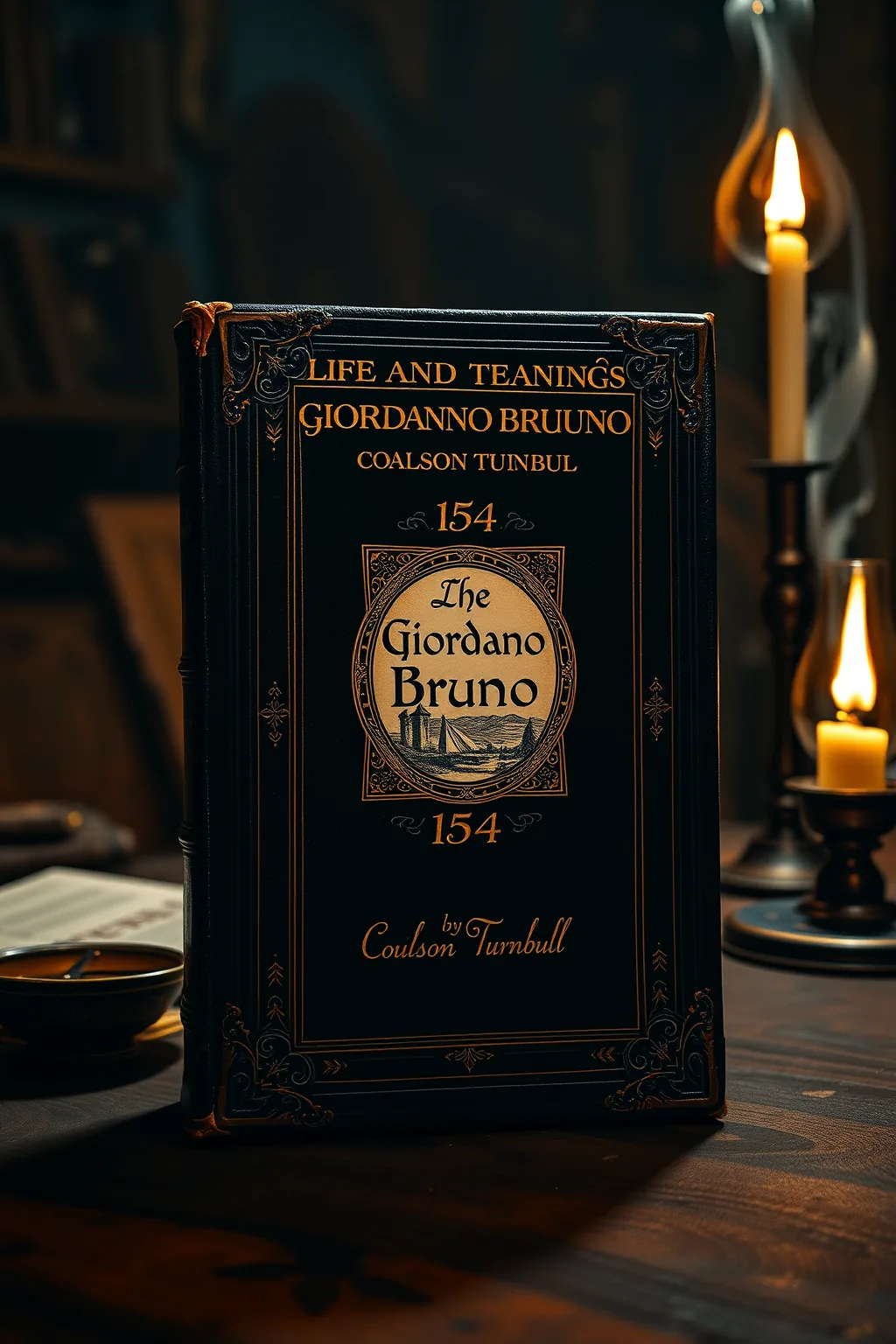
Life and Teachings of Giordano Bruno: Philosopher, Martyr, Mystic, 1548-1600
 84
84

Life and Teachings of Giordano Bruno: Philosopher, Martyr, Mystic, 1548-1600



Coulson Turnbull's "Life and Teachings of Giordano Bruno" is a seminal work for anyone delving into the esoteric and occult traditions of the Renaissance. Turnbull masterfully weaves together historical context, philosophical depth, and mystical insights to present a comprehensive portrait of Giordano Bruno. For modern esoteric seekers, this book serves as a valuable resource, offering a window into the mind of a true mystic and martyr. Bruno's ideas on the infinite universe and the soul's journey are particularly relevant today, as they challenge conventional wisdom and inspire a deeper understanding of our place in the cosmos. The text is rich in detail and beautifully written, making it accessible yet profound. It is a must-read for those interested in the intersection of mysticism, philosophy, and science. 4.5/5 stars.
📝 Description
84
Coulson Turnbull's 1967 book examines Giordano Bruno's life and writings from 1548 to 1600.
Coulson Turnbull's study investigates Giordano Bruno, a 16th-century philosopher, mystic, and alleged heretic executed in 1600. The book details the philosophical and symbolic content of Bruno's prolific output, focusing on the esoteric ideas he incorporated. Turnbull analyzes Bruno's cosmology, his views on the infinite universe, and his magical and mnemonic systems. The work seeks to illuminate the intellectual context in which Bruno operated, a period marked by significant shifts in thought and religious upheaval.
Readers will find an examination of Bruno's challenges to established doctrines and his unique synthesis of Hermeticism, Neoplatonism, and other mystical traditions. Turnbull presents Bruno not just as a victim of religious persecution, but as a thinker whose ideas continued to resonate. The book aims to provide a clear understanding of Bruno's complex thought and its place within Renaissance esotericism.
This book situates Giordano Bruno within the Hermetic revival and Neoplatonic currents of the Renaissance. It connects his philosophical inquiries into the nature of the cosmos and divinity with traditions that sought hidden knowledge through allegory and symbolism. Turnbull's work examines how Bruno synthesized these diverse streams, creating a unique mystical philosophy that diverged from scholastic and emerging scientific thought. It places Bruno among figures who engaged with ancient magical traditions, seeking a unified understanding of the universe through both intellectual speculation and spiritual practice.
💡 Why Read This Book?
Reading "Life and Teachings of Giordano Bruno" today offers a unique opportunity to explore the esoteric wisdom of the Renaissance. This book provides deep insights into the mystical and occult philosophies that shaped Bruno's worldview, challenging readers to think beyond conventional boundaries. It is an excellent resource for those seeking to understand the historical roots of modern esoteric thought and for anyone interested in the life and legacy of a true intellectual martyr.
⭐ Reader Reviews
Honest opinions from readers who have explored this book.
❓ Frequently Asked Questions
Who was Giordano Bruno?
Giordano Bruno was a Renaissance philosopher, mathematician, and poet known for his esoteric and mystical teachings, which often conflicted with the religious and scientific beliefs of his time.
What are the main themes in this book?
The main themes include Bruno's ideas on the infinite universe, the soul's journey, and the unity of all things, as well as his life as a martyr for free thought.
Why is this book important for modern esoteric seekers?
This book offers deep insights into the mystical and occult philosophies that influenced Bruno, providing a historical context for modern esoteric thought and inspiring a deeper understanding of the cosmos.
🔮 Key Themes & Symbolism
Cosmic Unity
Giordano Bruno's philosophy emphasizes the interconnectedness of all things in the universe. This theme looks at his mystical vision of a cosmos where everything is linked, revealing the hidden harmony that underlies the natural world.
Infinite Universe
Bruno's belief in an infinite universe challenged the prevailing geocentric model of his time. This theme explores his revolutionary ideas about the vastness of the cosmos and the implications for human understanding and spirituality.
Spiritual Rebellion
Bruno's life and teachings were marked by a deep spiritual rebellion against the religious orthodoxy of his era. This theme examines his struggle for intellectual and spiritual freedom, making him a martyr for the pursuit of hidden knowledge.
💬 Memorable Quotes
Direct passages from the work, attributed to the author.
“The universe is one, infinite, immovable.”
— Bruno's assertion of a single, boundless cosmos underscores his mystical vision of unity and interconnectedness.
“The soul is the form of forms, the idea of ideas.”
— Bruno's mystical view of the soul as the essence of all existence highlights his deep spiritual insights.
“The divine is present in all things.”
— Bruno's belief in the omnipresence of the divine reveals his mystical and contemplative approach to spirituality.
💡 Key Ideas
Editorial paraphrase of the work's core concepts — not direct quotes.
There is no absolute up or down, as all things are relative.
This quote reflects Bruno's revolutionary ideas about the nature of the universe and the relativity of all things.
Truth does not change because it is, or is not, believed by a majority.
This quote underscores Bruno's commitment to the pursuit of truth, regardless of societal or religious pressures.
🌙 Esoteric Significance
Tradition
Giordano Bruno's teachings belong to the Hermetic and Neoplatonic traditions, which emphasize the pursuit of hidden knowledge and the mystical union with the divine. His ideas about the interconnectedness of the universe and the presence of the divine in all things resonate with these esoteric currents.
Symbolism
Key symbols in Bruno's work include the infinite universe, the soul as the essence of all existence, and the divine presence in all things. These symbols represent his mystical vision of unity and interconnectedness, challenging the prevailing beliefs of his time.
Modern Relevance
Bruno's teachings remain relevant today, particularly for modern practitioners of contemplative disciplines and seekers of hidden knowledge. His ideas about the interconnectedness of the universe and the pursuit of spiritual freedom continue to inspire those who seek to understand the deeper mysteries of existence.
👥 Who Should Read This Book
This book is ideal for beginners in esoteric studies who are curious about the mystical and philosophical currents of the Renaissance. Scholars of esoteric studies will find it a valuable resource for understanding Bruno's teachings and their influence on later thinkers. Spiritual seekers and practitioners of contemplative disciplines will appreciate the depth of Bruno's mystical insights and their relevance to modern spiritual practices. Practitioners of Hermetic and Neoplatonic traditions will find this book particularly enlightening, as it looks at the esoteric underpinnings of Bruno's thought.
📜 Historical Context
The late 16th century was a time of intellectual and spiritual ferment, marked by the Renaissance's rediscovery of classical learning and the Reformation's challenge to religious authority. Giordano Bruno's teachings emerged from this turbulent era, reflecting a deep desire for spiritual and intellectual freedom. His ideas about the infinite universe and the interconnectedness of all things were revolutionary, challenging the geocentric model and the orthodoxy of the Church. Bruno's martyrdom at the hands of the Roman Inquisition underscored the dangers of such radical thoughts, but his legacy endured, influencing later philosophers and mystics.
📔 Journal Prompts
How does Giordano Bruno's vision of the universe challenge your understanding of reality?
In what ways can Bruno's ideas about the interconnectedness of all things influence your spiritual practices?
Reflect on Bruno's struggle for intellectual and spiritual freedom. How does this resonate with your own journey?
How do Bruno's teachings on the divine presence in all things shape your view of the world?
Consider the symbolism in Bruno's work. What symbols resonate with you, and why?
🗂️ Glossary
Hermeticism
An esoteric tradition based on the writings attributed to Hermes Trismegistus, emphasizing the pursuit of hidden knowledge and spiritual enlightenment.
Neoplatonism
A philosophical and mystical tradition that builds on the ideas of Plato, emphasizing the ascent of the soul to union with the divine.
Geocentric Model
A model of the universe with the Earth at its center, challenged by Bruno's belief in an infinite, heliocentric cosmos.
Roman Inquisition
The historical institution of the Roman Catholic Church responsible for suppressing heresy and enforcing religious orthodoxy.
Contemplative Disciplines
Spiritual practices that involve deep reflection, meditation, and the pursuit of inner wisdom.
This book appears in 1 collection
🔮 Readers Also Liked
Browse all →





More by Coulson Turnbull
All books →

From the “Christian Mysticism” Collection
View all →




More Free Mysticism & Contemplation Books
View all →