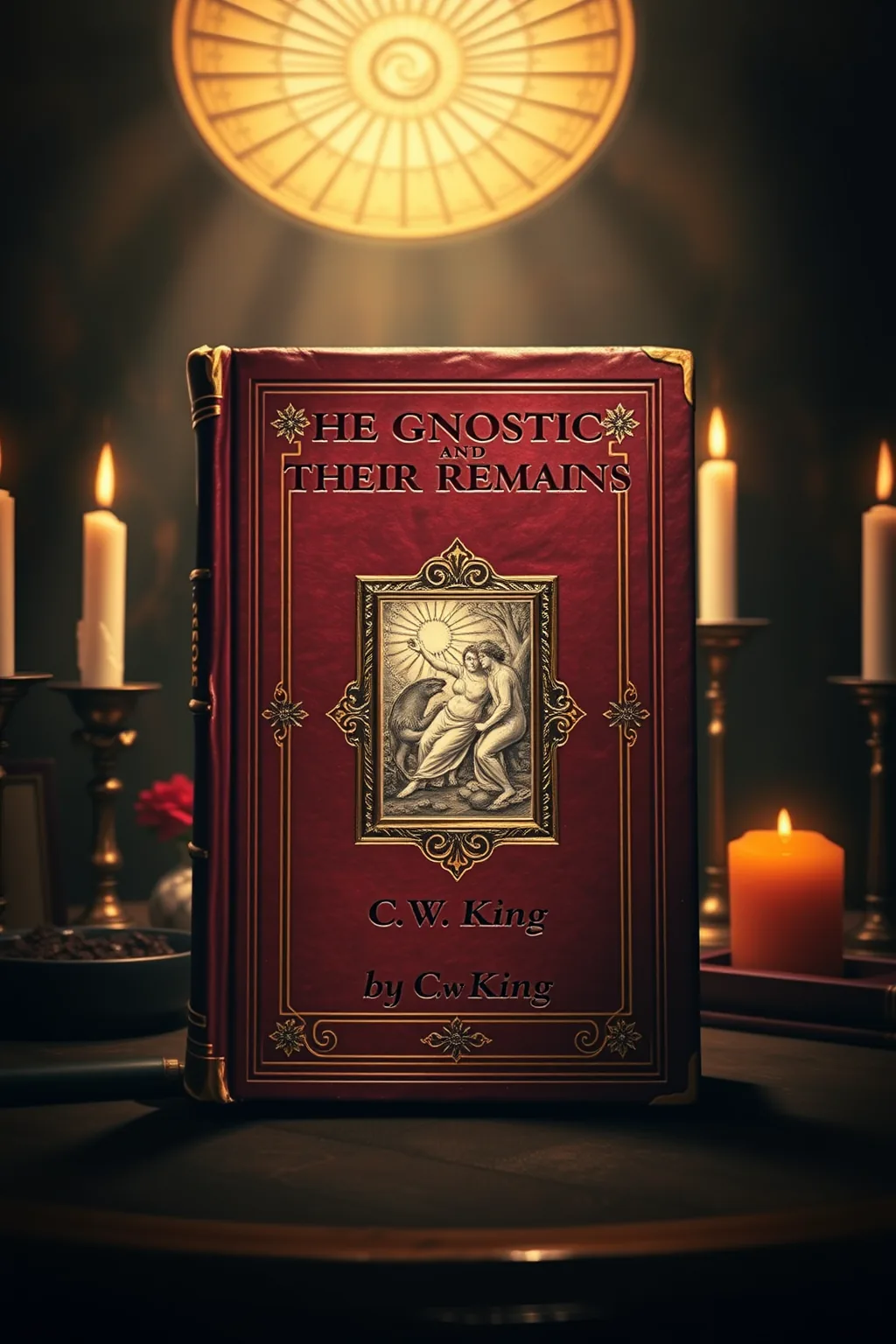
The Gnostics and Their Remains
 79
79

The Gnostics and Their Remains



Ophelia Vance (Mystical Literature Reviewer) — C. W. King's "The Gnostics and Their Remains" stands as a monumental testament to early Gnostic studies, offering an unparalleled glimpse into a complex and often misunderstood spiritual landscape. King's rigorous scholarship and evocative prose illuminate the intricate mythologies, profound philosophical inquiries, and potent symbolism that defined these ancient sects. This work is not merely historical; it is an invitation to engage with a tradition that prioritized direct, experiential knowledge of the divine. For scholars of comparative religion, students of esoteric traditions, and any soul yearning for a deeper understanding of the spiritual currents that shaped Western thought, this book is an essential and enriching read, unlocking profound insights into humanity's perennial quest for transcendence.
📝 Description
79
C. W. King's 1864 book examines Gnostic sects and their doctrines.
Published in 1864, "The Gnostics and Their Remains" by C. W. King investigates the early Christian Gnostic movements. King details their origins, their unique beliefs, their symbolic language, and their practices. He uses ancient texts and archaeological finds to show how Gnosticism blended with other philosophies and influenced early Christian theology. The book looks at Gnostic ideas about the divine and the human, and their pursuit of direct spiritual knowledge. It describes complex Gnostic cosmologies and their aim to escape the material world.
King’s work tries to reconstruct the beliefs and history of groups often marginalized or misunderstood by mainstream Christianity. He focuses on the intellectual and spiritual systems developed by these sects in the first few centuries CE. The book aims to clarify their positions on creation, salvation, and the nature of reality.
This book belongs to a tradition of scholarship that sought to understand heterodox spiritual movements outside established religious histories. C. W. King’s work situates Gnosticism within the broader context of early religious thought, connecting it to philosophical traditions and exploring its unique interpretations of Christian scripture and theology. It engages with the historical and textual evidence to reconstruct a spiritual current that emphasized immediate spiritual insight and challenged prevailing doctrines.
✍️ Author

C W King
This is a list of some notable authors in the Western fiction genre. Note that some writers listed below have also written in other genres. == A == Edward Abbey (1927–1989) Maria Dolores Acevedo (1932-1998) Andy Adams (1859–1934) William Lacey Amy (1877-…
💡 Why Read This Book?
Unearth the hidden spiritual currents that challenged early Christianity. "The Gnostics and Their Remains" offers a scholarly yet accessible journey into esoteric doctrines, rich symbolism, and the quest for divine knowledge. Ideal for seekers of ancient wisdom, students of mysticism, and anyone fascinated by the profound philosophical underpinnings of Gnosticism. Discover a tradition that valued inner awakening over dogma.
⭐ Reader Reviews
Honest opinions from readers who have explored this book.
❓ Frequently Asked Questions
What is Gnosticism?
Gnosticism was a diverse set of religious and philosophical movements in the early centuries CE characterized by a belief in salvation through knowledge (gnosis), often involving a dualistic worldview and a complex cosmology.
What are the 'remains' mentioned in the title?
The 'remains' refer to the surviving textual fragments, inscriptions, artifacts, and early Christian writings that allude to Gnostic beliefs and practices, which King meticulously analyzes.
What is the significance of C. W. King's work?
King's book was one of the first comprehensive academic attempts to systematically study and present Gnosticism, laying crucial groundwork for future scholarship and bringing these esoteric ideas to wider attention.
How does Gnosticism relate to Christianity?
Gnosticism emerged alongside early Christianity and often interacted with it, sometimes seen as a heresy by mainstream churches due to its differing interpretations of Christ, salvation, and the nature of God.
Is this book suitable for beginners?
While scholarly, King's work is remarkably engaging. It provides foundational knowledge for beginners interested in Gnosticism, though deeper engagement may benefit from supplementary readings.
🔮 Key Themes & Symbolism
The Quest for Gnosis
At the core of Gnosticism lies the concept of 'gnosis' – a profound, experiential knowledge of the divine that leads to spiritual liberation. This theme explores how Gnostic traditions sought to awaken individuals to their true, divine nature, often contrasting this inner awakening with the perceived illusions and limitations of the material world. It examines the methods and philosophies employed to achieve this transcendent understanding, highlighting the personal and immediate relationship with the divine that Gnostics championed.
Dualistic Cosmologies and the Demiurge
This theme examines the intricate and often complex cosmological frameworks developed by Gnostic sects. Central to many Gnostic systems is the idea of a flawed creator, the Demiurge, who fashioned the material universe, distinct from the true, supreme God. The exploration examines the implications of this dualism, the nature of the spiritual realms, and the perceived entrapment of divine sparks within material forms, setting the stage for the Gnostic path of escape and return to the Pleroma.
Syncretism and Esoteric Symbolism
King's work reveals the rich syncretic nature of Gnosticism, drawing influences from Jewish mysticism, Hellenistic philosophy, Persian dualism, and early Christian thought. This theme focuses on the profound and often multi-layered symbolism employed by the Gnostics, from their unique interpretations of biblical figures and narratives to their rich iconographic language found in amulets, gems, and art. Understanding these symbols is key to unlocking the deeper meanings embedded within Gnostic teachings.
💬 Memorable Quotes
Direct passages from the work, attributed to the author.
“Knowledge is the highest good, and the way to salvation.”
— This captures the Gnostic emphasis on gnosis as the primary means of spiritual liberation, prioritizing direct, inner knowing over external dogma or ritual.
“The world is a prison, and we are its divine captives.”
— This reflects the Gnostic view of the material existence as inherently flawed and a hindrance to the soul's true divine essence, highlighting the need for escape.
“The true God is hidden, not revealed.”
— This points to the Gnostic belief in a transcendent, unknowable supreme deity, distinct from the creator of the material world, emphasizing a journey of discovery.
“Symbols are the language of the soul.”
— This underscores the importance Gnostics placed on symbolic representation as a means to convey profound spiritual truths that often elude literal language.
“Light within, darkness without.”
— A concise expression of the Gnostic dualism, contrasting the divine spark within the human soul with the perceived corruption or ignorance of the external material realm.
🌙 Esoteric Significance
Tradition
This work is foundational to the study of Gnosticism, a complex spiritual tradition that predates and often runs parallel to orthodox Christianity. Gnosticism is characterized by its emphasis on achieving salvation through direct, personal knowledge (gnosis) of the divine, rather than through faith or adherence to dogma. It represents a significant stream within the broader spectrum of esoteric thought, focusing on inner transformation, the liberation of the divine spark within humanity, and the understanding of hidden cosmic realities.
Symbolism
Gnosticism is replete with rich and multi-layered symbolism, often drawn from a syncretic blend of Hellenistic, Jewish, and Eastern traditions. Key symbols include the Pleroma (divine fullness), the Aeons (emanations of the divine), the Demiurge (a flawed creator), the serpent (often a bringer of knowledge), and various cosmological diagrams. These symbols were not mere decorations but encoded expressions of profound metaphysical concepts, intended to guide the initiate towards understanding the soul's divine origin and its journey back to the spiritual realm.
Modern Relevance
The themes explored in "The Gnostics and Their Remains"—the quest for authentic knowledge, the critique of material illusions, the search for inner freedom, and the exploration of consciousness—remain profoundly relevant today. In an era often dominated by superficial distractions and societal pressures, Gnostic ideas offer a compelling framework for spiritual introspection and a call to awaken to one's inherent divinity. The book provides a historical lens through which to understand perennial spiritual struggles and the enduring human desire for transcendence.
👥 Who Should Read This Book
This important work is essential for scholars of ancient religions, comparative mythology, and early Christian history seeking a comprehensive overview of Gnostic thought. Mystics and practitioners of esoteric traditions will find deep resonance in its exploration of hidden knowledge, symbolism, and spiritual liberation. For the curious seeker, it offers an accessible yet profound introduction to one of the most influential and enigmatic spiritual movements of the ancient world, useful the path towards self-discovery and esoteric understanding.
📜 Historical Context
Published in 1864, C. W. King's "The Gnostics and Their Remains" emerged during a period of burgeoning interest in antiquity, comparative religion, and esoteric philosophies across Victorian England and Europe. The mid-19th century saw a surge in archaeological discoveries and textual translations that shed new light on marginalized spiritual traditions. King's work was a pioneering effort to synthesize existing knowledge of Gnosticism, a movement often dismissed or vilified by mainstream historical accounts. His meticulous research, drawing from patristic condemnations, apocryphal texts, and emerging archaeological evidence like Gnostic gems, provided a scholarly framework for understanding these complex early Christian heterodoxies and their profound philosophical underpinnings, influencing subsequent generations of occultists, theologians, and historians.
📔 Journal Prompts
Reflect on a time you felt a sense of 'hidden knowledge' or a profound inner knowing. How did it differ from conventional understanding?
Consider the concept of a 'flawed creator' or a 'prison' of the material world. What aspects of your own experience might align with this perspective?
Analyze a personal symbol or recurring image in your life. What deeper meaning might it hold for your spiritual journey?
In what ways do you feel 'trapped' by societal expectations or material concerns? What does liberation look like for you?
How can the pursuit of 'gnosis' or direct spiritual knowing be integrated into modern daily life?
🗂️ Glossary
Gnosis
Greek for 'knowledge,' referring to a direct, intuitive, and experiential understanding of divine truths, often seen as the key to spiritual salvation in Gnosticism.
Demiurge
In Gnosticism, the creator of the material universe, often depicted as an imperfect or ignorant being, distinct from the supreme, transcendent God.
Pleroma
The totality of divine powers and emanations in Gnostic cosmology, representing the perfect, spiritual realm from which all existence originates.
Aeon
Divine beings or emanations of God in Gnostic cosmology, often existing in pairs, who form the structure of the Pleroma.
Sophia
Greek for 'wisdom,' a prominent Aeon in many Gnostic systems, whose fall or error is often implicated in the creation of the material world.
This book appears in 1 collection
🔮 Readers Also Liked
Browse all →




From the “Christian Mysticism” Collection
View all →





More Free Mysticism & Contemplation Books
View all →