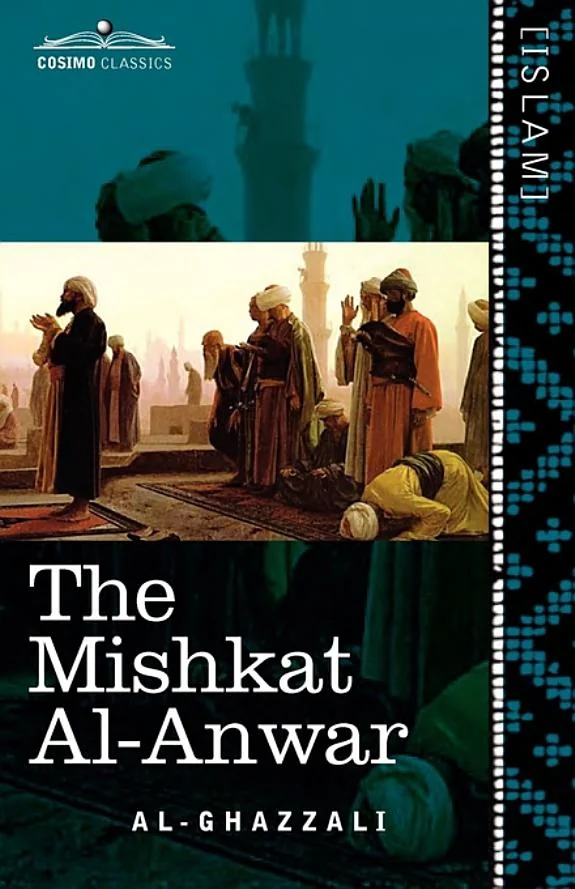
The Mishkat Al-Anwar
 84
84

The Mishkat Al-Anwar
Al-Ghazali's *Mishkat Al-Anwar* offers a dense, systematic exploration of divine illumination that goes beyond mere devotional poetry. Its strength lies in the rigorous, almost scholastic, approach to unpacking the Quranic Light Verse, presenting a complex metaphysical architecture for understanding God's relationship to creation. The categorization of "lights" and "veils" provides a structured framework for contemplating spiritual ascent. However, the sheer density of philosophical and theological argumentation can be an obstacle for those unfamiliar with Ash'ari theology or Neoplatonic concepts prevalent in Islamic thought. The section detailing the "veils of the intellect" requires considerable concentration. Despite this, the work remains a singular achievement in articulating a sophisticated Sufi cosmology, offering a profound meditation on the nature of reality and ultimate truth.
📝 Description
84
Al-Ghazali wrote The Mishkat Al-Anwar after his major work, Ihya' 'ulum al-din.
The Mishkat Al-Anwar, or "The Niche for Lights," is a theological and philosophical work by Abu Hamid al-Ghazali. He examines the Quranic Light Verse (Surah An-Nur, 24:35), discussing the symbolism of divine illumination and the barriers to spiritual sight. The book details how God is the ultimate Light, with the universe understood as a series of veils or emanations from this source. Al-Ghazali outlines these veils, progressing from the material world to subtle spiritual realities, and considers humanity's ability to perceive these different planes of existence. He also discusses prophecy, sainthood, and the dissolving of the self in the divine presence.
This text is for students of Islamic mysticism and theology, especially those interested in Sufi cosmology and Quranic interpretation. Readers wanting to grasp the classical Islamic view of the connection between the divine and creation will find significant content. It also serves scholars of comparative religion and the philosophy of religion.
Written in the later part of his career, Al-Ghazali's Mishkat Al-Anwar reflects a mature engagement with Sufi thought and philosophical inquiry. It is a notable contribution to the Neoplatonic currents within Islamic philosophy, particularly concerning divine light and emanations. This tradition also appears in the work of figures like Ibn Sina, though Al-Ghazali's approach here is distinctly theological and mystical, focusing on the nature of divine presence and perception.
💡 Why Read This Book?
• Understand Al-Ghazali's systematic interpretation of the Quranic Light Verse (24:35), revealing a structured cosmology of divine illumination and spiritual veils that differs from more poetic Sufi expressions. • Gain insight into the philosophical underpinnings of Sufism, specifically how Neoplatonic concepts were integrated into Islamic theology by a major figure, influencing later mystical thought. • Explore Al-Ghazali's detailed analysis of the "veils" separating humanity from divine reality, providing a framework for contemplating different levels of existence and perception, as outlined in the text's tripartite structure.
⭐ Reader Reviews
Honest opinions from readers who have explored this book.
❓ Frequently Asked Questions
When did Al-Ghazali write The Mishkat Al-Anwar?
The exact date is unknown, but *The Mishkat Al-Anwar* was composed after Al-Ghazali's seminal work, *Ihya' 'ulum al-din* (Revival of Religious Sciences), placing its composition in the later part of his prolific career.
What is the primary focus of The Mishkat Al-Anwar?
The book primarily focuses on an in-depth theological and philosophical interpretation of the Quranic Light Verse (Surah An-Nur, 24:35), exploring divine light and the concept of spiritual veils.
What are the main sections of The Mishkat Al-Anwar?
The work is divided into three principal sections. The first section begins the exposition of the Light Verse, followed by further elaborations on the nature of divine light and the veils that obscure it.
What philosophical tradition influenced Al-Ghazali in this work?
Al-Ghazali's thought in *The Mishkat Al-Anwar* shows significant influence from Neoplatonic philosophy, particularly in its conceptualization of divine emanations and hierarchical structures of reality.
Is The Mishkat Al-Anwar a purely theological text?
No, while deeply theological, it also functions as a philosophical treatise, employing rational argumentation and metaphysical concepts to explore spiritual truths within the Islamic tradition.
What does 'Mishkat Al-Anwar' literally translate to?
The Arabic title 'Mishkat Al-Anwar' translates literally to 'The Niche for Lights,' referring to a specific architectural feature that amplifies light, used here as a metaphor for the divine source of illumination.
🔮 Key Themes & Symbolism
Divine Light as Ultimate Reality
The core of *Mishkat Al-Anwar* is the concept of God as the absolute, uncreated Light, the source from which all existence emanates. Al-Ghazali meticulously deconstructs the Quranic metaphor of the Light Verse (24:35), presenting a sophisticated cosmology. He posits that this Divine Light is the ultimate reality, and all created things are, in essence, manifestations or reflections of this singular source, veiled in varying degrees.
The Nature of Spiritual Veils
Central to the text is the exploration of 'veils' (hijab) that obscure humanity's perception of the Divine Light. Al-Ghazali categorizes these veils, distinguishing between those of the material world, the imaginative realm, and the intellect. Understanding these veils is crucial for spiritual progress, as it involves recognizing the illusory nature of sensory reality and the limitations of ordinary cognition in grasping ultimate truth.
Levels of Illumination and Perception
The book outlines a hierarchy of spiritual understanding, moving from gross physical perception to the subtle apprehension of divine realities. Al-Ghazali details different 'lights' corresponding to these levels, emphasizing that true spiritual insight requires transcending ordinary consciousness. This involves a process of purification and intellectual ascent, allowing the seeker to perceive the Divine Light more directly.
Quranic Exegesis and Mystical Theology
Al-Ghazali employs rigorous exegesis (tafsir) not merely for legal or historical understanding, but to reveal the mystical and metaphysical dimensions of the Quran. *Mishkat Al-Anwar* exemplifies this approach, using a single verse to construct a comprehensive theological system. It bridges the gap between orthodox Islamic theology and practical Sufi experience, demonstrating how scripture itself contains profound esoteric teachings.
💬 Memorable Quotes
Direct passages from the work, attributed to the author.
“God is the Light of the heavens and the earth. His light is like a niche wherein is a lamp...”
— This foundational quote from the Quran (24:35) serves as the primary interpretive lens for the entire work. Al-Ghazali uses this metaphor of the lamp within a niche to explain the emanation of Divine Light and its presence within creation, while also hinting at the veils that can obscure it.
“The lights are of seven sorts, and they are the lights of the senses, the lights of the intellect...”
— Paralleling the concept of veils, this highlights Al-Ghazali's framework for understanding different degrees of spiritual awareness and divine manifestation. Each level of perception corresponds to a specific 'light,' useful the path from the mundane to the divine.
“The intellect is a mirror that reflects the lights.”
— This concise statement captures the Neoplatonic influence within Al-Ghazali's thought. The intellect, when purified, acts as a reflective surface, capable of receiving and displaying the Divine Light, though it is not the source of that light itself.
“The annihilation of the self is the beginning of illumination.”
— This captures a core Sufi tenet as presented by Al-Ghazali. True spiritual vision requires transcending the ego and its limited perspective, allowing the individual to become receptive to the divine presence and illumination.
💡 Key Ideas
Editorial paraphrase of the work's core concepts — not direct quotes.
The veils are of seven sorts, and they are the veils of the senses, the veils of the intellect...
This conceptual paraphrase highlights Al-Ghazali's systematic approach to spiritual obstacles. He categorizes the barriers to perceiving Divine Truth, moving beyond simple notions of sin to intellectual and perceptual limitations inherent in human consciousness.
🌙 Esoteric Significance
Tradition
This work is a core part of Islamic mysticism, specifically Sufism. It fits within the broader esoteric tradition of Islam by providing a highly intellectualized and philosophical framework for understanding core mystical concepts like divine union, annihilation (fana), and the nature of spiritual knowledge. While rooted in Islamic theology and Quranic exegesis, its Neoplatonic underpinnings connect it to a wider lineage of philosophical mysticism found across different cultures.
Symbolism
The central symbols are 'Light' (Nur) and 'Veils' (Hijab). 'Light' represents God as the ultimate, uncreated reality and the source of all existence and knowledge. The 'Veils' symbolize the various layers of material and psychic reality that obscure direct perception of the Divine Light, ranging from the physical senses to intellectual constructs. The 'Niche' (Mishkat) itself symbolizes a receptive spiritual heart or intellect capable of receiving and amplifying divine illumination.
Modern Relevance
Contemporary thinkers and practitioners in Islamic studies, comparative mysticism, and philosophy of religion continue to engage with Al-Ghazali's sophisticated metaphysical system. His work informs discussions on the relationship between faith and reason, the nature of consciousness, and the potential for spiritual perception. Modern Sufi orders and scholars still reference *Mishkat Al-Anwar* for its rigorous articulation of divine reality and the path of spiritual ascent.
👥 Who Should Read This Book
• Students of Islamic theology and Sufism seeking a systematic, philosophical exposition of divine illumination and Quranic symbolism. • Scholars of comparative religion and philosophy of religion interested in the Neoplatonic influences within classical Islamic thought and mysticism. • Mystically inclined individuals seeking a structured, intellectual framework for contemplating the nature of reality, divine presence, and the obstacles to spiritual perception.
📜 Historical Context
Abu Hamid al-Ghazali (1058-1111 CE) authored *Mishkat Al-Anwar* during the latter part of his influential career, a period marked by intense intellectual ferment and theological debate within the Islamic world. His work emerged from the rich philosophical milieu influenced by Greek thought, particularly Neoplatonism, which had been integrated into Islamic philosophy by figures like Ibn Sina (Avicenna). Al-Ghazali, initially a staunch defender of Ash'ari theology, increasingly engaged with Sufi mysticism, seeking to reconcile orthodox doctrine with inner spiritual experience. *Mishkat Al-Anwar* reflects this synthesis, offering a systematic, philosophical exploration of Sufi concepts. It implicitly engaged with philosophical traditions that might posit an independent intellect or separate divine principles, reaffirming the Quranic principle of God as the sole, ultimate Light and cause.
📔 Journal Prompts
The concept of the 'Niche for Lights' as a metaphor for the receptive soul.
The seven categories of 'Veils' described by Al-Ghazali and their modern parallels.
Reflect on the different 'lights' of perception Al-Ghazali outlines and your own experiences.
How does the idea of God as the sole 'Light' challenge conventional understandings of existence?
The role of the 'intellect' as a mirror in reflecting divine truths.
🗂️ Glossary
Mishkat
An Arabic term meaning 'niche' or 'small lampstand,' often referring to a recess in a wall where a lamp is placed, designed to amplify and direct its light. Used metaphorically in the title for the receptive capacity of the soul or cosmos.
Nur
The Arabic word for 'light.' In Islamic theology and Sufism, it signifies divine presence, revelation, knowledge, and ultimate reality. Al-Ghazali emphasizes God as the absolute Nur.
Hijab
An Arabic word meaning 'veil' or 'curtain.' In a spiritual context, it refers to anything that obscures or separates the seeker from direct perception of the Divine Truth or Light.
Quranic Light Verse
Refers to Surah An-Nur (Chapter 24), Verse 35 of the Quran, which begins with the famous description of God as the 'Light of the heavens and the earth.' This verse is central to Al-Ghazali's interpretive work.
Ihya' 'ulum al-din
Al-Ghazali's major work, translating to 'The Revival of the Religious Sciences.' It is a comprehensive encyclopedia of Islamic sciences, jurisprudence, theology, and Sufi ethics, preceding *Mishkat Al-Anwar*.
Neoplatonism
A school of philosophy founded by Plotinus in the 3rd century CE, based on Plato's ideas but incorporating mystical elements. It influenced Islamic philosophy through concepts like emanation from a single divine source (The One).
Tafsir
The Arabic term for exegesis, or commentary, on the Quran. Al-Ghazali's approach in *Mishkat Al-Anwar* is a form of mystical or esoteric tafsir.
This book appears in 1 collection
🔮 Readers Also Liked
Browse all →








From the “Sufism” Collection
View all →




More Free Esoteric History & Biography Books
View all →