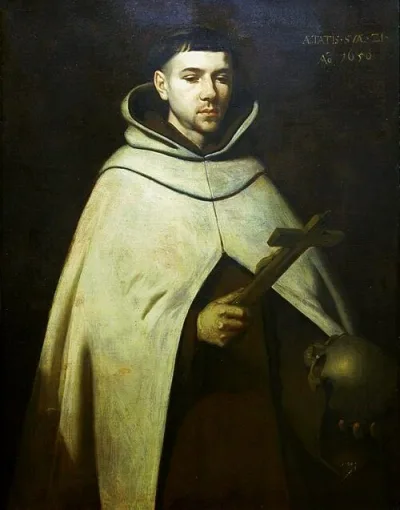
John of the Cross was a Spanish mystic, poet, and Carmelite friar instrumental in the Discalced Carmelite reform.
John of the Cross, born Juan de Yepes y Álvarez, was a Spanish Catholic priest, mystic, and Carmelite friar who lived from 1542 to 1591. He played a significant role in the Counter-Reformation in Spain and is recognized as one of the Church's Doctors. Influenced by Teresa of Ávila, he helped establish the Discalced Carmelites, aiming to return to the original, stricter Carmelite rule. His poetry and writings on the soul's spiritual development are considered masterpieces of Christian mystical literature and Spanish literature. His systematic approach to the spiritual life, detailing stages and challenges like the 'dark nights,' has profoundly impacted Catholic spirituality. He was canonized in 1726 and declared a Doctor of the Church in 1926, earning the title 'mystical doctor.'
His early life was marked by poverty, losing his father at a young age and moving with his mother and brothers to find work. He received a basic education and worked in a hospital before studying humanities and entering the Carmelite Order. Ordained a priest, he considered joining the Carthusians but met Teresa of Ávila, who inspired him to join her reform movement. He adopted the name John of the Cross and was central to founding the first Discalced Carmelite friary. He served as a spiritual director and confessor in Ávila, working alongside Teresa. His reform efforts led to significant tensions within the Carmelite Order, and he faced imprisonment and harsh treatment from opponents of the reform.
Mystical Theology and Spiritual Development
John of the Cross is renowned for his profound writings on the mystical path and the soul's journey toward union with God. He articulated a systematic framework for the spiritual life, often described as progressing through purgative, illuminative, and unitive ways. Central to his teachings are the concepts of the 'dark night of the senses' and the 'dark night of the soul,' periods of spiritual dryness and purification necessary for deeper divine encounter. These stages involve detachment from worldly comforts and self-love, leading to a more profound experience of God's presence. His poetic works, such as the 'Spiritual Canticle,' often composed during periods of hardship like his imprisonment, express the soul's intense longing for and union with the divine in lyrical and deeply symbolic language. His formulation of spiritual theology has been highly influential within the Catholic tradition and beyond.
Carmelite Reform and Discalced Order
John of the Cross was a key figure in the Carmelite reform movement initiated by Teresa of Ávila. This reform sought to return the Carmelite Order to the austerity and contemplative rigor of its original rule. John was instrumental in founding the Discalced Carmelites, a branch characterized by stricter observance, including simpler habits and the practice of going barefoot (discalced). He adopted the name John of the Cross upon establishing the first Discalced friary in Duruelo in 1568. His work involved establishing new communities, training friars, and serving as a spiritual director, notably for Teresa and the nuns at the Convent of the Incarnation in Ávila. The reform efforts, however, generated considerable opposition from traditionalist elements within the Carmelite Order, leading to significant tensions and conflict.
Imprisonment and Creative Output
The opposition to the Carmelite reform led to John of the Cross being arrested and imprisoned by friars who opposed his work. In December 1577, he was taken to the Carmelite monastery in Toledo and subjected to a harsh regime, including public lashings and confinement in a small cell. Despite these severe conditions, his imprisonment proved to be a period of intense spiritual creativity. It was during this time that he composed a significant portion of his most celebrated poem, the 'Spiritual Canticle,' a profound exploration of the soul's mystical union with God. This period highlights his resilience and his ability to find spiritual depth and artistic expression even amidst suffering and persecution.
Key Ideas
- Dark Night of the Senses
- Dark Night of the Soul
- Purgative Way
- Illuminative Way
- Unitive Way
Books by
8 free public domain books · Read online or download