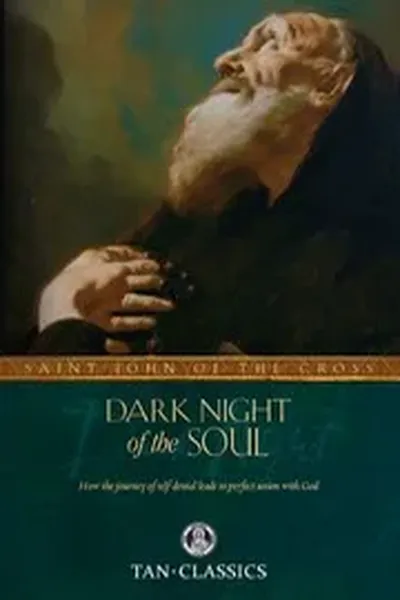
Dark Night of the Soul
 79
79

Dark Night of the Soul
Saint John of the Cross's 'Dark Night of the Soul' remains a stark and unflinching account of spiritual desolation. The author's prose, while dense, possesses a raw intensity that cuts through platitudes about faith. His detailed analysis of the 'night of the senses' as a necessary precursor to deeper union with the divine is particularly illuminating, presenting spiritual dryness not as a failure but as a stage of purification. However, the sheer theological density and the highly specific context of 16th-century Carmelite spirituality can present a formidable barrier for the modern reader. The extensive footnotes in this edition, while informative, further fragment the reading experience. Ultimately, it is a vital, albeit demanding, exploration of faith's crucible.
📝 Description
79
Saint John of the Cross wrote 'Dark Night of the Soul' in the late 16th century.
This theological treatise by Saint John of the Cross, a 16th-century Spanish Carmelite friar, comments on his own mystical poem. The book describes the soul's difficult path toward union with God. This path includes periods of spiritual emptiness and purification. It is written for those serious about spiritual practice, especially those familiar with Christian mysticism. The text addresses individuals questioning their faith during times of doubt or spiritual dryness. It frames these experiences as divine action rather than abandonment.
Written in the latter half of the 16th century, 'Dark Night of the Soul' appeared during the Counter-Reformation. This was a time of significant religious and intellectual activity within Catholicism. Saint John of the Cross, with Teresa of Ávila, led the Carmelite reform. His writings, sometimes created during imprisonment, add to a strong tradition of Spanish mystical literature. This tradition differed from more scholastic theological methods common then.
Saint John of the Cross's 'Dark Night of the Soul' belongs to the Christian mystical tradition, particularly Spanish mysticism of the 16th century. It follows a lineage of contemplative writers who sought direct experience of God beyond intellectual understanding or ritual. The text's focus on the 'dark night' as a necessary stage of spiritual growth aligns with concepts of purgation found in earlier mystics like Pseudo-Dionysius the Areopagite and later figures such as Madame Guyon. This approach emphasizes the transformative power of divine action within the individual soul.
💡 Why Read This Book?
• Gain a structured understanding of spiritual desolation, as detailed in Saint John of the Cross's analysis of the 'night of the senses,' offering a theological framework for periods of doubt. • Explore the 16th-century Carmelite reform movement by examining the historical context in which Saint John of the Cross wrote, understanding the spiritual landscape of the Counter-Reformation. • Grasp the metaphorical significance of the 'dark night' as a process of purification, moving beyond superficial spiritual comforts towards a more direct experience of the divine, as described in the treatise.
⭐ Reader Reviews
Honest opinions from readers who have explored this book.
❓ Frequently Asked Questions
What is the 'dark night' according to Saint John of the Cross?
The 'dark night' refers to a spiritual purification process where the soul detaches from worldly desires and spiritual consolations to achieve a more direct union with God. Saint John of the Cross describes two phases: the night of the senses and the night of the spirit.
When was Dark Night of the Soul written?
While the poem likely dates from the 1570s, Saint John of the Cross wrote the commentary, Dark Night of the Soul, between 1578 and 1579. It was first published posthumously.
Who was Saint John of the Cross?
Saint John of the Cross (1542-1591) was a Spanish mystic, Carmelite friar, and priest. He co-founded the Discalced Carmelites with Teresa of Ávila and is recognized as a Doctor of the Church for his profound spiritual writings.
What is the relationship between the poem and the treatise?
The treatise 'Dark Night of the Soul' is a theological commentary written by Saint John of the Cross to explain his own mystical poem of the same name. The poem expresses the experience, while the commentary elaborates on its spiritual meaning.
Is this book suitable for beginners in spirituality?
While foundational, the book is dense and requires commitment. Beginners might benefit from starting with introductory works on Christian mysticism or companion guides to Saint John of the Cross's writings before tackling this treatise directly.
What does the 'night of the spirit' entail?
The 'night of the spirit' is a more advanced stage of purification than the 'night of the senses.' It involves the intellect and will being stripped of their attachments and imperfections, leading to a profound, often painful, transformation and deeper union with God.
🔮 Key Themes & Symbolism
The Dark Night as Purification
The central theme is the 'dark night,' a metaphor for the soul's journey through spiritual dryness and desolation. Saint John of the Cross posits this is not abandonment by God but an active, divine process of purification. It involves stripping away sensory pleasures and spiritual consolations that, while helpful initially, can become hindrances to a more direct, unmediated encounter with the divine. This process prepares the soul for profound union.
Detachment and Spiritual Growth
This work emphasizes the necessity of detachment from all things, including spiritual consolations, to achieve true union with God. Saint John of the Cross argues that attachment, even to good things, creates an obstacle. The 'night of the senses' purges the soul of its reliance on tangible spiritual experiences, while the 'night of the spirit' refines the intellect and will, leading to a deeper, more stable form of spiritual life.
The Nature of Divine Union
The ultimate goal described is union with God. Saint John of the Cross portrays this not as a passive state but an active, transformative process. The dark nights, though painful, are the crucible in which this union is forged. The treatise explains how the soul, after being purified, can experience God more intimately and perfectly, moving beyond intellectual knowledge to a direct, loving apprehension.
Faith Amidst Dryness
The text directly addresses the experience of spiritual dryness, doubt, and a perceived absence of God. Saint John of the Cross validates these experiences, framing them as crucial stages in the spiritual journey rather than signs of spiritual failure. It offers solace and theological grounding for those undergoing such trials, encouraging perseverance through faith even when spiritual feelings are absent.
💬 Memorable Quotes
Direct passages from the work, attributed to the author.
“The soul that is drawing near to God... is wont to be purified by the dark night.”
— This statement captures the core thesis: spiritual advancement is often marked by periods of difficulty and obscurity. Saint John of the Cross frames these challenging phases not as divine punishment but as necessary steps in the soul's preparation for closeness with the divine.
“In this night, the soul is enkindled by love of God... and longs to go forth and seek him.”
— Here, the 'dark night' is depicted not as mere emptiness but as a fertile ground for divine love. The soul's 'longing' signifies an active desire for God, fueled by the very obscurity that challenges it, pointing towards an inner transformation.
“The spirit is darkened, and the soul is in suspense, and the will is set on God.”
— This describes the state of the soul during the 'night of the spirit.' The intellect is clouded, and the will feels suspended, yet this very state directs the purified will solely towards God, indicating a profound redirection of the soul's core.
“The more the soul desires to advance, the more it finds itself in darkness and aridity.”
— This highlights the paradoxical nature of spiritual progress as described by Saint John of the Cross. Increased desire for God and spiritual growth can paradoxically lead to feelings of emptiness and difficulty, as the soul is stripped of lesser comforts.
“For the purification of the senses... God begins to wean the soul from the sweetness of spiritual things.”
— This explains the initial phase of the dark night. God actively withdraws the soul's reliance on pleasant spiritual experiences, preparing it for a deeper, less mediated form of connection that transcends emotional highs.
🌙 Esoteric Significance
Tradition
While rooted in Christian mysticism, 'Dark Night of the Soul' has profound resonance within esoteric traditions. It speaks to the universal spiritual principle of the 'via negativa' or apophatic theology, a concept found in Neoplatonism, Kabbalah, and Sufism, which emphasizes understanding the divine through negation rather than affirmation. John of the Cross's work provides a Christian articulation of the soul's purgation necessary for direct Gnosis or unitive experience.
Symbolism
The central symbol is the 'dark night,' representing the void, the unknown, and the stripping away of the ego's attachments and illusions. Fire, specifically the 'living flame of love,' symbolizes the divine presence and the transformative power of God that purifies the soul. The journey itself symbolizes the arduous path of spiritual ascent, moving from the sensory world towards the unitive, spiritual realm.
Modern Relevance
Contemporary figures in transpersonal psychology and spiritual counseling often reference the 'dark night' to describe periods of existential crisis or profound spiritual awakening. Esoteric practitioners in various traditions, from Hermeticism to modern occultism, draw upon John of the Cross's description of purification and detachment as essential stages for achieving higher consciousness and direct spiritual insight, seeing it as a practical guide to inner transformation.
👥 Who Should Read This Book
["• Advanced practitioners of contemplative prayer seeking to understand and navigate periods of spiritual dryness and desolation, drawing on Saint John of the Cross's detailed analysis of the 'night of the senses.'", '• Students of Christian mysticism and comparative theology interested in the development of 16th-century Spanish spirituality and the Carmelite reform initiated by Saint John of the Cross and Teresa of Ávila.', "• Esoteric seekers exploring the concept of the 'via negativa' and the necessity of ego-death and purification in achieving direct spiritual experience, as articulated in the treatise's framework of spiritual nights."]
📜 Historical Context
The late 16th century was a period of intense religious upheaval and theological debate within Christianity, particularly following the Protestant Reformation and during the Catholic Counter-Reformation. Saint John of the Cross, a key figure in reforming the Carmelite Order alongside Teresa of Ávila, wrote 'Dark Night of the Soul' during a tumultuous period for the Church and for himself, including imprisonment by his opponents. His mystical theology, emphasizing direct experience of God and the soul's purification through suffering, stood in contrast to more scholastic or devotional approaches. This era saw figures like Ignatius of Loyola developing structured spiritual exercises, while others explored more immediate, ecstatic forms of prayer. John of the Cross's work, though deeply rooted in Catholic tradition, offered a distinct path, focusing on the arduous, often paradoxical, journey towards divine union.
📔 Journal Prompts
The soul's purification through the 'night of the senses' requires detachment from consolations. Reflect on what spiritual comforts you might be attached to.
How does Saint John of the Cross's description of the 'dark night' challenge conventional notions of spiritual progress?
Consider the paradox of increased spiritual desire leading to aridity. What might this imply about the nature of divine union?
The 'living flame of love' symbolizes divine presence. How might this flame be experienced even in periods of spiritual darkness?
Reflect on the concept of the 'dark night' as a divine action rather than abandonment. What does this reframing offer during difficult spiritual periods?
🗂️ Glossary
Dark Night
A spiritual metaphor used by Saint John of the Cross to describe a period of purification where the soul experiences dryness, desolation, and a perceived absence of God, leading to deeper union.
Night of the Senses
The initial phase of spiritual purification, where the soul detaches from sensory pleasures and spiritual consolations, making it more receptive to the divine.
Night of the Spirit
A more profound and difficult stage of purification, involving the intellect, memory, and will, leading to a deeper transformation and direct union with God.
Aridity
A state of spiritual dryness, characterized by a lack of spiritual feeling or consolation, often experienced during the dark nights.
Union with God
The ultimate goal of the spiritual journey, where the soul achieves a profound, transformative, and intimate connection with the divine.
Via Negativa
A path of spiritual understanding that emphasizes what God is not, rather than what God is, through negation and stripping away of concepts.
Mystical Poem
A poem by Saint John of the Cross, on which the treatise 'Dark Night of the Soul' is a commentary, expressing the soul's journey towards God.