Yoga
 78
78

Yoga
Alain Daniélou’s "Yoga" presents a much-needed corrective to the often-sanitized versions of yoga prevalent today. His grounding in Sanskrit scholarship is evident throughout, particularly in his nuanced discussion of the Vama Marg, or left-hand path traditions, which he elucidates with scholarly rigor rather than sensationalism. The strength of this book lies in its fidelity to original sources, offering a glimpse into yoga as a complex philosophical and spiritual system, not just a fitness regimen. However, the sheer density of information and the author's direct, unembellished prose can be challenging for the casual reader. A passage detailing the intricate cosmological framework underpinning yogic practices, for instance, requires sustained attention. Daniélou's work is an indispensable, albeit demanding, resource for anyone seeking the roots of yoga.
📝 Description
78
Alain Daniélou's 1991 book "Yoga" reconstructs the discipline from original Sanskrit texts.
Published in 1991, Alain Daniélou's "Yoga" presents a scholarly examination of the Indian discipline, drawing directly from Sanskrit sources. This approach offers a perspective distinct from modern, Westernized interpretations. The book systematically describes various yoga traditions, differentiating between orthodox practices and more unconventional paths, including those associated with "left-hand" traditions. Daniélou's aim is to convey an unadulterated understanding of yoga's philosophical foundations and practical methods.
This volume is suited for serious students of Eastern philosophy and esoteric traditions seeking knowledge grounded in original texts. It will interest those curious about yoga's historical evolution, its varied branches, and philosophical systems. The work also guides Western practitioners, suggesting ways to understand practices within their non-Indian cultural context while preserving the integrity of the original teachings. Daniélou's scholarship reflects his extensive life and work in India.
Daniélou's work on yoga emerged in the late 20th century, a time when Western interest in Eastern spirituality was growing but often led to simplified or commercialized understandings. By grounding his analysis in classical Sanskrit sources, Daniélou positioned his book as a counterpoint to these trends. He engaged with traditions like Tantra, which are often misunderstood or sensationalized, aiming for a more accurate representation of their philosophical and practical dimensions within the broader spectrum of Indian spiritual thought.
💡 Why Read This Book?
• Gain an authentic understanding of yoga's diverse paths, including the "left-hand" traditions, directly from Sanskrit sources as presented by Daniélou in his 1991 work. • Grasp the philosophical underpinnings of practices like *asana* and *pranayama* beyond their modern physical interpretations, as explored in the book's detailed explanations. • Discover which yogic methods are best suited for Western students, offering practical insights grounded in classical Indian traditions, a specific focus within Daniélou's research.
⭐ Reader Reviews
Honest opinions from readers who have explored this book.
❓ Frequently Asked Questions
What makes Alain Daniélou's "Yoga" different from modern yoga books?
Daniélou's "Yoga," first published in 1991, relies heavily on original Sanskrit texts, offering a scholarly perspective distinct from contemporary books that often focus on simplified physical or wellness aspects.
Does this book cover the physical postures of yoga?
Yes, the book discusses *asana* (posture) but within its broader philosophical and spiritual context, rather than as isolated exercises, referencing its role in classical Indian traditions.
What are the 'left-hand' paths mentioned in the blurb?
The 'left-hand' paths refer to certain Tantric traditions, often involving practices that diverge from orthodox norms, which Daniélou explains based on his study of original Sanskrit sources.
Is Alain Daniélou's "Yoga" suitable for beginners?
While accessible, the book's scholarly depth and focus on original sources make it best suited for serious students seeking an authentic, comprehensive understanding of yoga's origins and philosophies.
When was Alain Daniélou's "Yoga" originally published?
Alain Daniélou's "Yoga" was first published in August 1991, offering a scholarly perspective informed by decades of research into Indian traditions.
What Sanskrit sources does Daniélou base his "Yoga" on?
Daniélou's work is based on classical Sanskrit texts, providing an authentic account of yogic methods and philosophies, distinguishing it from later interpretations.
🔮 Key Themes & Symbolism
Authenticity and Sanskrit Sources
Daniélou’s "Yoga" prioritizes fidelity to classical Sanskrit scriptures, presenting a vision of yoga that is unadulterated by modern interpretations or Western adaptations. This commitment to primary sources allows the work to explore the philosophical depth and varied methodologies of yoga as it was understood and practiced within its original cultural milieu. The book aims to provide readers with a direct connection to the foundational texts, enabling a more profound comprehension of yoga's spiritual and cosmological dimensions, rather than its popular superficial applications.
Diversity of Yogic Paths
The book meticulously details the spectrum of yogic traditions, moving beyond a singular, monolithic understanding. It critically examines orthodox methods alongside more esoteric and often misunderstood practices, such as the Vama Marg (left-hand paths). Daniélou distinguishes these various approaches, explaining their unique philosophical bases and practical applications, thereby offering a comprehensive survey that respects the inherent diversity within the yogic landscape and its historical evolution.
Yoga for the Western Student
Recognizing the cultural and philosophical differences between East and West, Daniélou addresses how yogic practices can be understood and adapted by Western students. This section provides guidance on discerning which aspects of yoga are most relevant and applicable, while maintaining the integrity of the teachings. It offers a framework for integrating yogic principles into a Western context without compromising their original intent, serving as a bridge between ancient wisdom and modern seekers.
Philosophical and Cosmological Framework
Beyond mere technique, Daniélou studies the intricate philosophical and cosmological systems that underpin yoga. Concepts like the subtle body, energy centers, and the ultimate goal of liberation (*moksha*) are explained within their traditional Indian context. This approach highlights yoga not just as a personal practice but as a comprehensive worldview, offering readers a deeper appreciation of the spiritual architecture that informs its various disciplines and practices.
💬 Memorable Quotes
Direct passages from the work, attributed to the author.
“The methods of yoga are not limited to a single system.”
— This statement underscores Daniélou's emphasis on the vast diversity within yoga. It suggests that the discipline encompasses a wide array of techniques and philosophies, warning against a reductionist view that confines yoga to one specific, popular form.
“Authentic yoga requires understanding its roots in Sanskrit literature.”
— This core idea emphasizes Daniélou's scholarly approach. It posits that true comprehension of yoga's principles and practices is best achieved through direct engagement with its foundational texts written in Sanskrit.
“Practices must be adapted to the student's cultural context.”
— This highlights the book's practical application for Western readers. It suggests that while the essence of yoga remains constant, its methods of transmission and practice may need consideration for cultural relevance.
“Yoga aims at liberation from the cycle of existence.”
— This concise statement captures the ultimate spiritual goal of yoga as presented by Daniélou. It frames yoga not as a self-help technique but as a profound path towards spiritual freedom and transcendence.
💡 Key Ideas
Editorial paraphrase of the work's core concepts — not direct quotes.
The Vama Marg employs methods that transgress conventional social and religious norms.
Here, Daniélou addresses the often-misunderstood 'left-hand' paths of Tantra. This paraphrased concept highlights their transgressive nature, suggesting that their practices intentionally challenge societal boundaries in pursuit of spiritual realization.
🌙 Esoteric Significance
Tradition
Daniélou's work is deeply rooted in the broad spectrum of Indic traditions, particularly drawing from classical Yoga and Tantra as preserved in Sanskrit literature. While not strictly adhering to a single lineage like Hermeticism or Kabbalah, his scholarship engages with the universal esoteric principles of spiritual transformation, consciousness expansion, and liberation that are central to many esoteric traditions worldwide. He bridges the gap between orthodox philosophical systems and the more heterodox Tantric paths, providing a comprehensive view of yogic cosmology and practice.
Symbolism
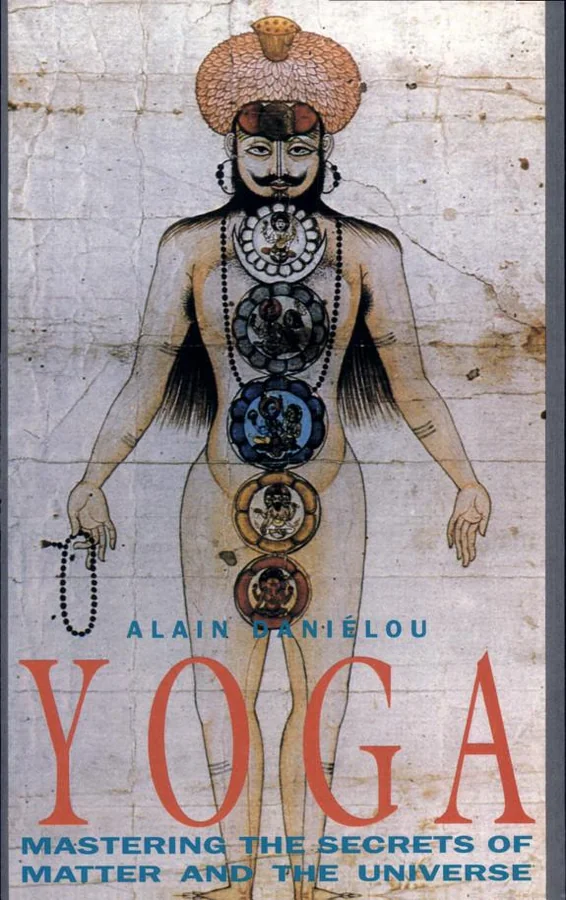
The book explores various symbols inherent in yogic traditions. A key motif is the concept of the subtle body, including *chakras* (energy centers) and *nadis* (energy channels), which represent a map of consciousness and vital force. Another significant symbol is the divine figures often invoked or contemplated in yogic practice, representing archetypal energies or ultimate reality. Daniélou explains these not as mere mythological characters but as symbolic representations of cosmic principles and states of awareness essential for spiritual progression.
Modern Relevance
Contemporary thinkers and practitioners interested in the historical and philosophical depth of yoga continue to draw from Daniélou's scholarship. His work is relevant to scholars of religion, comparative mysticism, and Indology. For modern yoga practitioners, Daniélou provides a crucial antidote to superficial Western interpretations, encouraging a return to the source texts and a deeper understanding of yoga's philosophical dimensions. His nuanced exploration of Tantric traditions also informs contemporary discussions on the more radical paths of spiritual development.
👥 Who Should Read This Book
• Serious students of Eastern philosophy and comparative religion seeking rigorous, source-based scholarship on yoga's origins and diverse practices. • Practitioners of yoga who wish to move beyond modern physical interpretations and understand the philosophical and spiritual depth of classical traditions. • Researchers and academics in Indology, religious studies, and esoteric traditions looking for an authoritative account grounded in Sanskrit literature.
📜 Historical Context
Alain Daniélou's "Yoga," published in 1991, entered a landscape significantly shaped by the post-war spiritual seeking and the academic study of Indian religions. The mid-20th century saw figures like Mircea Eliade popularizing Eastern thought in the West, sometimes through a lens that prioritized mystical experience over rigorous textual analysis. Daniélou, however, distinguished himself by his deep immersion in Indian culture and his command of Sanskrit, allowing him to critique prevailing interpretations. His work directly engaged with classical sources, offering a counterpoint to more generalized or esotericist accounts of yoga. While the Theosophical movement had earlier introduced concepts of Eastern spirituality to the West, Daniélou's approach was more philological and anthropological. The book's reception likely appealed to scholars and serious practitioners seeking a more authentic, source-based understanding, standing apart from the burgeoning New Age interpretations of the era.
📔 Journal Prompts
The distinction between orthodox yogic methods and the Vama Marg, as presented by Daniélou.
Reflection on the role of *asana* and *pranayama* as described in the classical Sanskrit sources discussed.
Consideration of the concept of *moksha* as the ultimate goal of yogic disciplines.
How the author's perspective on adapting yoga for Western students challenges common contemporary approaches.
The symbolic meaning of the subtle body (*chakras*, *nadis*) within the yogic cosmology explored.
🗂️ Glossary
Asana
A posture or physical position, particularly one in yoga. In classical yoga, *asana* is one of the eight limbs, intended to provide a stable and comfortable position for meditation, not merely physical exercise.
Pranayama
The regulation of breath through specific techniques. It is considered a vital practice in yoga for controlling vital energy (*prana*) and preparing the mind for deeper concentration and meditation.
Dhyana
Meditation or contemplation. It is the seventh limb of Ashtanga Yoga, a state of sustained, unwavering attention on a single object or concept, leading towards deeper absorption.
Vama Marg
Literally 'left-hand path.' Refers to certain Tantric traditions that often employ methods considered unconventional or transgressive by orthodox standards, aiming for spiritual liberation through direct engagement with all aspects of existence.
Moksha
Liberation or release. In Indian religions, it signifies freedom from the cycle of birth, death, and rebirth (*samsara*) and the attainment of ultimate spiritual realization or union with the divine.
Sanskrit
An ancient Indo-Aryan language in which many of the foundational scriptures of Hinduism, Buddhism, and Jainism are written. It is crucial for understanding the original context of yogic philosophy.
Chakras
Energy centers within the subtle body, often depicted as wheels or lotuses. They are considered focal points of spiritual energy and consciousness in Tantric and yogic traditions.
This book appears in 1 collection
🔮 Readers Also Liked
Browse all →








From the “Hatha Yoga” Collection
View all →







More Free Occult Philosophy Books
View all →


![[The English physician] Culpeper's English physician; and complete herbal. To which are now first added, upwards of one hundred additional herbs, with a display of their medicinal and occult properties, physically applied to the cure of all disorders incident to banking. To which are annexed, rules for compounding medicine. 1789](/img/thumb/the-english-physician-culpeper-s-english-physician-and-complete-herbal-to-which-are-now-first-added-upwards-of-one-hundred-additional-herbs-with-a-display-of-their-medicinal-and-occult-properties-phys.webp)