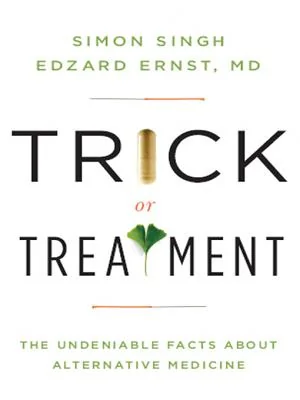
Trick Or Treatment: The Undeniable Facts about Alternative Medicine
 75
75

Trick Or Treatment: The Undeniable Facts about Alternative Medicine
Simon Singh and Edzard Ernst’s "Trick or Treatment" arrives not with a whisper but with a forensic audit of the alternative medicine landscape. The authors' approach is commendably direct, dissecting popular modalities like homeopathy and acupuncture with the same analytical rigor one might expect from a physics journal. Their strength lies in lucidly explaining complex scientific principles and statistical concepts, making the case against treatments that lack evidence accessible to a broad audience. A particular highlight is their systematic dismantling of homeopathy's core tenets, demonstrating how its principles violate fundamental laws of chemistry and physics. However, the book’s sheer scope means some treatments receive relatively brief attention, and readers seeking nuanced discussions on the *experience* of healing, beyond statistical outcomes, might find it somewhat dry. Despite this, "Trick or Treatment" remains a vital, clear-eyed assessment of what works, what doesn't, and why, offering essential clarity in a field often clouded by anecdote and marketing.
📝 Description
75
Simon Singh and Edzard Ernst applied scientific scrutiny to over thirty alternative therapies in 2008.
Published in 2008, "Trick or Treatment" by Simon Singh and Edzard Ernst examines popular complementary and alternative medicine (CAM) practices. The authors, a physicist and a researcher in complementary medicine, assess the evidence behind more than thirty different therapies. Their goal is to differentiate between treatments with demonstrable effects and those that rely on placebo. The book analyzes a variety of methods, including acupuncture, homeopathy, chiropractic, and herbal remedies, detailing the scientific consensus for each.
This book is for anyone curious about the effectiveness of alternative therapies. It provides factual responses to anecdotal claims for skeptics and offers an evidence-based evaluation for CAM proponents. Readers interested in medical history, the placebo effect, and scientific methodology will find it informative. It appeals to those who prioritize critical thinking and evidence in making health choices and are willing to question beliefs, whether conventional or alternative.
While this book critiques alternative medicine, it engages with a tradition that has historically existed alongside or outside of mainstream scientific and medical establishments. These practices often draw from ancient healing systems or personal philosophies that are not always subject to empirical validation. The book's focus on evidence and scientific method places it in dialogue with the broader philosophical and cultural discussions surrounding belief, efficacy, and the nature of healing that are central to many esoteric traditions. It questions claims that often form the bedrock of such alternative approaches.
💡 Why Read This Book?
• Gain a framework for critically evaluating health claims by understanding the scientific method and placebo effect, as detailed in the book's analysis of over thirty CAM practices. • Understand the specific scientific objections to therapies like homeopathy, as explained by the authors’ application of physics and chemistry principles. • Develop informed decision-making skills regarding your health by distinguishing evidence-based treatments from those lacking empirical support, a core objective of the 2008 publication.
⭐ Reader Reviews
Honest opinions from readers who have explored this book.
❓ Frequently Asked Questions
What is the primary aim of "Trick or Treatment"?
The book's primary aim is to critically assess the scientific evidence for over thirty popular alternative medicine therapies, distinguishing between those with proven benefits and those lacking empirical support, often explaining why they don't work.
Which specific alternative therapies are examined in the book?
The book examines a wide array, including acupuncture, homeopathy, aromatherapy, reflexology, chiropractic, herbal medicines, and many others, providing a comprehensive overview of the CAM landscape as of its 2008 publication.
What is Edzard Ernst's background relevant to this book?
Edzard Ernst is a physician and a pioneer in the field of complementary medicine research. He established the first academic department of complementary medicine, bringing a rigorous scientific perspective to the study of alternative therapies.
How does the book address the placebo effect?
The authors meticulously explain the placebo effect as a significant factor in perceived healing for many alternative therapies, differentiating its impact from genuine therapeutic action based on scientific evidence.
What is the authors' stance on the effectiveness of alternative medicine?
Singh and Ernst adopt a skeptical but evidence-based stance. They conclude that while some alternative therapies may offer relief through placebo or non-specific effects, many lack demonstrable efficacy beyond that, and some can even be harmful.
When was "Trick or Treatment" first published?
The book "Trick or Treatment: The Undeniable Facts about Alternative Medicine" was first published on August 17, 2008.
🔮 Key Themes & Symbolism
Scientific Skepticism in Medicine
The work champions a skeptical approach to health claims, particularly within the field of alternative medicine. It argues that efficacy must be demonstrated through rigorous, reproducible scientific methods, such as double-blind, placebo-controlled trials. The authors detail how many popular CAM practices, including homeopathy and iridology, fail to meet these basic scientific standards, often relying on anecdotal evidence or mechanisms that contradict established scientific principles. This theme underscores the importance of critical thinking when evaluating therapeutic interventions, urging readers to question efficacy beyond personal testimonials or traditional acceptance.
The Placebo Effect
A significant focus is placed on the powerful role of the placebo effect in perceived healing. Singh and Ernst explain how the context of treatment—the practitioner's attention, the ritual of therapy, and patient expectation—can lead to subjective improvements, irrespective of the treatment's specific biological action. They meticulously differentiate between genuine therapeutic effects, which must be specific to the intervention, and the subjective relief derived from the placebo response. This concept is crucial for understanding why some patients report benefits from therapies lacking scientific validation, such as certain forms of energy healing or aromatherapy.
Evidence-Based Practice
The book is a strong advocate for evidence-based practice in all areas of healthcare. It contrasts the robust testing required for conventional medicine with the often-lax standards applied to alternative therapies. The authors systematically review studies related to various CAM treatments, highlighting methodological flaws and the lack of consistent, positive results. This theme emphasizes that 'alternative' should not imply 'unproven' or 'untested,' and that patient safety and well-being depend on treatments supported by reliable data, a principle championed by researchers like Edzard Ernst since the late 20th century.
Misleading Health Industries
Singh and Ernst scrutinize the commercial aspects of alternative medicine, pointing out how a lack of regulation and stringent scientific oversight can allow dubious or ineffective treatments to flourish. They discuss how marketing and patient testimonials can create a perception of effectiveness that is not borne out by scientific data. This theme serves as a warning against health fads and the potential financial and physical exploitation of vulnerable individuals seeking cures or wellness. The book aims to empower consumers with the knowledge to discern legitimate medical advice from commercially driven health propositions.
💬 Memorable Quotes
Direct passages from the work, attributed to the author.
“The placebo effect is a genuine phenomenon, but it is not a treatment.”
— This statement captures the authors' core argument: while the subjective relief from the placebo effect is real and can be beneficial, it does not validate the underlying therapy itself as having specific medical efficacy.
“Homeopathy is a pseudoscience.”
— This is a direct assertion from the authors, reflecting their conclusion after applying scientific principles. They argue that homeopathy's claims, particularly regarding the memory of water, fundamentally contradict established chemistry and physics.
“The evidence for acupuncture's effectiveness is far from conclusive.”
— This represents a common conclusion reached by the authors for many therapies. While acknowledging some positive signals or historical use, they emphasize that rigorous scientific proof for specific conditions remains weak or absent.
“The burden of proof lies with those making the claims.”
— This principle, central to scientific inquiry, is applied by Singh and Ernst. They argue that proponents of alternative therapies must provide robust evidence of their efficacy, rather than relying on skepticism of conventional medicine as justification.
“Many alternative therapies are harmless, but many are not.”
— This highlights a critical danger. While some CAM might be inert, others can lead to direct harm through side effects, delayed diagnosis of serious illness, or direct toxicity from herbal remedies.
🌙 Esoteric Significance
Tradition
While not strictly an esoteric text in the Hermetic or Kabbalistic sense, "Trick or Treatment" engages with practices that often have esoteric roots or appeal to those seeking non-materialist explanations for health. It critically examines therapies like acupuncture, which have ancient philosophical underpinnings related to vital energy (Qi), and homeopathy, with its alchemical-like dilution processes. The book's significance lies in its scientific counterpoint to these traditions, acting as a modern, rationalist filter against beliefs that might otherwise be accepted on faith or historical precedent within certain spiritual or metaphysical circles.
Symbolism
The book's primary 'symbol' is the scientific method itself, presented as the ultimate arbiter of truth in medicine. Concepts like the 'placebo effect' function symbolically, representing the power of belief and ritual in healing, separate from material intervention. The very structure of the book, dissecting treatments like a biologist examines a specimen, employs a symbolic language of analysis and reduction. The 'undeniable facts' promised in the subtitle act as a secular scripture, offering a form of enlightenment through empirical data rather than mystical revelation.
Modern Relevance
In an era where misinformation, particularly online, continues to promote unverified health practices, "Trick or Treatment" remains highly relevant. Contemporary thinkers and practitioners focused on evidence-based wellness and critical health literacy frequently cite its arguments. Movements advocating for science communication and combating pseudoscience in healthcare echo its core message. The book provides a foundational understanding for reading through the complex range of modern health information, where scientifically dubious claims often masquerade as legitimate therapeutic options, influencing everything from personal health choices to public health policy.
👥 Who Should Read This Book
• Individuals exploring complementary and alternative medicine (CAM) who seek a balanced, evidence-based perspective before committing to treatments. • Healthcare professionals and students aiming to understand the scientific validity of various CAM modalities and how to discuss them with patients. • Skeptics and critical thinkers interested in the application of scientific methodology to popular health beliefs and practices, particularly those curious about the 2008 publication's findings.
📜 Historical Context
Published in 2008, "Trick or Treatment" emerged at a time when interest in complementary and alternative medicine (CAM) had reached new heights, fueled by dissatisfaction with conventional healthcare and a desire for more 'natural' approaches. This period, following the late 20th-century wellness boom, saw CAM become a multi-billion dollar industry. The book arrived amidst ongoing debates between proponents of evidence-based medicine and advocates of holistic or traditional healing systems. It directly challenged the burgeoning field, which often lacked the rigorous testing demanded by conventional medicine. Contemporaries like Ben Goldacre, whose work "Bad Science" also critiqued pseudoscientific claims, were part of a broader intellectual current questioning unsubstantiated health practices. The reception was significant, sparking discussions in scientific and public forums about the criteria for medical legitimacy and the crucial role of scientific validation.
📔 Journal Prompts
The scientific method's application to homeopathy, as detailed in the book.
Distinguishing the placebo effect from genuine therapeutic action.
The ethical implications of marketing unproven treatments.
Assessing the evidence for acupuncture's efficacy.
The concept of 'undeniable facts' in relation to personal health experiences.
🗂️ Glossary
Acupuncture
A traditional Chinese medicine technique involving the insertion of fine needles into specific points on the body to treat various conditions, often linked to balancing Qi (vital energy).
Homeopathy
A system of alternative medicine based on the principle of 'like cures like,' using highly diluted substances that are believed to stimulate the body's healing response.
Aromatherapy
The therapeutic use of aromatic plant extracts and essential oils, typically inhaled or applied topically, to promote physical and psychological well-being.
Reflexology
A complementary therapy involving the application of pressure to specific points on the feet, hands, and ears, believed to correspond to different organs and systems in the body.
Chiropractic
A form of alternative medicine focused on the diagnosis and treatment of mechanical disorders of the musculoskeletal system, especially the spine, through manual adjustment or manipulation.
Herbal Medicines
Therapeutic preparations derived from plants, used for medicinal purposes either in their raw form or as extracted compounds.
Placebo Effect
A beneficial effect produced by a placebo drug or treatment, which cannot be attributed to the properties of the placebo itself, and must therefore be due to the patient's belief in that treatment.
This book appears in 2 collections
🔮 Readers Also Liked
Browse all →







From the “Acupuncture” Collection
View all →





More Free Occult Philosophy Books
View all →