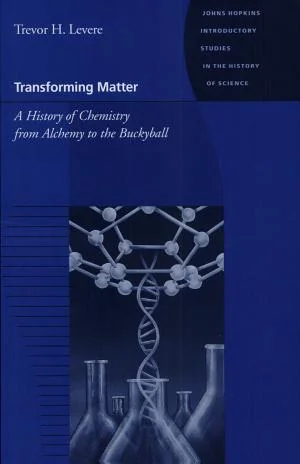
Transforming Matter
 74
74

Transforming Matter
Levere's "Transforming Matter" offers a commendably straightforward account of chemistry's historical trajectory. Its primary strength lies in its lucid prose, making complex scientific developments comprehensible to a non-specialist audience. The narrative effectively highlights key figures and their contributions, such as Antoine Lavoisier's systematic investigations that redefined elemental theory. However, the book occasionally feels a bit too encyclopedic, sometimes lacking the deeper analytical critique one might expect from an "occult philosophy critic." For instance, the transition from alchemical symbolism to empirical science is presented more as a linear progression than a complex intellectual negotiation. A specific passage detailing the phlogiston theory's eventual demise offers a clear example of Levere's skill in summarizing scientific debate. Despite this minor limitation, the work provides a solid, accessible foundation for understanding the historical construction of chemical knowledge.
📝 Description
74
Trevor H. Levere's Transforming Matter traces chemistry's evolution from alchemy to modern science.
This book chronicles the historical development of chemistry, beginning with ancient alchemical practices and moving toward its contemporary scientific structure. It details significant discoveries, changes in scientific thought, and the key figures who advanced the field. Levere illustrates the transition chemists made from relying on empirical observation and mystical interpretations to embracing rigorous experimentation and mathematical models.
The work is suitable for students new to the history of science, especially chemistry, and for general readers interested in how our perception of the material world has changed. Those fascinated by the philosophical foundations of scientific fields or the shift from alchemy to chemistry will find it particularly engaging. The narrative spans millennia, starting with early alchemists in Hellenistic Egypt around the 3rd century CE, who sought both metal transmutation and a symbolic understanding of substances. It follows the move away from these esoteric traditions, particularly during the Scientific Revolution, with figures like Robert Boyle in the 17th century championing a mechanical and experimental approach that informed modern chemical theory.
Transforming Matter situates the historical development of chemistry within its ancient roots in alchemy. Early alchemists, active from around the 3rd century CE in places like Hellenistic Egypt, pursued the transmutation of metals and a symbolic comprehension of matter. This tradition, deeply intertwined with philosophy and early empirical methods, represented a significant, albeit esoteric, engagement with the material world. The book maps the intellectual and practical shifts that moved the study of matter away from these mystical and symbolic frameworks toward the more mechanistic and quantitatively focused methods of modern chemistry, particularly during the Scientific Revolution.
💡 Why Read This Book?
• Gain a clear understanding of the scientific revolution's impact on chemistry, specifically how figures like Robert Boyle in the 17th century shifted focus towards empirical methods, a detail explored within the book. • Trace the evolution of elemental theory from ancient concepts to Antoine Lavoisier's groundbreaking work in the late 18th century, a pivotal shift detailed in the text. • Appreciate the conceptual leap from alchemical transmutation to modern atomic theory, understanding the intellectual journey as presented through the book's historical narrative.
⭐ Reader Reviews
Honest opinions from readers who have explored this book.
❓ Frequently Asked Questions
What is the primary focus of Trevor H. Levere's 'Transforming Matter'?
The book offers a clear and accessible historical overview of chemistry, detailing its development from early alchemical practices to its establishment as a modern scientific discipline.
Who would benefit most from reading 'Transforming Matter'?
Students new to the history of science, general readers interested in the evolution of our understanding of matter, and those exploring the philosophical shifts in scientific thought will find it valuable.
Does the book cover the transition from alchemy to chemistry?
Yes, it charts the gradual shift from the symbolic and empirical methods of alchemists, prevalent for centuries, to the more rigorous, experimental approach that defined modern chemistry.
What historical period is significantly discussed?
The book covers a vast span, but places particular emphasis on periods like the Scientific Revolution in the 17th century and the late 18th century with figures like Lavoisier.
Are key scientific figures mentioned?
Certainly. It highlights influential figures such as Robert Boyle, who championed experimental methods, and Antoine Lavoisier, central to the chemical revolution.
What core scientific concepts are explored?
It examines the evolution of concepts like elemental theory, from ancient ideas to modern atomic theory, and the changing understanding of how matter can be transformed.
🔮 Key Themes & Symbolism
Alchemy to Chemistry
This theme examines the profound transition from alchemical traditions, often intertwined with mystical philosophy and symbolic interpretation of matter, to the empirical and quantitative methods that define modern chemistry. Levere illustrates how early practitioners, influenced by Hellenistic traditions around the 3rd century CE, sought not just material transformation but also spiritual understanding. The work traces the gradual emergence of a scientific worldview, spurred by figures like Robert Boyle in the 17th century, who advocated for systematic experimentation, thereby laying the groundwork for chemistry's eventual establishment as a distinct scientific discipline.
Evolution of Elemental Theory
A central thread in Transforming Matter is the historical development of what constitutes an 'element'. The book contrasts ancient Greek notions of fundamental substances with the more complex, symbolic understanding prevalent in alchemy. It meticulously details the rethinking initiated by Antoine Lavoisier in the late 18th century, who provided a more rigorous definition of elements, moving away from concepts like phlogiston. This evolution continues through to the 19th century with the rise of atomic theory, charting humanity's progressively refined understanding of matter's basic constituents.
The Nature of Transformation
Levere's work inherently explores the concept of transformation, both material and intellectual. It discusses the alchemical quest for transmutation – the changing of base metals into gold – as a literal and symbolic pursuit. This is contrasted with the scientific understanding of chemical reactions and the transformation of substances through controlled processes. The book highlights how the very idea of what it means for matter to 'transform' has been a subject of intense debate and discovery across different historical epochs and philosophical frameworks.
Methodology in Science
The shift in scientific methodology is a critical undercurrent in Transforming Matter. It contrasts the often secretive and philosophical approach of alchemists with the increasingly public, repeatable, and mathematically described experiments of later chemists. The book showcases how figures like Robert Boyle championed an empirical approach, emphasizing observation and verifiable results. This evolution in methodology is presented as fundamental to chemistry's progress, enabling the systematic accumulation of knowledge and the development of predictive theories about the material world.
💬 Memorable Quotes
Direct passages from the work, attributed to the author.
“The work explores how early alchemists pursued not just material transmutation but also a deeper understanding of nature's secrets.”
— This highlights the dual nature of alchemical pursuits, encompassing both practical experimentation and a philosophical or spiritual quest for hidden knowledge, a perspective often overlooked in purely scientific histories.
“Lavoisier's systematic approach in the late 18th century marked a definitive break from earlier speculative theories of matter.”
— This points to a crucial turning point where rigorous measurement and theory replaced more intuitive or symbolic explanations, solidifying chemistry's empirical foundation.
“The transition from phlogiston theory to oxygen's role reflects a significant re-evaluation of combustion.”
— This specific example illustrates how scientific understanding is dynamic, with established theories being overturned by new evidence and more coherent explanatory frameworks.
“Robert Boyle advocated for a mechanical philosophy applied to chemical investigations.”
— This emphasizes Boyle's role in shifting the focus towards understanding matter in terms of particles and their interactions, a precursor to modern atomic and molecular theories.
“Early chemistry was deeply intertwined with philosophical inquiry into the fundamental nature of existence.”
— This suggests that the separation of science from philosophy is a relatively modern development, and that early scientific endeavors were often holistic, seeking to understand the world through multiple lenses.
🌙 Esoteric Significance
Tradition
While primarily a history of science, 'Transforming Matter' touches upon the Hermetic and alchemical traditions that formed the pre-scientific substrate of chemistry. These traditions, rooted in ancient Greek philosophy and Gnostic ideas, sought not merely material transformation but also spiritual enlightenment. Levere’s work implicitly acknowledges this lineage by tracing the concepts and practices that gradually shed their overtly mystical aspects to become empirical science, thereby charting a path away from, yet historically connected to, esoteric philosophies.
Symbolism
The book implicitly discusses symbols through its exploration of alchemy. Concepts like the Philosopher's Stone, often depicted as a red powder or elixir, represented the ultimate goal of transmutation and perfection. The symbolism of elements, such as the classical four (earth, air, fire, water) and their alchemical interpretations, are foundational to understanding the early conceptualization of matter that Levere charts the evolution away from. These symbols represented not just substances but fundamental principles of existence.
Modern Relevance
Contemporary esoteric practitioners, particularly those in Hermeticism and modern alchemy circles, often look to the historical roots discussed in 'Transforming Matter'. Understanding the symbolic language and philosophical underpinnings of historical alchemy provides context for modern interpretations of these ancient arts. Furthermore, the book’s focus on the transformation of matter appeals to contemporary interests in consciousness studies and the interplay between mind and material reality, albeit from a historical scientific perspective.
👥 Who Should Read This Book
• Students of the history of science seeking a clear overview of chemistry's development, especially the crucial transition from its alchemical past. • Readers interested in the philosophical evolution of scientific thought, understanding how concepts of matter and transformation have changed over centuries. • Individuals exploring the roots of modern scientific disciplines and how early, sometimes mystical, inquiries laid the groundwork for empirical investigation.
📜 Historical Context
Trevor H. Levere's "Transforming Matter" emerges from a rich historiography of science, particularly the study of chemistry's origins. The book's publication in 2001 places it within a period of renewed scholarly interest in the Scientific Revolution and the Enlightenment's impact on scientific disciplines. It engages with the intellectual currents that saw figures like Robert Boyle in the 17th century challenging Aristotelian and alchemical dogma with a more mechanistic and empirical worldview. Levere's work implicitly dialogues with scholars who have explored the philosophical underpinnings of early chemistry, such as Allen Debus, who extensively documented the alchemical tradition. The reception of such historical narratives often involves debates about the continuity versus discontinuity between alchemy and modern chemistry, with Levere largely framing it as a developmental progression rather than a complete rupture, a perspective that has been a subject of ongoing discussion among historians.
📔 Journal Prompts
The alchemical pursuit of the Philosopher's Stone and its symbolic meaning.
Robert Boyle's advocacy for a mechanical philosophy in chemistry.
The intellectual shift from phlogiston theory to oxygen's role.
Lavoisier's redefinition of elements in the late 18th century.
Ancient Greek elemental theories versus later chemical understanding.
🗂️ Glossary
Alchemy
An ancient tradition combining elements of chemistry, metallurgy, physics, medicine, astrology, semiotics, mysticism, and art. Historically focused on transmutation of base metals into gold and the discovery of a universal elixir.
Transmutation
In alchemy, the purported process of transforming base metals, such as lead or copper, into noble metals like gold or silver. It also carried spiritual and philosophical connotations of purification and perfection.
Phlogiston Theory
An early scientific theory proposing that a fire-like element called 'phlogiston' was released from combustible materials during burning. It was a dominant theory until challenged by Antoine Lavoisier in the late 18th century.
Element (Classical/Alchemical)
In pre-modern chemistry, elements often referred to fundamental substances like earth, air, fire, and water, or specific perceived building blocks of matter, distinct from the modern definition of chemical elements.
Mechanical Philosophy
A worldview that emerged during the Scientific Revolution, viewing the universe and its components as analogous to a complex machine, operating according to mechanical laws. Championed by figures like Robert Boyle.
Hellenistic Egypt
The region of Egypt under Greek rule from the death of Alexander the Great (323 BCE) until its conquest by Rome (30 BCE). This period was a significant center for alchemical development.
Atomic Theory
The scientific theory that matter consists of discrete units called atoms. Developed significantly by John Dalton in the early 19th century, it fundamentally changed the understanding of chemical composition.
This book appears in 1 collection
🔮 Readers Also Liked
Browse all →







From the “Alchemy” Collection
View all →








More Free Occult Philosophy Books
View all →