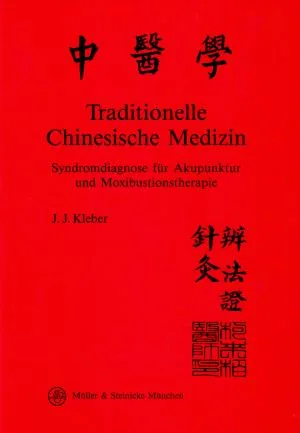
Traditionelle chinesische Medizin
 83
83

Traditionelle chinesische Medizin
Johann Josef Kleber’s Traditionelle chinesische Medizin presents a thorough grounding in the theoretical architecture of TCM. The strength of this work lies in its systematic presentation of abstract concepts like Qi and the Five Elements, which Kleber elucidates with commendable clarity for a 1989 publication. He avoids the common pitfall of oversimplification, instead offering a detailed account of how these elements interact to maintain health or manifest illness.
A notable passage detailing the cyclical generation and control phases of the Five Elements provides a concrete example of the book's analytical depth. However, the text’s primary limitation is its academic dryness; it is a scholarly treatise rather than an accessible introduction, demanding significant reader engagement. The original blurb’s absence is felt, as a clearer indication of the intended audience might have been beneficial.
Read more ↓
Ultimately, Kleber’s work is a valuable resource for those committed to understanding TCM’s philosophical roots.
📝 Description
83
Johann Josef Kleber's 1989 book systematically explains Traditional Chinese Medicine's core principles.
Published in 1989, Johann Josef Kleber's Traditionelle chinesische Medizin offers a systematic explanation of the principles that form the basis of Traditional Chinese Medicine (TCM). This is not a simple overview; it is a detailed examination of the theoretical structure that has informed Chinese medical practices for centuries.
The book is valuable for students and practitioners of alternative medicine, especially those interested in the energetic and philosophical foundations of healing. It also serves historians of medicine and philosophy who wish to understand how diagnostic and therapeutic systems developed outside the Western biomedical model.
Kleber's 1989 publication appeared during a period of renewed interest in non-Western healing methods in Europe and North America. Western science was beginning to examine and sometimes adopt complementary therapies. This time also saw growing academic study of medical history, with scholars like Paul U. Unschuld contributing to the understanding of ancient medical systems.
Traditionelle chinesische Medizin situates itself within the long history of esoteric thought that seeks to understand the body's vital forces and their connection to the cosmos. It presents a framework where health is understood not just through physical mechanics but through the balance of energetic principles and philosophical concepts. This approach contrasts with purely materialist views, aligning instead with traditions that posit unseen energies (like Qi) as central to well-being and disease.
💡 Why Read This Book?
• Gain a deep understanding of Qi, the vital energy central to TCM, by exploring its flow and function as described in Kleber's methodical analysis, a concept central to understanding Chinese energetic medicine. • Grasp the intricate relationships of the Five Elements (Wu Xing) as presented in the text, learning how their generative and controlling cycles inform diagnosis and treatment strategies rooted in classical Chinese philosophy. • Comprehend the diagnostic significance of pulse and tongue examination, as detailed in Kleber's work, offering insights into assessing imbalances within the body's energetic system beyond superficial symptoms.
⭐ Reader Reviews
Honest opinions from readers who have explored this book.
❓ Frequently Asked Questions
When was Traditionelle chinesische Medizin first published?
Traditionelle chinesische Medizin by Johann Josef Kleber was first published in 1989, reflecting a period of growing interest in alternative medicine in the West.
What core concepts does Johann Josef Kleber explain in his book?
Kleber's book meticulously explains foundational TCM concepts such as Qi, Yin and Yang, the Five Elements (Wu Xing), and the Meridian system of energy pathways.
Is this book suitable for absolute beginners in TCM?
While comprehensive, the book's academic tone and depth may be more suited for students and practitioners with some prior exposure to TCM or related philosophical systems.
What diagnostic methods are discussed in Traditionelle chinesische Medizin?
The work details classical TCM diagnostic techniques, including the crucial methods of pulse diagnosis and tongue examination for assessing internal imbalances.
What is the significance of the Five Elements in the book?
Kleber elaborates on the Five Elements (Wood, Fire, Earth, Metal, Water) and their complex interrelationships, explaining their role in both maintaining health and diagnosing disease within the TCM framework.
Does the book cover herbal medicine and acupuncture?
Yes, the book outlines various TCM treatment modalities, including acupuncture and herbalism, explaining their theoretical basis within the system Kleber describes.
🔮 Key Themes & Symbolism
The Energetic Body: Qi and Meridians
The book explores the concept of Qi, the vital life force that permeates all living beings according to TCM. Kleber details how Qi circulates throughout the body via a network of invisible pathways known as meridians. Understanding the flow, stagnation, or deficiency of Qi within these meridians is presented as fundamental to both diagnosing illness and prescribing effective treatments, such as acupuncture or herbal remedies, reflecting a holistic view of health and disease.
Cosmic Balance: Yin and Yang
Kleber systematically explains the dualistic philosophy of Yin and Yang, not as static opposites, but as complementary forces in constant flux. This dynamic interplay governs all phenomena, from physiological processes to natural cycles. The book illustrates how imbalances between Yin and Yang manifest as specific symptoms and diseases, and how TCM aims to restore harmony by supporting the deficient aspect or moderating the excessive one, providing a philosophical lens for understanding health.
The Five Elements (Wu Xing)
A significant portion of Traditionelle chinesische Medizin is dedicated to the theory of the Five Elements: Wood, Fire, Earth, Metal, and Water. Kleber elucidates their correspondences with seasons, organs, emotions, and tastes. Crucially, he details the generating (sheng) and controlling (ke) cycles that govern their interactions. This framework is presented as a sophisticated system for understanding complex physiological and pathological relationships, forming a core part of TCM diagnosis and treatment planning.
Holistic Diagnosis and Treatment
Beyond theoretical concepts, the book explores the practical application of TCM principles in diagnosis and treatment. Kleber details methods like pulse and tongue diagnosis, which provide insights into the internal state of the body. He then connects these diagnostic findings to therapeutic strategies, including acupuncture, moxibustion, and herbal pharmacology, emphasizing a unified approach where diagnosis directly informs the chosen treatment to restore systemic equilibrium.
💬 Memorable Quotes
Direct passages from the work, attributed to the author.
“Qi is the fundamental substance and vital force that animates life.”
— This statement captures the essence of Qi as the primary energy that drives all biological processes and consciousness within the TCM framework.
“The interrelationship of Yin and Yang is the basis of all existence and change.”
— This highlights the philosophical depth of Yin and Yang, presenting them not merely as opposing forces but as the dynamic engine of reality and transformation.
“The Five Elements manifest in cycles of generation and control, influencing health and disease.”
— This succinctly describes the functional aspect of the Wu Xing theory, emphasizing its role in understanding natural processes and bodily functions, as well as pathological deviations.
“Diagnosis relies on observing subtle signs in pulse and tongue.”
— This interpretation points to the sophisticated, non-invasive diagnostic techniques central to TCM, requiring skilled observation and interpretation of bodily signals.
“Harmony is achieved when the body's energetic flows are balanced.”
— This captures the ultimate goal of TCM: not just symptom removal, but the restoration of systemic equilibrium and vitality through energetic balance.
🌙 Esoteric Significance
Tradition
This work fits within the broader esoteric tradition of exploring ancient wisdom systems that offer alternative cosmologies and understandings of human physiology. While not strictly Hermetic or Kabbalistic, it aligns with the esoteric pursuit of understanding unseen forces (Qi) and their influence on the material world, echoing themes found in Neoplatonism and Taoist philosophy regarding the interconnectedness of the cosmos and the human body.
Symbolism
Central symbols include Qi, representing the vital breath or cosmic energy that animates all things, and the Yin/Yang duality, symbolizing the fundamental polarities that govern the universe. The Five Elements (Wu Xing) are also key symbols, each representing a complex set of correspondences linking natural phenomena, physiological functions, and emotional states, forming a symbolic language for understanding health and disease.
Modern Relevance
Contemporary practitioners of acupuncture, herbalism, and integrative medicine often draw upon the foundational principles detailed in works like Kleber's. Thinkers in fields exploring consciousness, bioenergetics, and psychosomatic medicine also find value in its detailed exposition of Qi and meridian theory, bridging ancient concepts with modern scientific inquiry into subtle energy systems.
👥 Who Should Read This Book
['• Students of Traditional Chinese Medicine seeking a rigorous academic foundation in the theoretical principles of Qi, Yin/Yang, and the Five Elements.', '• Practitioners of complementary and alternative therapies interested in understanding the philosophical and energetic underpinnings of Chinese medical practices.', '• Historians of medicine and comparative philosophy scholars exploring the development and intellectual context of non-Western healing traditions.']
📜 Historical Context
Johann Josef Kleber's Traditionelle chinesische Medizin, published in 1989, emerged during a period of increasing Western engagement with Eastern philosophies and medical systems. The late 20th century saw a growing academic and popular interest in alternative and complementary medicine, partly as a response to perceived limitations in conventional Western healthcare. This era was characterized by scholars like Paul U. Unschuld, whose work critically examined the historical development and cultural context of Chinese medicine, providing a scholarly backdrop for Kleber's text. While Kleber focused on the theoretical underpinnings, contemporary discussions often involved comparative analyses with other traditional systems, such as Ayurveda. The book's publication predated the widespread adoption of TCM in mainstream Western medicine but contributed to the foundational knowledge base for practitioners and researchers seeking to understand its complex theoretical framework.
📔 Journal Prompts
The concept of Qi as described by Kleber: how might it relate to personal vitality?
Reflecting on the Yin and Yang of a daily routine: where is balance achieved or lost?
The Five Elements: which element dominates your current emotional landscape, and why?
How does the Meridian system, as explained in the text, offer a different view of the body?
Considering pulse diagnosis: what subtle indicators of well-being might be overlooked in everyday life?
🗂️ Glossary
Qi (Chi)
The fundamental vital energy or life force that animates all living beings and flows through the body's meridians in Traditional Chinese Medicine.
Yin and Yang
Two complementary, opposing forces whose dynamic balance is considered essential for health and harmony in the universe and the human body.
Five Elements (Wu Xing)
A classical Chinese philosophical concept representing Wood, Fire, Earth, Metal, and Water, used to explain interactions and relationships in nature and the body.
Meridians
Channels or pathways within the body through which Qi circulates, connecting acupuncture points and vital organs.
Pulse Diagnosis
A diagnostic method in TCM where practitioners assess the state of Qi and organs by feeling the quality, rate, and rhythm of the pulse at different positions.
Tongue Diagnosis
A diagnostic technique in TCM that involves observing the color, coating, and shape of the tongue to assess internal imbalances and disease patterns.
Sheng Cycle
The 'generating' or 'mother-child' cycle within the Five Elements theory, where one element produces or supports another (e.g., Wood fuels Fire).
This book appears in 1 collection
🔮 Readers Also Liked
Browse all →







From the “Acupuncture” Collection
View all →






More Free Occult Philosophy Books
View all →