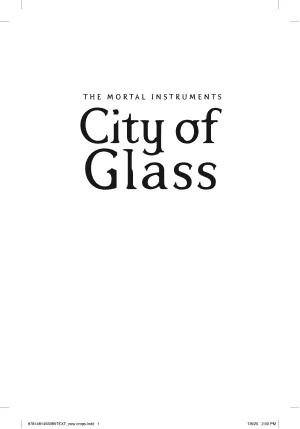
City of Glass
 83
83

City of Glass
Cassandra Clare's City of Glass confronts the inherent dangers of the Shadowhunter world with a grim determination that often surprises. The novel's strength lies in its unflinching portrayal of the consequences of war and familial betrayal. Clary's journey from bewildered newcomer to active participant is compelling, especially when she grapples with the moral ambiguities faced by her kind. However, the pacing occasionally falters, particularly in the middle sections where exposition threatens to overshadow the rising tension. The introduction of certain plot twists, while impactful, can feel slightly predictable to seasoned genre readers. A standout moment is the intricate depiction of the City of Glass itself, a place of ethereal beauty and hidden peril, which serves as a potent metaphor for the alluring yet dangerous world the characters inhabit. The book ultimately succeeds in deepening the stakes and complexity of the series.
📝 Description
83
Published in 2009, City of Glass is the third novel in Cassandra Clare's Mortal Instruments series.
City of Glass follows Clary Fray as she navigates the hidden world of Shadowhunters, demon hunters who protect humanity from supernatural threats. Clary discovers her own heritage within this society, which operates under ancient laws and faces constant inter-species conflict. The novel blends urban fantasy with a coming-of-age narrative, detailing Clary's integration into this secret world.
This book appeals to young adult readers who enjoy detailed world-building and character-focused stories. Fans of urban fantasy, paranormal romance, and narratives featuring secret societies and magical systems will find much to engage with. It speaks to those who like exploring identity, destiny, and the conflict between good and evil within a modern city setting. Readers looking for a quick plot with mystery and adventure elements will also be drawn to it.
The novel emerged during a period of significant growth for urban fantasy, drawing on a modern interpretation of classical mythology and demonology. Following popular series that blended the supernatural with contemporary settings, Clare's work tapped into a demand for stories that reimagined ancient lore within a modern framework. The 2009 publication date places it within a surge of paranormal romance and supernatural thrillers that dominated bestseller lists, often incorporating elements of adolescent angst and romantic entanglements.
💡 Why Read This Book?
• Gain insight into the intricacies of Shadowhunter society, including the governing body known as the Clave, and understand the rules that dictate their hidden war against demons, as detailed through Clary's initial immersion. • Experience the personal toll of intergenerational conflict and secrets, particularly through the complex relationship between Valentine Morgenstern and his children, which drives much of the narrative's emotional weight. • Explore the symbolic power of the Mortal Instruments—the Cup, Sword, and Mirror—and their historical significance within the Shadowhunter lore, as their discovery and use become central to the plot's resolution.
⭐ Reader Reviews
Honest opinions from readers who have explored this book.
❓ Frequently Asked Questions
When was Cassandra Clare's City of Glass originally published?
City of Glass was first published in hardcover in 2009. This marked a significant point in The Mortal Instruments series, expanding the lore and the conflict.
What are the Mortal Instruments mentioned in the book?
The three Mortal Instruments are the Mortal Cup, the Mortal Sword, and the Mortal Mirror. These ancient artifacts hold immense power and are central to the Shadowhunters' history and ongoing struggles.
Who are the Shadowhunters?
Shadowhunters, also known as Nephilim, are a half-angelic race who protect the human world from demons. They are trained from a young age to fight and possess unique abilities enhanced by runes.
What is the Clave?
The Clave is the governing body of the Shadowhunters. It establishes laws, enforces the Accords, and makes decisions that affect all Shadowhunter communities worldwide.
Is City of Glass the first book in The Mortal Instruments series?
No, City of Glass is the third book in The Mortal Instruments series. It follows City of Bones and City of Ashes, building upon the established characters and plotlines.
What is the significance of Idris in City of Glass?
Idris is the hidden homeland of the Shadowhunters and the location of the City of Glass. It represents their ancestral home and a place of great importance and magical power.
🔮 Key Themes & Symbolism
Heritage and Identity
The narrative deeply explores the concept of inherited destiny versus personal choice, particularly through Clary Fray's discovery of her Shadowhunter lineage. She grapples with the expectations placed upon her by her bloodline and the Clave, questioning whether her identity is predetermined or something she can shape herself. This internal conflict is amplified by the revelations surrounding her family history and the complex relationships within the Morgenstern family, forcing her to confront difficult truths about who she is and where she belongs.
The Nature of Good and Evil
City of Glass scrutinizes the binary of good and evil, presenting characters who operate in shades of gray. Valentine Morgenstern, the primary antagonist, embodies a twisted ideology that, in his view, serves a greater good, challenging the reader's perception of villainy. Similarly, characters within the Shadowhunter community exhibit flaws and make morally ambiguous decisions, suggesting that true heroism lies not in perfection but in the struggle against darkness and personal failings. The novel questions who truly defines 'good' in a world steeped in ancient conflict.
Sacrifice and Duty
The weight of duty and the necessity of sacrifice are paramount themes. Shadowhunters are bound by an oath to protect humanity, a commitment that often demands immense personal cost. Characters frequently face situations where they must put the lives of others or the safety of the world above their own desires and well-being. This theme is explored through both major and minor characters, highlighting the sacrifices made in the ongoing war against demonic forces and the internal struggles that arise from such responsibilities.
The Supernatural in the Mundane
A core element is the juxtaposition of the mundane world with a hidden supernatural reality. Clary's journey involves navigating this duality, learning to perceive the magical elements that exist alongside everyday life in New York City. The novel illustrates how ancient prophecies, demonic incursions, and magical artifacts intersect with modern urban landscapes, creating a mix of the familiar and the fantastical. This theme emphasizes the idea that extraordinary worlds can lie just beneath the surface of ordinary existence.
💬 Memorable Quotes
Direct passages from the work, attributed to the author.
“It is not supposed to be easy. If it were easy, everyone would do it.”
— This aphorism underscores the value of difficult endeavors and the dedication required for significant achievements. It implies that challenges are inherent to meaningful pursuits and that their very difficulty is what makes them worthwhile and exclusive.
“There are those who follow the law, and those who make it.”
— This highlights a distinction between adherence to established rules and the power to create or redefine them. It touches upon themes of authority, rebellion, and the different roles individuals play within a structured society or system.
“Love is not a victory march, it's a semaphore.”
— This metaphorical statement suggests that love is not a triumphant conquest but a continuous, nuanced form of communication. It implies a need for constant signals, interpretation, and careful exchange rather than a simple win.
“The more you know, the more you know that you don't know.”
— This paradox reflects the expansive nature of knowledge. As one learns more, the vastness of what remains unknown becomes increasingly apparent, fostering humility and a deeper appreciation for the learning process.
💡 Key Ideas
Editorial paraphrase of the work's core concepts — not direct quotes.
When what you love is gone, you're left with what you were born with.
This quote speaks to the core of identity and resilience. It suggests that even in the face of profound loss, one's inherent nature and foundational self remain, offering a source of strength or a starting point for rebuilding.
🌙 Esoteric Significance
Tradition
While not strictly adhering to a single esoteric lineage, City of Glass draws heavily from Gnostic and Hermetic concepts, particularly concerning dualism, hidden knowledge, and the angelic/demonic dichotomy. The Nephilim (Shadowhunters) can be seen as angelic-human hybrids akin to figures in certain Kabbalistic or Gnostic cosmologies, tasked with policing the boundaries between spiritual realms. The narrative explores themes of hidden realities and the awakening of latent spiritual powers within individuals, common threads in Western esotericism.
Symbolism
The runes used by Shadowhunters function as potent magical sigils, reminiscent of alchemical or Hermetic symbols used for invoking specific energies or protections. The Mortal Instruments—Cup, Sword, and Mirror—carry archetypal weight: the Cup often symbolizes transformation or the divine chalice, the Sword represents judgment and spiritual warfare, and the Mirror signifies introspection and hidden truths. These artifacts embody fundamental concepts within esoteric traditions, acting as keys to power and understanding.
Modern Relevance
Contemporary urban fantasy authors and practitioners of modern occultism continue to engage with Clare's world-building. The series' success has influenced subsequent works that blend fantasy lore with contemporary settings. Thinkers exploring the psychology of archetypes within popular culture often cite the Shadowhunter mythology. Furthermore, the exploration of identity, belonging, and the struggle against oppressive systems within the books appeals to current social and philosophical discussions, making the series a touchstone for analyzing modern myth-making.
👥 Who Should Read This Book
• Young adult readers discovering urban fantasy who enjoy intricate world-building and characters navigating complex social structures and personal identities. • Fans of paranormal romance seeking a series that balances supernatural conflict with developing romantic relationships and high emotional stakes. • Readers interested in exploring themes of hidden worlds, secret societies, and the intersection of the mundane and the magical within a contemporary setting.
📜 Historical Context
Published in 2009, City of Glass arrived during a burgeoning era for young adult urban fantasy. The genre had been significantly boosted by works like Stephenie Meyer's *Twilight* series, which premiered in 2005, and Jim Butcher's *Dresden Files*, which began in 2000. These successes created a market eager for supernatural elements woven into contemporary settings. Cassandra Clare's Mortal Instruments series, with its blend of Shadowhunters, demons, and romance, tapped directly into this trend. While authors like Suzanne Collins were also gaining prominence with dystopian fiction like *The Hunger Games* (2008), Clare's work solidified the paranormal romance subgenre's appeal. The novel's intricate lore and complex character relationships found a strong audience, contributing to the ongoing popularity of high-concept fantasy narratives aimed at teens and young adults.
📔 Journal Prompts
Clary Fray's awakening to her Shadowhunter heritage.
The moral compromises made by members of the Clave.
Valentine Morgenstern's vision for the future of Shadowhunters.
The symbolic meaning of the City of Glass itself.
Jace Wayland's internal conflicts regarding his upbringing and loyalties.
🗂️ Glossary
Shadowhunter
A member of a secret race of half-angelic beings who protect the human world from demons. They are trained warriors possessing unique abilities.
Nephilim
The official term for Shadowhunters, referring to their lineage derived from angels and humans. This term carries significant historical and spiritual weight within their culture.
Clave
The governing body of the Shadowhunters, responsible for laws, justice, and the overall governance of their society across the globe.
Mortal Instruments
Three ancient artifacts of immense power: the Mortal Cup, the Mortal Sword, and the Mortal Mirror. Their possession dictates authority and holds the key to significant magical capabilities.
Runes
Magical symbols tattooed onto Shadowhunters' skin, which grant them special abilities when activated by a trained user, such as healing or invisibility.
Idris
The hidden, magical homeland of the Shadowhunters, containing their ancestral cities and centers of power, including the City of Glass.
Downworlders
Supernatural beings who share the Earth with humans and Shadowhunters, including vampires, werewolves, faeries, and warlocks.
This book appears in 1 collection
🔮 Readers Also Liked
Browse all →









From the “Demonology” Collection
View all →

![The secrets of black arts!: A key note to witchcraft, devination [sic], omens, forwarnings, apparitions, sorcery, dæmonology, dreams, predictions, visions, and the Devil's legacy to earth mortals, compacts with the Devil! With the most authentic history of Salem witchcraft](/img/thumb/the-secrets-of-black-arts-b-a-key-note-to-witchcraft-devination-sic-omens-forwarnings-apparitions-sorcery-d-monology-dreams-predictions-visions-and-the-devil-s-legacy-to-earth-mortals-compacts-with-th.webp)

More Free Occult Philosophy Books
View all →