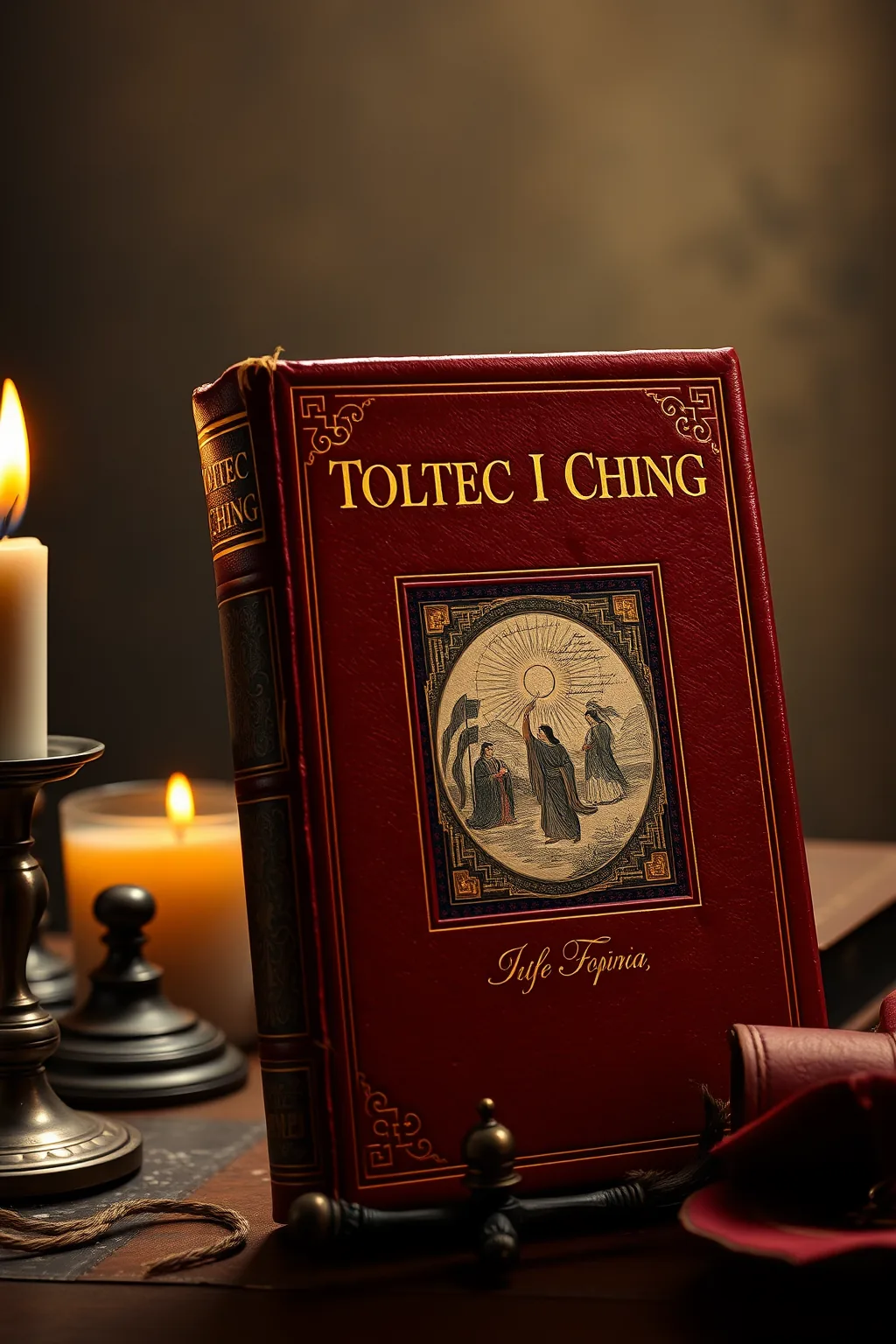
Toltec I Ching
 61
61

Toltec I Ching



Review by Isolde Whitaker (Sacred Texts Editor) — Isolde Whitaker, Sacred Texts Editor, hails "Toltec I Ching" as a groundbreaking fusion of esoteric traditions. Ramirez-Oropeza's scholarly yet accessible approach unlocks the profound synergy between the ancient Chinese oracle and the rich spiritual tapestry of the Toltecs. This book offers unparalleled insights into universal archetypes and personal destiny, rendered with an evocative clarity that resonates deeply. It is an indispensable resource for anyone seeking to deepen their understanding of divination, ancient metaphysics, or the enduring quest for spiritual enlightenment. A truly transformative work for the serious student of the occult and mystical arts.
📝 Description
61
Martha Ramirez-Oropeza's "Toltec I Ching" connects Mesoamerican philosophy with the ancient Chinese divination system.
This book presents a unique synthesis of the I Ching's divinatory structure and the spiritual teachings of the Toltec civilization. Ramirez-Oropeza interprets the 64 hexagrams through the lens of Mesoamerican cosmology, imbuing them with concepts drawn from Toltec traditions. The work aims to illuminate principles of life cycles, consciousness, and personal development.
It is structured for individuals interested in spiritual inquiry and self-understanding. Beyond its use as a divinatory tool, the book suggests a framework for perceiving the connections between all elements of existence. Readers are encouraged to engage with these ideas to foster their spiritual awareness and guide their personal development.
The "Toltec I Ching" situates itself within traditions that seek to unify disparate spiritual systems. By merging the I Ching, an ancient Chinese text central to Taoist thought and divination, with the philosophy of the Toltecs, a pre-Columbian Mesoamerican culture known for its spiritual depth, the book creates a bridge between Eastern and Western esoteric thought. This approach echoes historical efforts to find universal patterns in different cultural mythologies and wisdom practices.
💡 Why Read This Book?
Unlock the profound wisdom of two ancient civilizations through a unique divination system. This book offers a transformative perspective on life's challenges, spiritual growth, and the interconnectedness of the cosmos. Ideal for seekers of esoteric knowledge, practitioners of divination, and scholars interested in cross-cultural spiritual traditions seeking deeper self-understanding and guidance.
⭐ Reader Reviews
Honest opinions from readers who have explored this book.
❓ Frequently Asked Questions
What is the primary purpose of the Toltec I Ching?
The Toltec I Ching serves as a divinatory tool and a guide to spiritual wisdom, merging the ancient Chinese I Ching with Toltec philosophy to illuminate personal paths and cosmic understanding.
How does this book connect the I Ching with Toltec traditions?
It reinterprets the I Ching's hexagrams and lines through the lens of Toltec cosmology, symbolism, and spiritual practices, offering fresh insights into universal energies and human experience.
Is this book suitable for beginners in divination?
Yes, while rich in esoteric depth, the author provides clear explanations, making it accessible for beginners eager to explore a new form of divination and spiritual inquiry.
What kind of spiritual insights can one gain from this book?
Readers can expect insights into self-mastery, understanding life's cycles, navigating challenges with wisdom, and fostering a deeper connection with the spiritual dimensions of existence.
What makes the Toltec I Ching unique compared to the traditional I Ching?
Its uniqueness lies in the infusion of Toltec worldview, emphasizing concepts like the Nagual, the art of dreaming, and the sacredness of the earth, which adds a distinct flavor and depth to the I Ching's core wisdom.
🔮 Key Themes & Symbolism
The Synthesis of Ancient Oracles
This theme explores the profound integration of the I Ching's time-tested divinatory framework with the rich spiritual range of the Toltec civilization. It examines how these seemingly disparate traditions resonate and amplify each other, revealing universal truths about cosmic order, human destiny, and the intricate dance of existence. The book acts as a bridge, allowing readers to experience the I Ching through a new, vibrant lens, infused with the earthy wisdom and profound self-awareness characteristic of Toltec philosophy. It's an exploration of how ancient wisdom systems, when thoughtfully combined, can offer deeper, more holistic insights into the human condition and our place within the universe.
Toltec Cosmology and Spiritual Evolution
Central to the "Toltec I Ching" is the unveiling of Toltec cosmology, a worldview that emphasizes conscious awareness, the power of intention, and the spiritual journey of the individual. This theme examines key Toltec concepts such as the Nagual (the hidden, spiritual self), the dream body, and the mastery of energies that shape our reality. Ramirez-Oropeza guides readers to understand how these principles are interwoven with the I Ching's hexagrams, transforming the oracle from a mere predictive tool into a profound guide for spiritual evolution. It highlights the Toltec emphasis on living in balance, embracing personal responsibility, and consciously shaping one's destiny through mindful action and inner transformation.
Symbolism, Archetypes, and the Sacred Dance
This theme examines the rich symbolic language shared by both the I Ching and Toltec traditions, exploring how archetypal imagery serves as a conduit for profound spiritual understanding. The book illuminates the deep meanings embedded within the hexagrams, re-contextualized through Toltec metaphors of nature, the cosmos, and the human psyche. Readers will discover how these symbols are not static pronouncements but dynamic keys that unlock inner potentials and reveal the sacred patterns underlying all phenomena. The "Sacred Dance" refers to the continuous interplay of forces, the ebb and flow of energies, and the harmonious movement of life that the Toltec I Ching helps us to perceive and participate in with greater awareness and grace.
💬 Memorable Quotes
Direct passages from the work, attributed to the author.
“Wisdom is not found, but remembered through the heart's quiet knowing.”
— Emphasizes introspection and intuition as the primary pathways to true wisdom, rather than external acquisition, aligning with esoteric traditions of inner discovery.
“The Serpent sheds its skin, so too must the soul embrace transformation.”
— Highlights the archetypal symbolism of the serpent as a representation of cyclical change, renewal, and the essential process of spiritual evolution and shedding old ways.
“To dream is to walk the liminal spaces between worlds.”
— Speaks to the Toltec emphasis on the power of dreaming, positioning it as a sacred practice that allows access to higher consciousness and domains of spiritual insight.
“The earth breathes, and in its rhythm, we find our own sacred beat.”
— Connects human existence to the natural world, emphasizing a harmonious relationship and the importance of aligning personal life with the fundamental energies of the planet.
💡 Key Ideas
Editorial paraphrase of the work's core concepts — not direct quotes.
The stars whisper secrets to those who know how to listen.
This quote captures the essence of divination, suggesting that cosmic forces communicate profound truths to individuals who cultivate inner receptivity and awareness.
🌙 Esoteric Significance
Tradition
This work is deeply rooted in the syncretic esoteric traditions that seek to bridge Eastern and Western mystical philosophies. It draws heavily from the ancient Chinese Taoist and Confucian principles embedded in the I Ching, while simultaneously integrating the shamanistic and spiritual teachings of the Toltecs, particularly those associated with the Nagual and the mastery of the dream state. It represents a modern approach to esoteric studies, aiming to reveal universal archetypes and energies that are present across diverse spiritual landscapes, offering a holistic path to self-knowledge and spiritual liberation.
Symbolism
The book is replete with potent symbolism drawn from both traditions. The I Ching's hexagrams themselves are rich symbolic representations of universal forces and situations. These are further illuminated by Toltec symbols such as the feathered serpent (Quetzalcoatl), the jaguar (representing shadow work and transformation), the eagle (vision and spirit), and the crystalline skull (consciousness and ancient wisdom). These symbols function as keys, unlocking deeper layers of meaning within the I Ching's structure and offering useful insights into the cycles of life, death, and rebirth, as well as the interplay of the material and spiritual realms.
Modern Relevance
In an era often characterized by fragmentation and rapid change, the "Toltec I Ching" offers a vital anchor of ancient wisdom. Its emphasis on self-mastery, conscious awareness, and understanding life's cyclical nature provides practical tools for navigating modern complexities. The book's synthesis of divination with profound spiritual philosophy empowers individuals to seek inner guidance, cultivate resilience, and foster a deeper connection with themselves and the universe. It speaks to the contemporary seeker's desire for authentic spiritual growth, offering a path that is both deeply personal and universally resonant, bridging the gap between ancient knowledge and contemporary challenges.
👥 Who Should Read This Book
This clear text is a treasure for a diverse range of readers. **Beginners** in divination will find a clear yet profound introduction to a unique oracle system, guided by accessible explanations. **Scholars** of comparative religion, ancient history, and esotericism will appreciate the rigorous research and insightful synthesis of two distinct cultural traditions. **Spiritual seekers** yearning for deeper self-understanding and guidance on their life's journey will discover a powerful tool for introspection and personal growth. **Practitioners** of divination and occult arts will find a fresh perspective that expands their repertoire and deepens their engagement with cosmic energies and archetypal patterns.
📜 Historical Context
The "Toltec I Ching" emerges from a collection of ancient knowledge, drawing from the venerable Chinese I Ching, whose origins are traced back to the Zhou Dynasty (c. 1046-256 BCE), and the spiritual philosophy of the Toltecs, a civilization that flourished in Mesoamerica between the 9th and 12th centuries CE. The I Ching, a foundational text of Chinese thought, has served as a profound source of wisdom, divination, and philosophical inquiry for millennia, influencing Confucianism, Taoism, and various esoteric practices. The Toltecs, on the other hand, are renowned for their advanced understanding of astronomy, mathematics, and their sophisticated spiritual teachings, often associated with figures like Quetzalcoatl. Martha Ramirez-Oropeza's work bridges these two powerful traditions, offering a unique synthesis that speaks to universal human experiences of seeking meaning, navigating change, and achieving inner harmony. This fusion reflects a modern esoteric impulse to find common threads and deeper resonances between disparate ancient wisdom systems, revealing timeless truths that transcend cultural and temporal boundaries.
📔 Journal Prompts
Reflect on a recent challenge: Which I Ching hexagram, viewed through a Toltec lens, might offer guidance or insight into its underlying dynamics?
Consider the concept of the 'Nagual' from Toltec tradition. How does this idea of a hidden spiritual self resonate with your personal journey?
Explore the symbolism of transformation as presented by the serpent in the 'memorable quotes.' What aspects of your life are currently undergoing a shedding process?
If you were to 'dream consciously' (a Toltec practice), what spiritual insights might you seek to uncover or understand more deeply?
How can you align your daily actions with the 'sacred beat' of the earth, as suggested by the quote about its rhythm?
🗂️ Glossary
Hexagram
A figure composed of six stacked horizontal lines, where each line is either Yang (solid) or Yin (broken), forming 64 unique combinations used in the I Ching for divination and philosophical insight.
Toltec
An ancient Mesoamerican civilization known for their sophisticated spiritual philosophy, mastery of astronomy, and profound influence on later cultures such as the Aztec.
Nagual
A central concept in Toltec spirituality, referring to the hidden, spiritual, or true self; the visionary aspect of a person that can travel and interact in the dream world.
Yin
In the I Ching and Taoist philosophy, the feminine, passive, dark, and receptive principle, often represented by a broken line.
Yang
In the I Ching and Taoist philosophy, the masculine, active, light, and creative principle, often represented by a solid line.
This book appears in 3 collections
🔮 Readers Also Liked
Browse all →







From the “Tarot” Collection
View all →







More Free Divination & Tarot Books
View all →