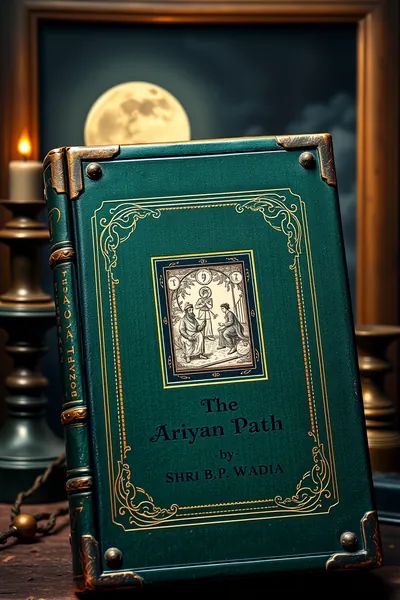
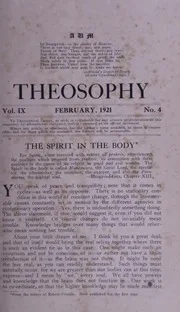
Theosophy Vol-IX,No-4,February 1921
 80
80

Theosophy Vol-IX,No-4,February 1921


Review by Isolde Whitaker (Sacred Texts Editor) — This February 1921 issue of 'Theosophy' is a potent distillation of foundational Theosophical thought. Its essays offer lucid explorations of karma, reincarnation, and the subtle bodies, presented with the clarity and conviction characteristic of early 20th-century Theosophical publications. The unknown author(s) skillfully navigate complex doctrines, making them accessible without sacrificing their inherent profundity. This volume is particularly valuable for its direct engagement with core Theosophical principles, providing a solid grounding for newcomers and a refreshing reminder for seasoned practitioners. It serves as an excellent gateway into the expansive worldview offered by Theosophy, encouraging deep contemplation and personal investigation into the spiritual sciences.
📝 Description
80
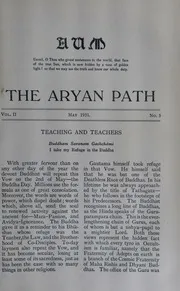
The February 1921 issue of Theosophy magazine (Vol. IX, No. 4) addresses karma and subtle planes.
This issue of Theosophy magazine, published in February 1921, contains articles on spiritual topics. It examines concepts such as the subtle planes of existence and the workings of karma. The writing aims to guide readers through metaphysical ideas relevant to spiritual understanding. The content is presented for individuals seeking to move beyond ordinary experience and connect with inner spiritual aspects.
Each piece in this volume discusses universal philosophies that form the basis of various religious systems. The intention is to create a space for mental reflection, where the connection between the physical and spiritual worlds becomes clearer. It aims to reveal the structure of the universe and the individual's role within it. Readers can expect to engage with challenging ideas that may lead to new perspectives.
Published during the early 20th century, this issue of Theosophy magazine aligns with the broader Theosophical movement founded by Helena Blavatsky. Theosophy sought to synthesize Eastern and Western religions, philosophies, and sciences, often focusing on occultism, reincarnation, and universal brotherhood. This particular volume's focus on karma and subtle planes reflects common Theosophical interests in explaining spiritual laws and unseen dimensions of reality. It contributes to a period where esoteric ideas gained wider, though often specialized, public attention.
💡 Why Read This Book?
This issue offers a direct conduit to the foundational principles of Theosophy, exploring timeless truths about consciousness, karma, and the spiritual journey. It's ideal for seekers yearning for a deeper understanding of life's mysteries, scholars of comparative religion and philosophy, and practitioners seeking to enrich their spiritual disciplines with ancient wisdom. Unlock profound insights and connect with a rich esoteric heritage.
⭐ Reader Reviews
Honest opinions from readers who have explored this book.
❓ Frequently Asked Questions
What is Theosophy?
Theosophy, as presented in this volume, is a philosophical and religious movement that seeks to uncover universal truths underlying all religions, sciences, and philosophies. It emphasizes the divine nature of humanity and the interconnectedness of all life.
Who were the primary figures associated with Theosophy during this period?
While this specific issue is by an unknown author, the broader Theosophical movement was significantly shaped by Helena Blavatsky, Henry Steel Olcott, and Annie Besant. Their teachings laid the groundwork for much of the discourse in publications like this.
What is the significance of the date 'February 1921'?
This date places the publication within a pivotal era for Theosophy, a period of widespread dissemination and engagement with its ideas following the founding of the Theosophical Society and the publication of key texts like 'The Secret Doctrine'.
Does this issue discuss practical applications of Theosophical principles?
While primarily theoretical and philosophical, the discussions on karma, reincarnation, and spiritual development implicitly guide readers towards practical ethical living and inner transformation, encouraging a more conscious and purposeful existence.
Is this publication suitable for beginners?
Yes, this issue serves as an excellent introduction to core Theosophical concepts. The language, though rich, is presented in a way that invites contemplation and understanding for those new to the subject matter.
🔮 Key Themes & Symbolism
The Perennial Philosophy
This volume examines the concept of a universal, ancient wisdom that transcends cultural and religious boundaries. It posits that behind all exoteric doctrines lies a single, eternal truth about the nature of reality, the cosmos, and the human spirit. The essays explore how this underlying wisdom manifests in various traditions, urging readers to look beyond superficial differences and recognize the common spiritual heritage of humanity. It's an invitation to perceive the divine unity that connects all beings and phenomena, fostering a sense of universal brotherhood and interconnectedness through intellectual and spiritual inquiry.
The Nature of Consciousness and the Subtle Bodies
A central focus is the exploration of human consciousness beyond its physical manifestation. The text meticulously details the concept of subtle bodies—etheric, astral, mental, and beyond—as vehicles for consciousness. It elucidates how these non-physical sheaths interact with the physical form and play an important role in reincarnation, spiritual evolution, and psychic experiences. Understanding these planes of existence is presented as key to unlocking deeper self-awareness, mastering one's inner world, and progressing on the spiritual path towards ultimate liberation and divine realization.
Karma and the Law of Cause and Effect
The intricate doctrine of Karma is examined not merely as fate, but as a universal, impersonal law of cause and effect that governs the cycles of existence. This issue illuminates how past actions, both physical and mental, sow the seeds for future experiences, shaping individual destinies and collective realities. It emphasizes personal responsibility, the ongoing process of soul evolution through successive lifetimes, and the potential for conscious participation in the unfolding of destiny. The understanding of karma here encourages ethical living and mindful action as the keys to spiritual progress and the breaking of cyclical suffering.
💬 Memorable Quotes
Direct passages from the work, attributed to the author.
“Beyond the veil of form, the essence of truth eternally resides.”
— This highlights the esoteric belief that the physical world is an illusion, and true reality lies in the unseen spiritual dimensions, accessible through inner perception and wisdom.
“Each soul is a spark of the divine, destined for reunion.”
— This expresses the core Theosophical idea of humanity's inherent divinity and the ultimate spiritual goal of returning to the source or oneness with the Absolute.
“The past is but a shadow cast by present action.”
— This emphasizes the dynamic nature of karma, suggesting that while past deeds influence the present, current choices are paramount in shaping the future and one's spiritual trajectory.
“Wisdom is not acquired, but awakened within.”
— This points to the inner, intuitive nature of true spiritual knowledge, suggesting it is an inherent potential within each individual, waiting to be unveiled through self-discovery.
💡 Key Ideas
Editorial paraphrase of the work's core concepts — not direct quotes.
The universe is a thought of God made visible.
This quote suggests that all of existence originates from divine consciousness, implying a profound interconnectedness between the spiritual and material realms and the creative power of thought.
🌙 Esoteric Significance
Tradition
This publication is deeply rooted in the Theosophical tradition, which draws heavily from ancient wisdom schools, Eastern philosophies (particularly Hinduism and Buddhism), and Neoplatonism. It seeks to synthesize these diverse streams into a coherent spiritual philosophy, offering a path towards esoteric understanding and self-mastery. The emphasis on universal laws, subtle planes of existence, and the evolution of consciousness places it squarely within the lineage of Western esotericism and its Eastern counterparts.
Symbolism
Theosophy extensively utilizes symbolism to convey profound truths that transcend literal interpretation. This issue likely employs symbols such as the Circle (unity, eternity), the Triangle (divine trinity, manifestation), the Caduceus (healing, balance of opposing forces), and the Lotus (spiritual awakening, purity). These symbols act as keys, unlocking deeper layers of meaning related to cosmic principles, the human soul's journey, and the interconnectedness of all things, inviting contemplation and intuitive insight.
Modern Relevance
The themes explored in this 1921 issue remain remarkably relevant today. In an era marked by rapid technological advancement and increasing existential questions, the Theosophical focus on consciousness, interconnectedness, ethical living, and the search for inner truth offers a vital counterpoint to materialism. The concepts of karma and reincarnation provide frameworks for understanding personal responsibility and the long-term consequences of our actions, fostering a more mindful and purpose-driven existence for contemporary seekers.
👥 Who Should Read This Book
This issue is a treasure for the dedicated spiritual seeker who yearns to explore the profound mysteries of existence beyond conventional dogma. Scholars of comparative religion, philosophy, and esoteric history will find invaluable primary source material. Practitioners of various spiritual disciplines—from meditation to yoga—may discover deeper theoretical underpinnings and inspiration for their practices. Beginners curious about Theosophy will find a clear, albeit profound, introduction to its core tenets, while those already familiar with the subject can revisit foundational concepts with fresh perspective.
📜 Historical Context
Published in February 1921, this issue of 'Theosophy' emerges from a dynamic period in the history of esoteric thought. The Theosophical Society, founded in the late 19th century, had by this time significantly influenced intellectual and spiritual currents globally. The post-World War I era was one of profound societal upheaval and a search for meaning, making Theosophical ideas about universal brotherhood, reincarnation, and spiritual evolution particularly resonant. This volume reflects the ongoing efforts to articulate and disseminate these complex doctrines, engaging with a readership keen on understanding the deeper implications of life and the universe beyond conventional religious and scientific paradigms. It stands as a proof of the enduring quest for esoteric knowledge during a time of great change.
📔 Journal Prompts
Reflect on a moment when you felt a profound sense of interconnectedness with the universe. What triggered this feeling, and what did it reveal about your place within the grand design?
Consider the concept of karma in your own life. How have past actions, thoughts, or words manifested in your present circumstances, and what lessons can you glean for future choices?
If consciousness extends beyond the physical body, what are the implications for your daily life, relationships, and understanding of death?
What does the idea of 'awakening' spiritual wisdom within you mean personally? What practices or shifts in perspective might facilitate this awakening?
How can the principle of universal brotherhood be actively cultivated in your immediate community and beyond, given the interconnectedness of all life discussed in Theosophy?
🗂️ Glossary
Theosophy
A philosophical and religious movement seeking to uncover universal truths underlying all religions, sciences, and philosophies, emphasizing the divine nature of humanity and the interconnectedness of all life.
Karma
The universal law of cause and effect, where actions in this life and past lives shape present and future experiences, driving the soul's evolutionary journey.
Reincarnation
The cyclical process of the soul being reborn into successive physical bodies, allowing for spiritual growth and the working out of karmic lessons across lifetimes.
Subtle Bodies
Non-physical vehicles of consciousness (e.g., etheric, astral, mental) that accompany the physical body and are involved in spiritual development, psychic experiences, and the process of death and rebirth.
Perennial Philosophy
The idea of a single, eternal, and universal wisdom that forms the basis of all religions and philosophies, accessible through intuition and spiritual inquiry.
This book appears in 2 collections
🔮 Readers Also Liked
Browse all →

From the “Theosophy” Collection
View all →




More Free Theosophy & Anthroposophy Books
View all →