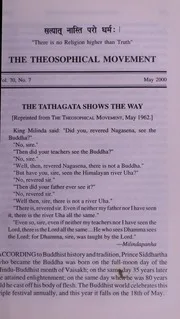
Thought-forms
 79
79

Thought-forms
Annie Besant's "Thought-forms" offers a vivid, if sometimes dated, glimpse into the Theosophical understanding of mental energy. The book's strength lies in its ambitious attempt to map the unseen, presenting abstract ideas through concrete, albeit speculative, descriptions and accompanying colour plates. The detailed exploration of how emotions like anger or love manifest as distinct energetic shapes is particularly striking, offering a visual metaphor for internal states. However, the work suffers from the inherent limitations of its speculative nature; the descriptions, while elaborate, are ultimately subjective interpretations of psychic phenomena. The passage detailing the formation of a "thought-form of hatred" as a jagged, dark entity illustrates both the book's imaginative power and its reliance on allegorical representation rather than empirical proof. It remains a significant document of early 20th-century esoteric thought, valuable for its historical perspective and conceptual framework, but requires a reader willing to engage with its premises on faith.
📝 Description
79
Annie Wood Besant and C.W. Leadbeater published Thought-forms in 1925, detailing how thoughts manifest visible shapes.
Published in 1925, Thought-forms by Annie Wood Besant and C.W. Leadbeater explains that human thoughts, emotions, and desires can take on distinct energetic shapes in unseen realms. These "thought-forms" are described as having colors and specific forms, influencing both the person generating them and their surroundings. The book uses detailed descriptions and illustrations to make these abstract concepts more concrete, aiming to give readers a visual grasp of subtle energies. It is particularly relevant for those studying Theosophy or esoteric philosophy who want to understand the mechanics of the mental and astral planes. Readers interested in how emotions create energetic impacts or the structure of spiritual practices will find this work informative. It also appeals to those curious about early 20th-century occultism and the history of psychic research.
Thought-forms emerged from the Theosophical Society, founded in 1875 by Helena Blavatsky. This movement sought to blend spiritual beliefs with scientific inquiry. Besant and Leadbeater were prominent figures within Theosophy, investigating unseen realities. The book's approach, complete with illustrations derived from alleged psychic observations, represents an effort to document and visualize the subjective experiences central to esoteric traditions of the early 20th century.
💡 Why Read This Book?
• Gain insight into the Theosophical concept of thought-forms, understanding how emotions and intentions are believed to manifest as tangible energetic structures, as described in the book's detailed plates. • Learn about the historical context of early 20th-century esoteric thought, specifically how the Theosophical Society, with figures like Annie Besant, attempted to visually represent occult phenomena around 1925. • Develop a framework for contemplating the energetic impact of one's own thoughts and feelings, moving beyond abstract notions to consider them as potential influences on one's immediate environment.
⭐ Reader Reviews
Honest opinions from readers who have explored this book.
❓ Frequently Asked Questions
What is the main purpose of Annie Besant's book 'Thought-forms'?
The primary purpose is to illustrate and explain how thoughts and emotions can manifest as distinct energetic or semi-physical forms in the unseen realms, influencing both the individual and their surroundings.
Who were the authors of 'Thought-forms'?
The book was written by Annie Wood Besant and C.W. Leadbeater, both prominent figures within the Theosophical Society.
When was 'Thought-forms' first published?
'Thought-forms' was first published in 1925, reflecting the esoteric and psychic research interests prevalent in the early 20th century.
What kind of imagery does 'Thought-forms' use?
The book is known for its detailed descriptions of various thought-forms and is often accompanied by colour plates that visually represent these imagined energetic structures.
Is 'Thought-forms' considered a scientific text?
No, 'Thought-forms' is considered an esoteric or metaphysical text, presenting speculative ideas based on psychic observation rather than empirical scientific methodology.
What is a 'thought-form' according to the book?
A thought-form is an entity or shape believed to be created by the force of a thought or emotion, possessing colour, form, and sometimes a degree of independent existence on astral or mental planes.
🔮 Key Themes & Symbolism
Manifestation of Mental States
The core theme is the tangible manifestation of thoughts and emotions in subtle realms. Besant and Leadbeater describe how feelings like joy, anger, or desire coalesce into distinct energetic entities, complete with specific colours and shapes. These 'thought-forms' are presented not as mere abstractions but as active forces that can affect the environment and other beings. The book provides detailed accounts of these manifestations, aiming to educate the reader on the energetic consequences of their mental and emotional lives.
Theosophical Cosmology
This work is deeply rooted in Theosophical cosmology, particularly its concepts of planes of existence and the subtle bodies of humans. It expands on Helena Blavatsky's foundational ideas by offering a visual lexicon for the astral and mental planes. The book illustrates how these planes are populated by the energetic residue of human consciousness, shaping the spiritual landscape. It aligns with Theosophy's goal of understanding the universe through spiritual evolution and inner perception.
Colour and Form Symbolism
A significant aspect is the symbolic language of colour and form attributed to different mental states. For instance, certain colours might signify purity or passion, while specific shapes could indicate constructive or destructive intentions. These correspondences are presented as universal principles observable through clairvoyant perception. The book uses these symbolic associations to decode the nature of thought-forms, offering a visual guide to the unseen energetic architecture of consciousness.
Spiritual Development and Ethics
The exploration of thought-forms serves a practical purpose: to guide individuals towards greater self-awareness and ethical conduct. By understanding that negative thoughts can create harmful entities and positive thoughts can generate beneficial ones, readers are encouraged to cultivate mental discipline. The book implies that conscious control over one's thoughts is a vital component of spiritual growth and contributes to a more harmonious personal and collective energetic environment.
💬 Memorable Quotes
Direct passages from the work, attributed to the author.
“The colour of a thought-form depends on the emotion behind the thought.”
— This highlights the symbolic language of the book, where specific colours are directly correlated with the emotional quality of the originating thought, serving as a key to identifying its nature.
“A thought-form can influence its creator and others.”
— This interpretation points to the active nature of these mental constructs, suggesting they are not static but possess agency, capable of impacting both the thinker and those around them.
“The shape of a thought-form reflects its purpose or nature.”
— This suggests that the visual form a thought-form takes is not arbitrary but directly representative of the intention or inherent quality of the thought that brought it into being.
💡 Key Ideas
Editorial paraphrase of the work's core concepts — not direct quotes.
Thoughts are things, and next to air, the most abundant thing in the universe.
This quote captures the central thesis: thoughts possess a substantial, almost material reality, existing in vast quantities throughout existence, comparable in prevalence to the very air we breathe.
When a man thinks, he creates a thought-form.
This paraphrased concept emphasizes the direct causal link between the act of thinking and the creation of an energetic entity, suggesting that every thought has a consequence in the subtle realms.
🌙 Esoteric Significance
Tradition
This work is a core part of modern Theosophy, building directly upon the foundations laid by Helena Blavatsky. It extends Theosophical cosmology by providing a detailed, visual representation of the astral and mental planes, which are central to the tradition's understanding of consciousness and reincarnation. While drawing on older esoteric concepts of elemental beings and subtle bodies found in Hermeticism and Eastern philosophies, Besant and Leadbeater codified them within a specific Theosophical framework, emphasizing clairvoyant observation as a valid source of knowledge.
Symbolism
The primary symbolism in "Thought-forms" revolves around the colour and form attributed to different mental states. For instance, vibrant colours like gold or blue might represent higher spiritual aspirations or pure thought, while jagged shapes and murky colours are associated with negative emotions like anger or fear. These visual representations act as a symbolic language, enabling practitioners to 'read' the energetic quality of thoughts and their potential impact, thereby offering a visual key to understanding the subtle energetic environment.
Modern Relevance
Contemporary practices in energy healing, manifestation techniques, and mindfulness often echo the principles presented in "Thought-forms." Modern proponents of law of attraction concepts and visualization exercises implicitly engage with the idea that thoughts have creative power. Furthermore, New Age spirituality and certain branches of Jungian psychology, which explore archetypes and the collective unconscious, find conceptual resonance with Besant and Leadbeater's detailed mapping of subjective experience onto externalized forms.
👥 Who Should Read This Book
• Students of Theosophy and esoteric philosophy seeking to understand the foundational concepts of thought-forms and subtle bodies as presented by prominent early 20th-century figures. • Individuals interested in the history of psychic research and occultism who wish to explore how thinkers like Annie Besant attempted to visualize and systematize unseen phenomena. • Practitioners of visualization and manifestation techniques looking for a historical text that offers detailed descriptions and symbolic interpretations of how thoughts are believed to shape reality.
📜 Historical Context
Published in 1925, "Thought-forms" emerged from the heart of the Theosophical Society, a movement founded in 1875 by Helena Blavatsky. This period was marked by a fervent global interest in spiritualism, psychic phenomena, and alternative religious philosophies, seeking to bridge the perceived gap between science and spirituality. Annie Wood Besant and C.W. Leadbeater, leading Theosophists, used their alleged clairvoyant abilities to describe the unseen worlds. Their work presented a systematic, visual approach to concepts previously explored more abstractly. It stood in contrast to the burgeoning field of academic psychology, which was beginning to explore the mind through empirical methods, and also differed from more mystical traditions like Christian Gnosticism. The book's detailed colour plates, intended to represent these invisible phenomena, were groundbreaking for their time and contributed to its significant reception among esoteric circles.
📔 Journal Prompts
The visual representation of a thought-form of joy described in the text.
The energetic impact of a specific negative thought-form on its environment.
The symbolic meaning of the colours associated with different emotions in Besant's work.
The process of creating a benevolent thought-form as detailed in the book.
The distinction between a thought-form and a purely physical object as explored in the book.
🗂️ Glossary
Thought-form
An entity or shape believed to be created by the force of a thought or emotion, possessing colour, form, and sometimes a degree of independent existence on astral or mental planes.
Astral Plane
In esoteric traditions, a subtle plane of existence associated with emotions, desires, and the non-physical experiences of consciousness, often considered the realm where thought-forms reside.
Mental Plane
A higher subtle plane of existence, distinct from the astral plane, associated with abstract thought, intellect, and pure ideation, where more refined thought-forms may manifest.
Clairvoyance
The purported psychic ability to perceive objects, events, or energies that are not accessible to the senses, often described as seeing into the invisible realms or future.
Theosophy
A spiritual movement founded in the late 19th century by Helena Blavatsky, seeking to synthesize Eastern and Western religions and philosophies and to investigate the laws of nature and divine potential of humanity.
Subtle Body
In various esoteric traditions, a non-physical or energetic body that is thought to exist in conjunction with the physical body, often associated with consciousness and psychic phenomena.
Elemental
In esoteric lore, a being associated with one of the classical elements (earth, air, fire, water), often considered a basic constituent of nature or a product of elemental forces.
🔮 Readers Also Liked
Browse all →



More by Annie Wood Besant
All books →




More Free Theosophy & Anthroposophy Books
View all →