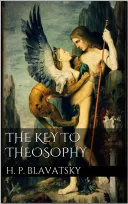
The Key to Theosophy by H.P. Blavatsky
 83
83

The Key to Theosophy by H.P. Blavatsky
Blavatsky's "The Key to Theosophy" is less a literary work and more a philosophical primer, functioning as a direct conduit to the foundational ideas of the Theosophical Society. Its question-and-answer format, while efficient, can sometimes feel didactic, lacking the narrative sweep of her more ambitious texts. However, this directness is precisely its strength for newcomers. The explanation of the seven principles of man, for instance, offers a clear, albeit abstract, model for understanding human constitution beyond the physical. A notable limitation is the inherent density of the subject matter, which even in this simplified form, requires significant reader concentration. Despite its academic tone, the underlying aim to present a unified spiritual vision remains palpable. It serves as an indispensable, if challenging, entry point for comprehending the movement's core doctrines.
📝 Description
83
H.P. Blavatsky's 1889 book, The Key to Theosophy, uses a question-and-answer format to explain its core ideas.
Published in 1889, The Key to Theosophy serves as an introduction to the main principles of the Theosophical Society. Helena Blavatsky structured the book as a dialogue, posing questions and then answering them to clarify the movement's spiritual and philosophical doctrines. This approach makes complex occult subjects more understandable for new students. The work addresses fundamental inquiries about the universe, humanity, and the divine as seen through a Theosophical lens.
This volume is suited for those seriously interested in esoteric thought and the study of religions. It is particularly useful for individuals seeking to grasp the concepts of karma, reincarnation, and universal unity, which are central to Theosophy. Readers who want a direct explanation of Blavatsky's teachings, without tackling her larger works like The Secret Doctrine, will find this book a clear entry point. It offers a structured overview of her system.
The Key to Theosophy appeared during a time of renewed interest in Eastern religions and Western occult traditions, a period often reacting against the scientific materialism of the late 19th century. Blavatsky, a co-founder of the Theosophical Society in 1875, used this book to articulate the Society's philosophical framework. It functioned as a guide to the esoteric doctrines that the Society promoted, aiming to offer a comprehensive spiritual philosophy that blended Eastern wisdom with Western esoteric thought.
💡 Why Read This Book?
• You will gain a structured introduction to the three fundamental propositions of Theosophy, as articulated by Blavatsky, providing a framework for understanding universal unity and cyclical evolution. • You will learn about the seven principles of man, a core Theosophical concept that offers a detailed map of human consciousness and spiritual anatomy beyond the physical. • You will understand the practical application of karma and reincarnation as explained in the book, offering a perspective on cause and effect across multiple lifetimes, as presented to the public in the late 19th century.
⭐ Reader Reviews
Honest opinions from readers who have explored this book.
❓ Frequently Asked Questions
What is the primary purpose of H.P. Blavatsky's "The Key to Theosophy"?
Its primary purpose is to serve as an accessible introduction to the fundamental principles and doctrines of the Theosophical Society, answering common questions about its philosophy in a clear, question-and-answer format.
When was "The Key to Theosophy" first published?
"The Key to Theosophy" was first published in 1889, providing a foundational text for students of Theosophy shortly after the Society's establishment in 1875.
What key concepts does "The Key to Theosophy" explain?
The book explains core Theosophical concepts such as the three fundamental propositions, the seven principles of man, karma, reincarnation, and the Universal Brotherhood, making them understandable for a general audience.
Is "The Key to Theosophy" suitable for beginners in esoteric studies?
Yes, due to its question-and-answer structure, it is considered an excellent starting point for beginners seeking to understand the basics of Theosophy without immediately tackling Blavatsky's more extensive works.
Who are the Mahatmas mentioned in "The Key to Theosophy"?
The Mahatmas are referred to as hidden spiritual masters who, according to Theosophical teachings, guide the work of the Theosophical Society and impart wisdom to humanity.
How does "The Key to Theosophy" relate to other Blavatsky works like "The Secret Doctrine"?
"The Key to Theosophy" serves as a more condensed and direct explanation of Theosophical principles, acting as a companion or primer to the much larger and more complex "The Secret Doctrine."
🔮 Key Themes & Symbolism
The Three Fundamental Propositions
This foundational theme lays out the cosmic structure as understood by Theosophy: the Absolute Unity of all existence, the Principle of Periodicity governing manifestation and dissolution, and the essential spiritual identity of every soul with the Universal Over-Soul. Blavatsky uses these propositions to frame the entire Theosophical worldview, asserting a monistic and cyclical understanding of reality that contrasts sharply with dualistic or linear Western metaphysical systems. The work emphasizes that all phenomena arise from this single, underlying divine principle, guiding the evolutionary journey of all beings.
The Seven Principles of Man
Central to understanding human nature within Theosophy is the concept of the septenary constitution. "The Key to Theosophy" delineates these principles, ranging from the physical body (Sthula Sharira) and its vital force (Prana) to higher spiritual aspects like the intuitive mind (Manas) and the divine spark (Atma). This framework provides a complex model for consciousness, explaining the interplay between lower, personal aspects and the immortal, spiritual ego. It offers a basis for understanding spiritual development and the process of death and rebirth.
Karma and Reincarnation
The book presents karma not as fatalistic punishment but as an immutable law of ethical causation, where every action generates consequences that shape future experiences. This law is intrinsically linked to reincarnation, the process by which the individual soul undergoes multiple physical lives to learn, evolve, and ultimately fulfill its spiritual destiny. Blavatsky explains these concepts as fundamental mechanisms governing the universe and individual spiritual progress, offering a rationale for suffering and a path towards liberation.
Universal Brotherhood
This theme underscores the Theosophical Society's primary object: to form a nucleus of universal brotherhood of humanity without distinction of race, creed, sex, caste, or color. Blavatsky posits that recognizing the shared spiritual essence of all beings is crucial for societal harmony and individual enlightenment. This principle challenges divisive social and religious structures, advocating for a global understanding based on the inherent unity of all life, a concept rooted in ancient wisdom traditions.
💬 Memorable Quotes
Direct passages from the work, attributed to the author.
“There is no religion higher than Truth.”
— This concise statement expresses the Theosophical ethos, prioritizing empirical spiritual discovery and universal ethical principles above dogma or sectarian claims. It suggests that the pursuit of truth is the ultimate spiritual path, transcending the limitations of any single religious framework.
“Karma is not a thing that does good or evil—it is simply the Sixth and most wonderful of Nature’s laws, that all effects return from whencesoever they are produced.”
— This interpretation clarifies karma as an impersonal, natural law akin to gravity, rather than a divine judgment. It emphasizes the principle of universal balance and the inevitable return of energy or action to its source, governing the unfolding of consequences.
“The Theosophical Society is an integral part of the great work which the Masters are doing.”
— This statement highlights the Society's perceived role as a vehicle for a larger, divinely guided spiritual movement. It positions the Society's efforts within a cosmic plan orchestrated by advanced spiritual beings (the Masters) for the upliftment of humanity.
“Reincarnation is the doctrine that the Ego, or the spiritual soul, returns to Earth in a new body.”
— This is a direct and simplified explanation of the core Theosophical belief in rebirth. It clearly distinguishes the immortal spiritual self (Ego) from the transient physical form, outlining the cyclical nature of existence for spiritual evolution.
“The statement that the Theosophical Society has for its object the investigation of the laws of Nature and the hidden powers dormant in man is certainly a correct one.”
— This emphasizes the Society's dual focus on both external natural laws and internal human potential. It frames Theosophy as a path of scientific and spiritual inquiry into the unseen aspects of the universe and the human psyche.
🌙 Esoteric Significance
Tradition
This work is a core part of the Theosophical tradition, a syncretic spiritual movement Blavatsky herself largely formulated. It draws heavily from Hindu (Vedanta, Yoga) and Buddhist philosophies, alongside Hermeticism, Neoplatonism, and Kabbalah, aiming to present a unified 'Ancient Wisdom' underlying all religions. "The Key to Theosophy" departs from purely Western esoteric lineages by re-contextualizing their concepts within a vast cosmic evolutionary framework and introducing specific doctrines like the septenary man and the Mahatmas.
Symbolism
The book frequently references symbolic concepts central to esoteric traditions. The 'Seven Principles of Man,' for instance, represent a symbolic map of consciousness, with the lower principles (physical, etheric, astral) being transient and the higher (lower and higher mental, Buddhic, Atmic) representing the immortal spiritual core. The concept of 'Cycles' (Yugas, Kalpas) functions symbolically to represent the vast, recurring patterns of manifestation and dissolution in the cosmos, emphasizing cosmic rhythm over linear progression.
Modern Relevance
Contemporary esoteric thinkers and spiritual movements continue to draw from "The Key to Theosophy." New Age spirituality, various forms of modern occultism, and comparative religion studies often reference its explanations of karma, reincarnation, and the nature of consciousness. Authors exploring mind-body-spirit connections or alternative metaphysical systems frequently engage with Blavatsky's foundational ideas, particularly her models for human spiritual evolution and the interconnectedness of all life.
👥 Who Should Read This Book
• Students of comparative religion and philosophy seeking a primary source for understanding the origins and core tenets of the Theosophical movement. • Aspiring practitioners of esoteric or occult studies interested in foundational concepts like karma, reincarnation, and the levels of consciousness presented in a structured format. • Researchers of late 19th-century spiritualism and occult revivals wanting to grasp the intellectual landscape shaped by Helena Blavatsky and the Theosophical Society.
📜 Historical Context
Published in 1889, "The Key to Theosophy" arrived during a period of fervent spiritual exploration in the West. The Theosophical Society, established in 1875 by Helena Blavatsky, Henry Steel Olcott, and William Quan Judge, sought to synthesize Eastern and Western esoteric traditions, challenging the rigid materialism prevalent in Victorian intellectual circles. This era saw figures like Madame Blavatsky herself become focal points of both intense admiration and fierce criticism, with accusations of fraud and sensationalism frequently leveled against her. The book served as a vital primer amidst this climate, aiming to clarify the Society's complex doctrines, including karma and reincarnation, which contrasted sharply with prevailing Christian and secular thought. Contemporaries like Annie Besant would later champion Theosophy, significantly expanding its reach after Blavatsky's death, while critics like the SPR's Richard Hodgson's report (though later contested) cast significant shadows on the movement's early credibility.
📔 Journal Prompts
The three fundamental propositions as a framework for cosmic unity.
Reflections on the seven principles of man and their interplay.
Personal understanding of karma as a law of ethical causation.
The meaning of Universal Brotherhood in contemporary society.
Exploring the concept of the Mahatmas and their role.
🗂️ Glossary
Theosophy
A complex spiritual philosophy aiming to synthesize religions, philosophies, and sciences, positing an underlying 'Ancient Wisdom' and exploring the divine nature within humanity and the cosmos.
Karma
The universal law of cause and effect, asserting that every action generates a consequence that influences future experiences, guiding spiritual evolution across lifetimes.
Reincarnation
The doctrine that the spiritual essence of an individual (the Ego) returns to Earth in successive physical bodies to undergo spiritual development and learning.
Mahatmas
Literally 'Great Souls,' these are revered as advanced spiritual beings or hidden masters believed to guide the Theosophical movement and humanity's evolution.
Seven Principles of Man
A Theosophical model detailing the human constitution as comprising seven distinct aspects or layers, from the physical body to the highest spiritual spark (Atma).
Universal Brotherhood
A core Theosophical ideal promoting the fundamental unity of all humanity, irrespective of differences in race, creed, or status, based on shared spiritual essence.
The Secret Doctrine
Helena Blavatsky's monumental work, considered a more comprehensive and complex exposition of Theosophical cosmology and anthropology compared to 'The Key to Theosophy'.