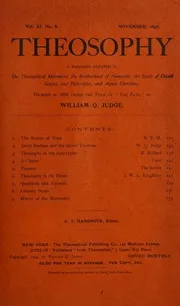
Theosophy 1896-11: Vol 11 Iss 8
 83
83

Theosophy 1896-11: Vol 11 Iss 8

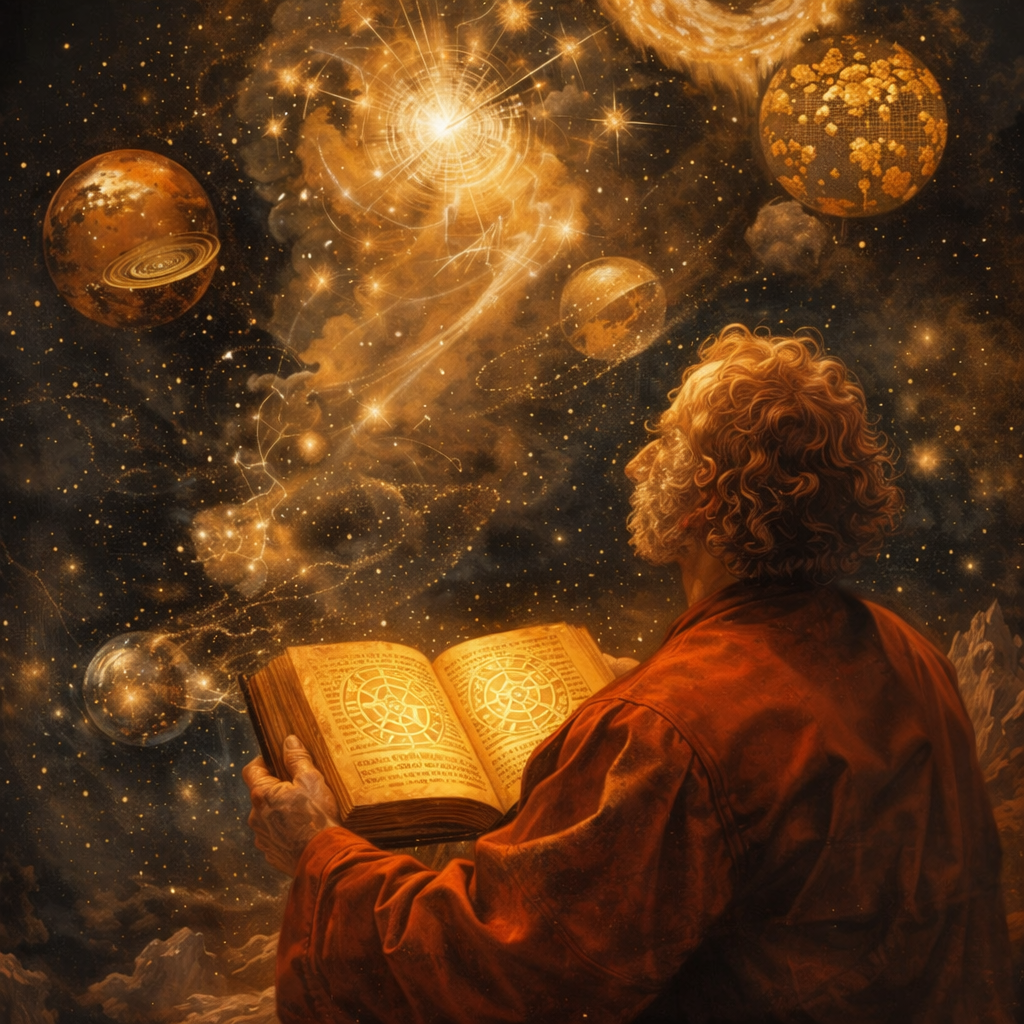

Evander Ashcroft (Alchemy & Hermeticism Editor) — This issue of 'Theosophy' from November 1896 is a potent elixir for the discerning occultist. Its anonymous author(s) delve into complex metaphysical concepts with a clarity that belies the era, illuminating the subtle interplay between the physical and spiritual realms. The strength lies in its comprehensive approach to Theosophical doctrines, offering esoteric insights into karma, reincarnation, and the hierachies of spiritual beings. It is an indispensable resource for serious students of Anthroposophy and Theosophy, providing a rich intellectual and spiritual nourishment for those committed to the Great Work.
📝 Description
83
This November 1896 issue of Theosophy magazine covers occult science and ancient philosophies.
The November 1896 issue of Theosophy magazine presents articles on occult science and spiritual development from a theosophical perspective. It includes discussions on cosmic evolution, the nature of consciousness, and the symbolic interpretations of existence. The content reflects the intellectual currents of the late 19th century, a period when many were examining spiritual and philosophical ideas outside mainstream thought. The aim is to guide readers toward a deeper understanding of reality and the human potential for spiritual growth.
This particular issue delves into the symbolic language and hidden meanings found in various traditions. It seeks to illuminate the connections between different belief systems and the underlying principles of the universe. The articles are written for individuals interested in exploring the metaphysical aspects of life and expanding their awareness beyond ordinary perception. It encourages a thoughtful approach to understanding the mysteries of existence.
Published in 1896, this issue of Theosophy magazine belongs to the broader movement of Western esotericism that gained traction in the late 19th century. Theosophy, as articulated by figures like Helena Blavatsky, sought to synthesize Eastern and Western mystical traditions, presenting a 'universal brotherhood' of spiritual knowledge. This era saw a surge of interest in subjects like occultism, psychic phenomena, and ancient religions, often framed as uncovering lost or suppressed wisdom. The magazine's content reflects this milieu, aiming to articulate a coherent system of spiritual philosophy accessible to its readership.
💡 Why Read This Book?
Unearth profound spiritual insights and hidden philosophical currents from a pivotal moment in esoteric history. Ideal for seekers of ancient wisdom, scholars of comparative religion, and practitioners of inner development who wish to explore the foundational texts of Theosophy and Anthroposophy.
⭐ Reader Reviews
Honest opinions from readers who have explored this book.
❓ Frequently Asked Questions
What is Theosophy?
Theosophy is a philosophical and religious movement founded in the late 19th century, seeking to understand the divine nature of reality and the place of humanity within it, drawing from ancient wisdom traditions and mystical philosophies.
Who were the primary figures associated with Theosophy in 1896?
Key figures include Helena Blavatsky, Henry Steel Olcott, and Annie Besant. This particular issue reflects the intellectual currents and discourse prevalent within the Theosophical Society during that period.
What is Anthroposophy?
Anthroposophy, a spiritual philosophy developed by Rudolf Steiner, builds upon Theosophical ideas but emphasizes human spiritual development and a scientific approach to the spiritual world, often referred to as spiritual science.
Is this book suitable for beginners?
While rich in content, its subject matter can be dense. Beginners might benefit from accompanying it with introductory texts on Theosophy or Anthroposophy for a smoother assimilation of concepts.
What makes this 1896 issue significant?
Published during the formative years of the Theosophical Society, this issue offers a direct window into the foundational discussions, evolving doctrines, and the intellectual fervor surrounding esoteric thought at the turn of the 20th century.
🔮 Key Themes & Symbolism
The Nature of the Divine and Cosmic Order
This theme examines the fundamental understanding of the universe as a manifestation of a divine principle, exploring concepts of a unified source and the intricate laws that govern creation. It examines the hierarchical structure of existence, from the highest spiritual planes to the material world, emphasizing the inherent order and purpose within the cosmos. Readers will encounter discussions on the Seven Planes of Being, the role of Dhyan Chohans, and the grand cycles of manifestation and dissolution, all contributing to a holistic view of reality.
Humanity's Spiritual Evolution and Reincarnation
Central to the issue is the exploration of human spiritual evolution through the doctrine of reincarnation and karma. It posits that the soul undergoes a continuous process of development across multiple lifetimes, learning and purifying itself through experiences. The text elucidates the mechanisms of karma, the law of cause and effect, and the ultimate goal of achieving liberation from the cycle of rebirth. This theme invites contemplation on personal responsibility and the long journey toward self-mastery and spiritual enlightenment.
The Inner Planes and Esoteric Practices
This section illuminates the existence of subtler domains of consciousness and the 'inner planes' of reality, accessible through dedicated spiritual discipline. It touches upon the development of psychic faculties, the nature of the astral body, and the importance of meditation and ethical living in facilitating spiritual progress. The issue hints at practical applications of Theosophical principles, guiding the reader towards cultivating inner awareness and aligning oneself with higher spiritual forces for personal transformation.
💬 Memorable Quotes
Direct passages from the work, attributed to the author.
“Karma is the unerring sculptor of destiny.”
— This highlights the principle of karma as the driving force behind an individual's life experiences and future circumstances, emphasizing that actions have inevitable and precise consequences across lifetimes.
“The path to illumination is paved with self-knowledge.”
— This emphasizes the crucial role of introspection and understanding one's own nature, motivations, and limitations as a prerequisite for spiritual awakening and the attainment of higher wisdom.
“We are but sparks of a divine fire, seeking to return.”
— This poetic metaphor illustrates the belief in the divine origin of every individual soul and its inherent journey back to the ultimate source of spiritual light and unity.
“The silence holds more truth than the loudest pronouncements.”
— This encourages a contemplative approach to wisdom, suggesting that profound truths are often found not in outward noise or dogma, but in inner stillness and intuitive perception.
💡 Key Ideas
Editorial paraphrase of the work's core concepts — not direct quotes.
The universe is a thought made manifest.
This quote expresses the idealistic and spiritual perspective of Theosophy, suggesting that all existence originates from a divine mind or consciousness, and the material world is a projection of this fundamental reality.
🌙 Esoteric Significance
Tradition
This publication is firmly rooted in the esoteric tradition of Theosophy, a movement that sought to revive ancient wisdom and reveal the hidden spiritual truths underlying all religions and philosophies. It draws heavily from concepts found in Hinduism, Buddhism, and Gnosticism, aiming to present a universalist, non-dogmatic spiritual philosophy for the modern age.
Symbolism
The text is rich with symbolism, employing archetypal imagery and allegorical language to convey complex metaphysical ideas. Key symbols likely include the Serpent (representing wisdom and cyclic evolution), the Triangle (divine unity and trinity), the Lotus (spiritual unfolding and purity), and the Eye (divine omniscience and inner vision), inviting readers to interpret beyond the literal meaning to grasp deeper esoteric principles.
Modern Relevance
The enduring relevance of this issue lies in its exploration of timeless themes such as consciousness, karma, reincarnation, and the interconnectedness of all life. In an age often marked by materialism and disconnection, theosophical insights offer a profound framework for understanding the human condition, fostering spiritual growth, and seeking a more meaningful existence. The emphasis on inner development and universal brotherhood remains pertinent for contemporary seekers.
👥 Who Should Read This Book
This issue is a treasure for dedicated students of Theosophy and Anthroposophy, offering a direct glimpse into the movement's foundational discussions. Scholars of comparative religion, mysticism, and the history of esoteric thought will find invaluable primary source material. Seekers of deeper spiritual understanding and practitioners of meditation and self-inquiry will benefit from its profound philosophical and metaphysical explorations. It is particularly suited for those who appreciate rigorous intellectual engagement with spiritual concepts and are interested in the historical evolution of esoteric ideas.
📜 Historical Context
Published in November 1896, this issue of 'Theosophy' emerges from a period of intense spiritual and intellectual ferment in the West. The late 19th century witnessed a surge of interest in Eastern religions, occultism, and alternative philosophies, largely fueled by the burgeoning Theosophical Society. This era saw a rejection of purely materialistic worldviews and a yearning for deeper meaning and connection to the divine. Theosophy, with its syncretic approach, offered a compelling framework that synthesized Eastern wisdom with Western esoteric traditions, influencing thinkers, artists, and spiritual seekers across the globe. This volume stands as a proof of the vibrant discourse and foundational explorations of these profound ideas during a transformative time.
📔 Journal Prompts
Reflect on the concept of 'the universe as a thought made manifest.' How does this perspective influence your understanding of reality and your place within it?
Consider the law of karma as presented in this issue. How might past actions, consciously or unconsciously, be shaping your present circumstances?
Explore the idea of 'inner planes' of consciousness. What are your personal experiences or intuitive understandings of these subtler realms?
The text suggests the path to illumination is paved with self-knowledge. What is one aspect of yourself you are currently seeking to understand more deeply?
How can the principle of universal brotherhood, as likely espoused in Theosophy, be more actively cultivated in your daily life and interactions?
🗂️ Glossary
Theosophy
A philosophical and religious movement founded in the late 19th century, seeking to understand the divine nature of reality and humanity's place within it by synthesizing ancient wisdom traditions and mystical philosophies.
Anthroposophy
A spiritual philosophy developed by Rudolf Steiner, building upon Theosophical ideas, which emphasizes human spiritual development and a scientific approach to the spiritual world, often termed spiritual science.
Karma
The universal law of cause and effect, where every action, thought, or intention has a corresponding consequence that influences present and future experiences, often across multiple lifetimes.
Reincarnation
The doctrine that the soul or spirit, after physical death, begins a new life in a new body, undergoing a continuous process of spiritual evolution through successive existences.
Esoteric
Relating to or intended only for a select group of people having special knowledge or interests, often referring to hidden meanings, spiritual teachings, or mystical practices.
This book appears in 2 collections
🔮 Readers Also Liked
Browse all →





From the “Theosophy” Collection
View all →




More Free Theosophy & Anthroposophy Books
View all →