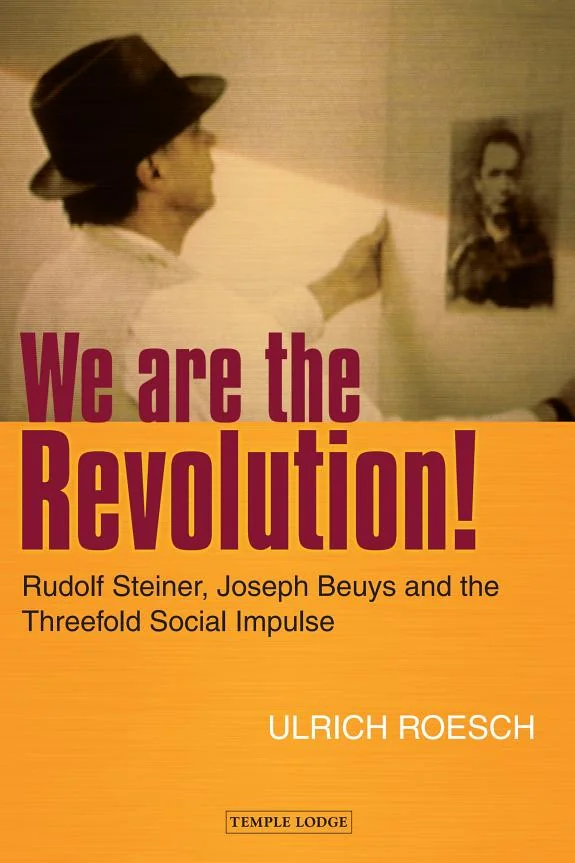
We are the Revolution!
 83
83

We are the Revolution!
Ulrich Rösch’s 2013 work, 'We are the Revolution!', presents a stark, almost biological, imperative for societal change. The central thesis, that stagnation leads to collapse unless a developmental leap occurs, is forcefully articulated. Rösch avoids the usual platitudes, instead offering a clear, if demanding, call to action rooted in his tripartite vision of freedom, equality, and initiative. The comparison of society to a living organism facing a crisis of internal blockages is particularly effective, lending a sense of urgency. However, the book's brevity means it sketches these radical ideas rather than fully developing them. The specific mechanisms for achieving this 'leap in development,' especially within the economic sphere, remain somewhat abstract. While the intent is clearly to provoke thought and inspire action, a more detailed exposition of practical implementation would have strengthened its impact. Nevertheless, as a concise, uncompromising statement on the necessity of societal evolution, Rösch’s work serves as a potent reminder of the risks of inertia.
📝 Description
83
Ulrich Rösch's 2013 book argues societal evolution requires spiritual, cultural, and economic transformation.
First published in 2013, 'We are the Revolution!' by Ulrich Rösch presents a call for societal transformation through spiritual, cultural, and economic change. Rösch frames societal stagnation as a critical condition, likening it to a biological organism needing healing to avoid demise. He redefines revolution not as simple political unrest, but as a significant advancement in collective human development. The book is for individuals troubled by modern society's inertia and searching for methods of constructive change. It will appeal to those interested in the intersection of social critique, spiritual growth, and the dynamics of societal evolution. Readers seeking philosophical justification for social activism and a comprehensive perspective on human progress will find value here.
Rösch's argument centers on the idea that societies, like living organisms, must adapt to survive and thrive. He outlines a three-part vision for a renewed society: freedom in spiritual and cultural life, equality in human rights and democracy, and initiative and solidarity in the economic sphere. This model favors an organic approach to social progress over a mechanical one, emphasizing adaptation as vital for flourishing.
Emerging in 2013 amid global economic uncertainty, Rösch's work connects with traditions critiquing industrial society and advocating for spiritual renewal. It echoes Rudolf Steiner's emphasis on spiritual development for societal structures. The book's tripartite vision—freedom in the spiritual-cultural sphere, equality in human rights, and initiative in the economic sphere—reflects ongoing discussions within Anthroposophy regarding the practical application of its principles to social organization and human progress.
💡 Why Read This Book?
• Understand the necessity of societal evolution by examining the organic analogy Rösch uses, highlighting how social organisms, like living beings, must adapt or perish. • Grasp Rösch's specific vision for societal transformation, focusing on the three core pillars: freedom in the spiritual-cultural realm, equality in human rights, and initiative in the economic sphere. • Gain a framework for analyzing social inertia, recognizing how stagnation and resistance can precipitate a critical need for radical developmental leaps, as detailed in the book's core argument.
⭐ Reader Reviews
Honest opinions from readers who have explored this book.
❓ Frequently Asked Questions
What is the core philosophy behind Ulrich Rösch's 'We are the Revolution!'?
The core philosophy posits that societal stagnation is a precursor to collapse, necessitating a 'leap in development' akin to biological healing. It advocates for freedom in spiritual-cultural life, equality in human rights, and initiative in the economic sphere.
When was 'We are the Revolution!' first published?
'We are the Revolution!' by Ulrich Rösch was first published in 2013.
What is the primary analogy used in the book to explain societal change?
The book uses the analogy of living organisms suffering from inner blockages. Just as these organisms must heal or die, Rösch argues that societies facing stagnation require drastic change to avoid collapse.
What are the three main spheres of societal transformation proposed by Rösch?
Rösch proposes transformation across three spheres: the spiritual-cultural life (emphasizing freedom), human rights (emphasizing equality and democracy), and the economic sphere (emphasizing initiative and solidarity).
Is 'We are the Revolution!' a political manifesto or a spiritual one?
It bridges both, framing societal revolution as a necessary evolutionary leap driven by spiritual and cultural renewal, alongside democratic and economic reforms. It's a call for holistic societal transformation.
What is the main driver of revolution according to the book?
The book argues that revolutions are driven by societal non-change and resistance. When society fails to evolve organically, stagnation builds, creating a situation where a drastic leap in development becomes essential for survival.
🔮 Key Themes & Symbolism
Societal Organism Analogy
Rösch frames society as a living organism susceptible to stagnation and disease. This crucial analogy, central to the work, suggests that just as biological entities must adapt and heal to survive, social structures require periodic, drastic evolution to overcome internal blockages and avoid collapse. This perspective moves beyond purely political or economic analyses to embrace a more holistic, almost vitalistic, understanding of collective human development.
The Three Spheres of Revolution
The book outlines a vision for societal transformation structured around three interconnected domains: the spiritual-cultural life, human rights, and the economic sphere. Rösch champions 'freedom' for the former, 'equality and democracy' for the latter, and 'initiative and solidarity' for economic activity. This tripartite model provides a framework for understanding the necessary components of a truly evolved society, aiming for balance and mutual reinforcement across these fundamental areas.
The Necessity of Evolutionary Leaps
Central to Rösch's argument is the concept that 'revolutions' are not necessarily violent overthrows but essential 'leaps in development' triggered by societal inertia. When a social organism fails to adapt organically, resistance builds, creating a critical point where dramatic change becomes the only path to avoid disintegration. This perspective redefines revolution as a natural, albeit sometimes drastic, evolutionary process.
Freedom, Equality, Initiative
These three principles form the bedrock of Rösch's proposed societal restructuring. 'Freedom' is designated for the spiritual and cultural dimensions, allowing for authentic expression and development. 'Equality and democracy' are assigned to the field of human rights, ensuring fair treatment and collective governance. Finally, 'initiative and solidarity' are called for in the economic sphere, fostering both individual enterprise and communal support, creating a dynamic and just socio-economic system.
💬 Memorable Quotes
Direct passages from the work, attributed to the author.
“Freedom for the spiritual-cultural life, equality and democracy for human rights, initiative and solidarity for the economic sphere!”
— This is the foundational declaration of Rösch's vision. It succinctly outlines the essential pillars for a revitalized society, emphasizing distinct yet interconnected principles for each major domain of human activity.
“Revolutions happen when society does not change and evolve. Stagnation and resistance create a situation in which a leap in development is required.”
— This statement defines the book's core premise: revolution as an inevitable consequence of societal inertia. It reframes upheaval not as an anomaly, but as a necessary evolutionary response to prolonged stagnation.
“In nature, living organisms suffering from inner blockages must heal or die. The same applies to the social organism--society--which occasionally requires drastic change to avoid complete collapse or violent revoluti”
— This potent analogy draws a direct parallel between biological and social health. It underscores the idea that societies, like organisms, have mechanisms for adaptation, and failure to respond to 'inner blockages' can lead to terminal decline.
“Initiative and solidarity for the economic sphere!”
— This specific call to action within the economic domain suggests a balance. It advocates for encouraging individual and collective enterprise ('initiative') while ensuring a foundation of mutual support and community wellbeing ('solidarity').
💡 Key Ideas
Editorial paraphrase of the work's core concepts — not direct quotes.
The same applies to the social organism--society--which occasionally requires drastic change to avoid complete collapse or violent revolution.
This paraphrase from the blurb highlights the critical point that societal change, even drastic change, is a survival mechanism. It suggests that the alternative to planned evolution is often uncontrolled collapse or destructive conflict.
🌙 Esoteric Significance
Tradition
The work aligns with certain streams of Western Esotericism that seek to understand and transform social structures through spiritual principles. It shares conceptual ground with Anthroposophy's focus on the spiritual evolution of humanity and society, particularly its ideas on the Threefold Social Order. Rösch departs from purely theoretical Anthroposophy by presenting a more direct, manifesto-like call for immediate societal 'revolution' as a necessary developmental leap.
Symbolism
The central symbolic structure is the 'social organism,' representing society as a living entity with needs for balance and adaptation. The tripartite division—spiritual-cultural, rights, economic—acts as a symbolic map for societal health, where each sphere has a distinct vital function. 'Freedom,' 'equality,' and 'initiative' function as symbolic ideals guiding the harmonious interaction and development of these spheres.
Modern Relevance
Rösch's ideas resonate with contemporary movements focused on social innovation, conscious capitalism, and holistic approaches to governance. Thinkers and practitioners exploring alternative economic models, such as cooperative enterprises and social impact investing, might find the emphasis on 'initiative and solidarity' particularly relevant. The call for a spiritual-cultural renaissance also connects with current discussions on values-based living and the search for meaning beyond materialism.
👥 Who Should Read This Book
• Social reformers and activists seeking a philosophical framework for systemic change, offering a holistic view beyond purely political or economic solutions. • Students of Anthroposophy and the Threefold Social Order, interested in a concise, action-oriented interpretation of these principles applied to contemporary societal challenges. • Individuals concerned with societal inertia and seeking a conceptual understanding of how stagnation necessitates evolutionary leaps for collective survival and progress.
📜 Historical Context
Published in 2013, Ulrich Rösch's 'We are the Revolution!' emerged during a period marked by the lingering effects of the 2008 global financial crisis and widespread social and political disillusionment. The work’s emphasis on spiritual freedom, democratic human rights, and economic initiative echoes themes explored by thinkers associated with Anthroposophy and the Threefold Social Order movement, particularly Rudolf Steiner, who advocated for a separation of the cultural, rights, and economic spheres. While not a direct response to a specific event, the book tapped into a broader zeitgeist of questioning established social and economic paradigms. Unlike more radical political manifestos of the time, Rösch's approach sought a fundamental, evolutionary shift rooted in spiritual renewal. The work implicitly engages with critiques of materialism and capitalist excess prevalent in various social reform circles, positioning itself as a holistic alternative.
📔 Journal Prompts
The social organism's need for a leap in development: When has your community or society demonstrated stagnation?
Reflect on the principle of 'freedom for the spiritual-cultural life' in your own context.
Analyze the balance of 'initiative and solidarity' within your local economic activities.
Consider the concept of 'inner blockages' within societal structures you observe.
Evaluate the implementation of 'equality and democracy' in contemporary human rights frameworks.
🗂️ Glossary
Social Organism
A metaphor used by Rösch to conceptualize society as a living entity. This perspective implies that society has needs for growth, adaptation, and healing, and that prolonged dysfunction can lead to collapse if not addressed through fundamental change.
Leap in Development
Rösch's term for a necessary, often drastic, period of change or transformation that a society must undergo to overcome stagnation and avoid collapse. It signifies a qualitative shift rather than mere incremental progress.
Spiritual-Cultural Life
The sphere of human activity concerned with art, religion, philosophy, education, and creative expression. Rösch advocates for freedom within this domain as a vital component of societal health.
Human Rights Sphere
The domain encompassing legal, political, and social rights essential for individual dignity and societal justice. Rösch emphasizes the need for equality and democratic principles here.
Economic Sphere
The field of production, distribution, and consumption of goods and services. Rösch calls for a balance of 'initiative' (enterprise) and 'solidarity' (mutual support) within this sphere.
Stagnation and Resistance
Conditions within a society where change is resisted or fails to occur, leading to a buildup of internal blockages. According to Rösch, these conditions necessitate a 'leap in development' or revolution.
Threefold Social Order
A concept, often associated with Rudolf Steiner, advocating for the functional separation and spiritual renewal of the cultural, rights, and economic spheres of society. Rösch's work echoes this structure.
This book appears in 1 collection
🔮 Readers Also Liked
Browse all →



From the “Anthroposophy” Collection
View all →




More Free Theosophy & Anthroposophy Books
View all →