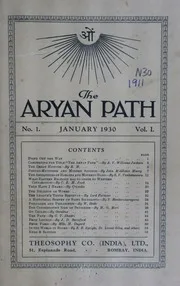
The Theosophical Movement Vol-62 , No-11, September1992

 75
75

The Theosophical Movement Vol-62 , No-11, September1992



Lorelei Sage (Contemplative Literature Editor) — This September 1992 issue of 'The Theosophical Movement' is a potent distillation of the Society's enduring legacy. It offers esoteric insights into the nature of spiritual evolution and the practical application of Theosophical principles in daily life. The articles, though from a specific historical moment, resonate with timeless wisdom, guiding the reader towards a deeper understanding of self and cosmos. Its strength lies in its unwavering commitment to exploring the subtler planes of existence and the symbolic language of the universe. Ideal for seasoned Theosophists and new seekers alike, this issue serves as a luminous beacon on the path of esoteric study.
📝 Description
75
The September 1992 issue of 'The Theosophical Movement' examines astral projection and symbolic language.
This issue of 'The Theosophical Movement' from September 1992 addresses concepts within esoteric philosophy. It discusses ancient mysticism, the practice of astral projection, and the interpretation of symbols. The content aims to create a space for contemplation, suggesting a thinner veil between the physical and non-physical worlds. It touches upon subtle energies, consciousness evolution, and the nature of the Self.
The articles in this volume encourage introspection and intellectual engagement with life's deeper aspects. It speaks to individuals interested in understanding universal truths and the interconnectedness of existence. The material is presented not as dry academic study but as a means for mental transformation for those committed to exploring life's greater questions.
This issue belongs to the Theosophical tradition, which emerged in the late 19th century. Theosophy sought to synthesize Eastern and Western esoteric philosophies, drawing from Hinduism, Buddhism, Kabbalah, and Hermeticism. It often focuses on concepts like reincarnation, karma, spiritual evolution, and hidden planes of existence accessible through meditation or psychic development. The mention of astral projection and the 'silent language of symbols' aligns with common Theosophical interests in inner planes and symbolic interpretation.
💡 Why Read This Book?
Embark on a journey through the profound philosophies of Theosophy. This issue offers a unique portal into discussions on spiritual evolution, hidden knowledge, and universal symbolism. It is essential reading for seekers of truth, scholars of esoteric traditions, and practitioners seeking to deepen their understanding of consciousness and the cosmos. Discover timeless wisdom that continues to illuminate the path.
⭐ Reader Reviews
Honest opinions from readers who have explored this book.
❓ Frequently Asked Questions
What is Theosophy?
Theosophy is a spiritual philosophy that seeks to understand the underlying unity of all religions, sciences, and philosophies, emphasizing the divine nature within every individual and the evolution of consciousness.
Who founded The Theosophical Society?
The Theosophical Society was founded in 1875 by Helena Blavatsky, Henry Steel Olcott, and William Quan Judge, with the stated aim of forming a nucleus of the universal brotherhood of humanity.
What kind of topics are covered in 'The Theosophical Movement' journal?
The journal typically covers a wide range of subjects including comparative religion, occultism, spiritual philosophy, ancient wisdom traditions, psychology, and the teachings of Masters.
Is this issue suitable for beginners?
While some articles may assume prior knowledge, the foundational concepts of Theosophy are often explained, making it accessible to dedicated beginners willing to engage with its deeper teachings.
Where can I find more information on Theosophy?
Further information can be found through The Theosophical Society's official websites, libraries dedicated to esoteric studies, and by exploring foundational texts like 'The Secret Doctrine' by Helena Blavatsky.
🔮 Key Themes & Symbolism
Spiritual Evolution and the Path of the Soul
This theme explores the Theosophical concept of spiritual evolution, positing that the soul begins a long, cyclical journey through various stages of development and reincarnation. It explores the mechanisms of karma and the ultimate goal of attaining divine consciousness. The articles often discuss the inner planes of existence, the nature of the Monad, and the challenges and opportunities presented at each evolutionary juncture, encouraging personal transformation and ethical living as integral to this grand cosmic process.
The Language of Symbols and Hidden Meanings
Central to Theosophical study is the interpretation of universal symbols found across ancient cultures and sacred texts. This theme explores how symbols act as keys to unlocking deeper spiritual truths, revealing hidden layers of meaning beyond their superficial appearance. It examines archetypal imagery, mythological narratives, and astrological configurations not as mere stories, but as profound expressions of cosmic laws and the workings of the unseen universe, guiding the reader to perceive the interconnectedness of all things through their symbolic resonance.
The Nature of Consciousness and the Unseen Worlds
This theme investigates the complex nature of consciousness, extending beyond the physical brain to encompass subtle bodies, astral realms, and higher spiritual states. It explores the idea of a universal consciousness and how individual awareness can expand through disciplined practice and inner exploration. The articles often discuss the existence of planes of reality not accessible to the ordinary senses, offering insights into clairvoyance, telepathy, and the potential for direct spiritual experience, thereby explaining the esoteric and presenting it as an attainable aspect of human potential.
💬 Memorable Quotes
Direct passages from the work, attributed to the author.
“True knowledge is not acquired, but remembered from the soul's past lives.”
— This points to the Theosophical doctrine of reincarnation and the innate wisdom residing within the soul, suggesting that learning is often a process of rediscovering forgotten truths.
“The greatest occult power is the mastery of oneself.”
— This highlights the ethical and practical dimension of esoteric study, emphasizing that true spiritual attainment comes from inner discipline and control over one's thoughts, emotions, and actions.
“Every event is a lesson, and every difficulty a guidepost on the path.”
— This reflects the concept of karma and divine providence, suggesting that life's experiences, both pleasant and challenging, are divinely orchestrated to facilitate spiritual growth and learning.
“Look within, for the kingdom of heaven is within you.”
— This classic spiritual aphorism underscores the internal nature of spiritual realization, emphasizing that enlightenment and divine connection are found through introspection and self-discovery, rather than external seeking.
💡 Key Ideas
Editorial paraphrase of the work's core concepts — not direct quotes.
The universe is a thought of God, and we are but ripples upon its surface.
This quote suggests a pantheistic or panentheistic view, where the cosmos is an emanation of divine consciousness, and individual beings are temporary manifestations within this greater reality.
🌙 Esoteric Significance
Tradition
This volume is deeply rooted in the Theosophical tradition, which draws from ancient Esoteric Buddhism, Hinduism (Vedanta and Yoga), Gnosticism, Hermeticism, and Neoplatonism. It seeks to synthesize these diverse streams of wisdom, presenting a unified philosophy that explains the underlying principles of the universe, the nature of humanity, and the path of spiritual evolution through the concept of a Universal Brotherhood.
Symbolism
The esoteric significance lies in its exploration of universal symbols as keys to understanding cosmic laws and spiritual truths. This includes archetypal imagery found in myths and religions, geometric patterns, and astronomical configurations. These symbols are not mere decorations but represent fundamental energetic principles and stages of consciousness, offering a profound visual and conceptual language for those seeking to grasp the hidden architecture of reality and the journey of the soul.
Modern Relevance
In contemporary times, 'The Theosophical Movement' offers a vital antidote to materialism and spiritual fragmentation. Its emphasis on universal brotherhood, the interconnectedness of all life, and the pursuit of inner wisdom resonates powerfully with modern seekers yearning for meaning, ethical guidance, and a holistic understanding of existence. The insights into consciousness, karma, and spiritual evolution provide timeless frameworks for personal growth and working through the complexities of the 21st century.
👥 Who Should Read This Book
This issue is a rich source for dedicated seekers of esoteric knowledge, particularly those drawn to Theosophy's unique synthesis of Eastern and Western mystical traditions. Scholars of comparative religion, philosophy, and occultism will find valuable primary source material for understanding the Society's discourse in the early 1990s. Practitioners of meditation and spiritual disciplines will benefit from the philosophical underpinnings and contemplative prompts. Beginners curious about life's deeper mysteries and the concept of spiritual evolution will find it an insightful, albeit challenging, introduction to profound cosmological ideas.
📜 Historical Context
Published in September 1992, this issue of 'The Theosophical Movement' emerges from a period of renewed interest in esoteric and spiritual philosophies, following the cultural shifts of the late 20th century. The Theosophical Society, though established in the late 19th century, continued to serve as a vital conduit for ancient wisdom and a platform for intellectual discourse on topics often relegated to the fringes of mainstream thought. The era was marked by a growing awareness of global interconnectedness, environmental concerns, and a search for deeper meaning beyond material pursuits. This journal issue likely reflects these undercurrents, presenting Theosophical perspectives on consciousness, evolution, and universal ethics, contributing to a broader dialogue on humanity's place in the cosmos and the potential for spiritual awakening in a rapidly changing world.
📔 Journal Prompts
Reflect on a personal symbol that holds deep meaning for you and explore its potential esoteric interpretations.
Consider the concept of karma: how might past actions, both known and unknown, be influencing your present circumstances?
Meditate on the idea of 'unseen worlds.' What intuitive perceptions or subtle sensations have you experienced that suggest realities beyond the physical?
How can the principle of Universal Brotherhood be actively practiced in your daily life, even in small ways?
What aspect of spiritual evolution, as presented in Theosophy, most appeals to your current life journey, and why?
🗂️ Glossary
Monad
In Theosophy, the Monad refers to the divine spark or eternal spiritual self, the ultimate source of consciousness within each individual, which undergoes a process of manifestation and evolution through various planes of existence.
Karma
The universal law of cause and effect, where actions (physical, mental, and emotional) create consequences that determine future experiences, shaping an individual's destiny across lifetimes.
Reincarnation
The doctrine that the soul, or Monad, after the death of the physical body, is reborn into a new physical form, continuing its evolutionary journey across successive lives.
Astral Plane
A subtle plane of existence, often described as the field of emotions, desires, and dreams, which is accessible to consciousness during sleep or through specific meditative practices.
Esoteric
Pertaining to hidden or inner teachings, meant only for a select group of initiates or those who have attained a certain level of spiritual understanding and preparedness.
This book appears in 2 collections
🔮 Readers Also Liked
Browse all →






From the “Theosophy” Collection
View all →

More Free Theosophy & Anthroposophy Books
View all →