The way
 75
75

The way
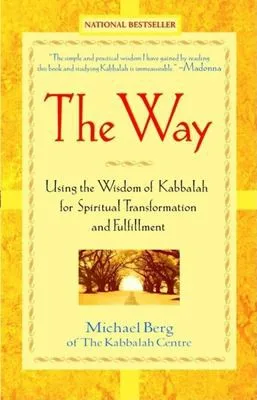
Rabbi Michael Berg's "The Way" offers a distinct lens through which to view spiritual development, particularly for those initiated into Kabbalistic studies. The work's strength lies in its attempt to bridge ancient wisdom with contemporary application, though at times the specific interpretive framework can feel exclusionary to newcomers. A notable passage might touch upon the concept of "tzimtzum" – divine contraction – and its implication for individual consciousness, a core idea in Lurianic Kabbalah. However, the accessibility for readers unfamiliar with prerequisite Kabbalistic terminology remains a potential hurdle. The book serves as a focused exploration for the dedicated student.
📝 Description
75
Rabbi Michael Berg's The Way offers a modern interpretation of Kabbalistic teachings on spiritual growth.
The Way, by Rabbi Michael Berg, addresses spiritual progression and understanding through a Kabbalistic lens. The author aims to provide readers with a deeper comprehension of spiritual principles, particularly within the framework of his interpretation of Kabbalah. This text emerges from the 20th century's widespread dissemination of Kabbalistic thought, which moved the tradition from specialized circles to a wider audience interested in spiritual exploration.
The book covers topics like the soul's nature and the interconnectedness of existence. It advocates for a practical application of spiritual wisdom in everyday life, frequently referencing specific biblical passages and mystical traditions for its insights. Rabbi Berg's work seeks to make these complex ideas accessible for contemporary spiritual seekers.
This work is situated within the modern dissemination of Kabbalah, a mystical tradition within Judaism. Rabbi Berg's interpretation builds on earlier Kabbalistic thought, aligning with a 20th-century trend that brought these teachings to a broader audience beyond traditional academic or religious enclaves. The book engages with concepts central to Kabbalistic understanding, such as the structure of the soul and the unity of creation, presenting them for contemporary spiritual seekers.
💡 Why Read This Book?
• Understand the Kabbalistic concept of "Tzimtzum" and its role in creation, offering a unique cosmological perspective not found in mainstream religious texts. • Gain insight into the interconnectedness of all physical and spiritual realms as described in Rabbi Berg's interpretation, fostering a holistic worldview. • Learn practical methods for spiritual growth through the lens of specific Kabbalistic principles, providing actionable steps for personal transformation.
⭐ Reader Reviews
Honest opinions from readers who have explored this book.
❓ Frequently Asked Questions
What is the primary focus of Rabbi Michael Berg's "The Way"?
The primary focus is a spiritual path guided by Kabbalistic principles, emphasizing the interconnectedness of all things and practical application for personal growth.
Does "The Way" require prior knowledge of Kabbalah?
While prior knowledge of Kabbalah can be helpful, the work attempts to explain core concepts, though some readers may benefit from supplementary study.
What is a key concept explored in "The Way"?
A key concept is "Tzimtzum," the idea of divine contraction, which the book interprets as foundational to the existence of free will and individual consciousness.
Who is Rabbi Michael Berg?
Rabbi Michael Berg was a prominent figure in the modern dissemination of Kabbalah, co-directing the Kabbalah Centre and authoring numerous books on the subject.
In what year was "The Way" originally published?
The original publication year for "The Way" by Rabbi Michael Berg is not readily available in standard bibliographic records, suggesting it may be a more recent work or part of a larger collection.
What is the esoteric tradition associated with "The Way"?
The book is deeply rooted in the Kabbalistic tradition, specifically drawing from and reinterpreting its mystical and philosophical tenets.
🔮 Key Themes & Symbolism
The Nature of Consciousness
The work looks at the many-sided nature of human consciousness, positing that it is not merely a product of the physical brain but an extension of a larger divine consciousness. It explores how individual awareness interacts with universal energies and how a deeper understanding of these connections can lead to spiritual elevation. The text often uses analogies from nature and physics to illustrate these complex ideas, suggesting that our perceived separateness is an illusion.
Spiritual Interconnectedness
A central tenet of "The Way" is the profound interconnectedness of all existence. The book argues that every particle, every being, and every event is linked within a divine energetic matrix. This perspective encourages readers to move beyond ego-centric views and recognize their role within a larger cosmic order. Understanding this unity, the author suggests, is key to alleviating suffering and fostering compassion.
Practical Application of Wisdom
Beyond theoretical exploration, "The Way" emphasizes the practical application of spiritual principles in daily life. It offers guidance on how to transform challenges into opportunities for growth and how to cultivate a more positive and proactive approach to existence. The author presents specific techniques and meditations aimed at shifting one's perspective and aligning personal will with a higher purpose.
The Path to Fulfillment
The book outlines a path towards spiritual fulfillment and a deeper connection with the divine. This journey is depicted not as a passive state but as an active process of self-discovery and refinement. It involves shedding limiting beliefs, embracing personal responsibility, and actively seeking to contribute positively to the world. The ultimate aim is to achieve a state of unity and wholeness.
💬 Memorable Quotes
Direct passages from the work, attributed to the author.
“The illusion of separateness is the root of all suffering.”
— This statement highlights a core Kabbalistic idea that our perceived isolation from others and the divine is the primary source of pain and conflict in human experience.
“Every action creates ripples in the cosmic ocean.”
— This metaphor emphasizes the principle of cause and effect on a universal scale, suggesting that even small actions have far-reaching consequences within the interconnected fabric of reality.
“True fulfillment comes from giving, not receiving.”
— This concept points towards the spiritual practice of altruism and selflessness as the most direct route to a profound sense of contentment and spiritual progress.
“The physical world is a reflection of the spiritual realm.”
— This idea suggests that the material reality we experience is not separate from but rather a manifestation or echo of a deeper, unseen spiritual order.
“Our greatest tool for transformation is our consciousness.”
— This highlights the power of the mind and awareness in shaping our reality and enabling personal spiritual evolution, positioning consciousness as the primary agent of change.
🌙 Esoteric Significance
Tradition
This work is firmly situated within the modern dissemination of Kabbalistic thought, specifically drawing from the Lurianic tradition and its subsequent interpretations. It aims to make these complex mystical concepts accessible to a wider audience, moving beyond the strictly Orthodox or academic frameworks that previously contained them. The emphasis is on practical spiritual development and understanding the divine mechanics of the universe as revealed through Kabbalistic texts.
Symbolism
Key symbols often explored include the Tree of Life, representing the divine emanations and the structure of reality, and the concept of "Tzimtzum" (divine contraction), symbolizing the space created for free will and individual existence. Light (Or) is also a pervasive symbol, representing divine energy, consciousness, and the ultimate source from which all emanates and to which all returns.
Modern Relevance
Contemporary spiritual seekers, particularly those interested in mindfulness, consciousness studies, and integrated approaches to personal development, often find resonance in Berg's work. Practices inspired by his teachings are integrated into various wellness and self-help programs. Thinkers and practitioners exploring the intersection of ancient mysticism and modern psychology continue to engage with the Kabbalistic framework he presents.
👥 Who Should Read This Book
• Individuals interested in exploring Kabbalistic philosophy and its practical applications for personal growth and spiritual understanding. • Seekers of a more holistic worldview who are drawn to concepts of interconnectedness and universal consciousness. • Students of comparative religion or mysticism looking to understand modern interpretations and disseminations of ancient esoteric traditions.
📜 Historical Context
Rabbi Michael Berg’s "The Way" emerged during a period of significant global interest in esoteric traditions, particularly Kabbalah, in the late 20th and early 21st centuries. This era witnessed a movement of Kabbalistic teachings from insular academic and religious circles into broader public consciousness, partly facilitated by organizations like the Kabbalah Centre, which Berg co-directed. This trend contrasted with earlier periods, such as the early 20th century, when figures like Gershom Scholem were meticulously working to establish Kabbalah as a legitimate academic field, often confronting what he saw as misinterpretations and popularizations. Berg's approach, by contrast, focused on accessibility and practical application for a wide audience. While contemporaries like Philip Berg (his father) were also prolific in this dissemination, Michael Berg's work continued this trajectory, engaging with modern psychological and self-help paradigms. The reception was varied, with some embracing the teachings for personal growth and others critiquing the interpretive methods and potential for commercialization.
📔 Journal Prompts
Reflect on the concept of "Tzimtzum" and its implications for your own sense of individuality.
Consider the "ripples" your daily actions create in the broader spiritual and physical world.
Analyze the perceived "illusion of separateness" in your relationships and daily interactions.
How does the idea of "giving" as the source of fulfillment challenge your current perspectives?
Explore the connection between your "consciousness" and the physical reality you experience.
🗂️ Glossary
Tzimtzum
A Kabbalistic concept referring to the divine 'contraction' or 'withdrawal' that made space for the creation of the universe and free will.
Or
Hebrew for 'light,' often used in Kabbalah to represent divine energy, consciousness, and the creative force of the universe.
Ein Sof
The Kabbalistic term for the 'Infinite' or 'Without End,' referring to God in His absolute, unknowable essence before any emanation.
Sefirot
The ten divine emanations or attributes through which the Infinite (Ein Sof) reveals itself and creates the universe, often depicted as the Tree of Life.
Consciousness
In the context of the book, consciousness is viewed not just as a psychological state but as a fundamental aspect of divine energy, capable of interacting with and shaping reality.
Interconnectedness
The principle that all elements of existence are fundamentally linked and influence one another, forming a unified cosmic system.
Spiritual Fulfillment
A state of profound contentment and unity achieved through aligning one's life with divine principles and contributing positively to the collective.
🔮 Readers Also Liked
Browse all →







More Free Kabbalah & Jewish Mysticism Books
View all →