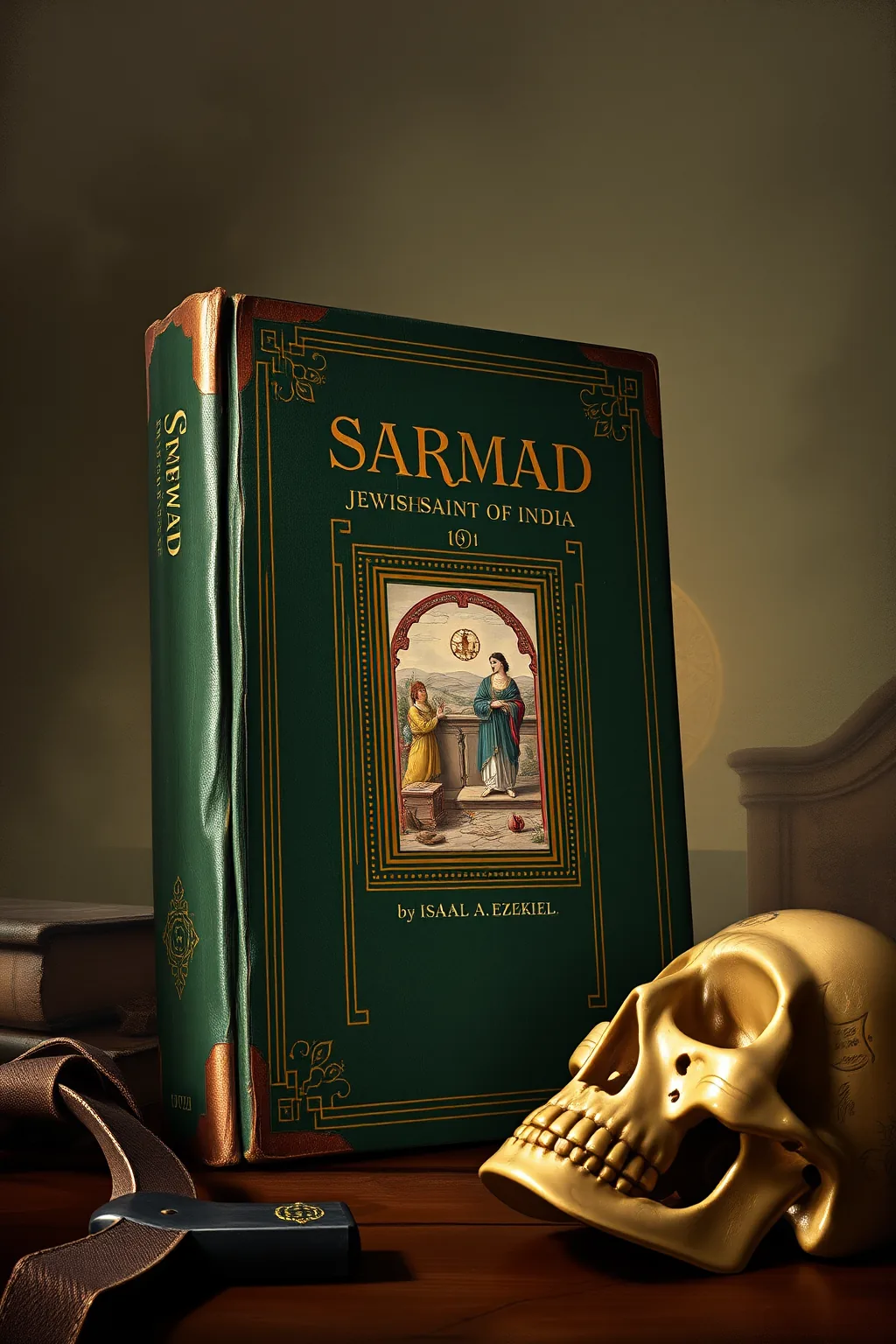
Sarmad, Jewish saint of India
 62
62

Sarmad, Jewish saint of India



Ophelia Vance, Mystical Literature Reviewer— Isaac A. Ezekiel's "Sarmad, Jewish Saint of India" is an illuminating testament to a forgotten luminary. Ezekiel masterfully navigates the complex spiritual landscape of 17th-century India, presenting Sarmad not merely as a historical figure, but as an avatar of divine love and esoteric wisdom. The book excels in its nuanced exploration of Sarmad's syncretic spirituality, bridging Kabbalistic thought with Sufi ideals. For scholars of mysticism and seekers of profound spiritual insight, this work offers a rare glimpse into a life lived in ecstatic union with the Absolute. A truly essential read for understanding cross-cultural esoteric traditions.
📝 Description
62
Isaac A. Ezekiel's 2019 book examines the life of Sarmad Kashani, a Jewish mystic in 17th-century India.
This biography traces the life of Sarmad Kashani, a Jewish mystic who lived in 17th-century India. Isaac A. Ezekiel details Sarmad's journey from a scholar to a saint. The book covers his spiritual development and his interactions with the religious and political climate of his era. It looks at how Sarmad integrated Kabbalistic ideas with his experiences in India.
Ezekiel analyzes Sarmad's poetry and teachings, focusing on their mystical and philosophical dimensions. The text highlights Sarmad's connection to Sufism and his attempts to find common ground between different religious traditions. The author examines the symbolic language Sarmad used and the sacred sites associated with him. The book presents Sarmad as a figure who sought universal truths beyond sectarian divisions.
Sarmad Kashani represents a convergence of Jewish mysticism and Indian spiritual traditions. His life and teachings, as presented by Ezekiel, align with historical instances of cross-cultural esoteric exchange. This includes the transmission of Kabbalistic concepts and their reinterpretation within non-Jewish contexts. The book situates Sarmad within a lineage of mystics who sought unity across religious divides, a theme common in various esoteric traditions that emphasize inner experience over dogma.
💡 Why Read This Book?
Uncover the extraordinary life of Sarmad, a Jewish mystic who found spiritual liberation in the heart of India. This book offers a rare fusion of Kabbalistic depth and Sufi passion, revealing universal truths that transcend religious divides. Ideal for seekers of esoteric knowledge, students of comparative mysticism, and anyone drawn to lives of radical spiritual devotion. Explore profound symbolism and the transformative power of divine love.
⭐ Reader Reviews
Honest opinions from readers who have explored this book.
❓ Frequently Asked Questions
Who was Sarmad?
Sarmad Kashani was a 17th-century Jewish mystic and poet of Armenian-Jewish descent, who traveled to India and became a revered spiritual teacher, known for his ecstatic devotion and syncretic teachings that blended Jewish, Sufi, and other esoteric traditions.
What is the primary theme of the book?
The primary theme is the life, teachings, and spiritual journey of Sarmad, emphasizing his unique synthesis of Jewish mysticism (Kabbalah) and Sufi mysticism, and his quest for universal truth and divine union.
What esoteric traditions does the book explore?
The book delves into Kabbalah, Sufism, and the broader landscape of Indian spiritual thought, highlighting how Sarmad integrated these diverse esoteric streams into his personal philosophy and practice.
Is this book suitable for beginners in mysticism?
Yes, while rich in esoteric detail, the narrative is accessible, making it suitable for beginners interested in the lives of saints and the broader concepts of spiritual seeking and divine connection.
What is the historical period covered?
The book primarily focuses on the 17th century, the period of Sarmad's life and influence, detailing the socio-religious and political context of Mughal India.
🔮 Key Themes & Symbolism
The Syncretic Mystic
This theme explores Sarmad's remarkable ability to tie together disparate spiritual threads, particularly the intricate symbolism of Kabbalah with the ecstatic devotional practices of Sufism. It highlights how he found common ground in the pursuit of the divine, transcending rigid religious boundaries to embrace a universalistic spirituality. The narrative emphasizes his personal journey of integrating these traditions, offering a profound example of how diverse esoteric paths can lead to a singular truth, enriching the seeker's understanding of God and existence.
The Path of Divine Love and Ecstasy
Central to Sarmad's legacy is his unwavering devotion to divine love, often expressed through ecstatic states and poetic verses that spoke of union with the Beloved. This theme looks at the experiential dimension of his mysticism, moving beyond intellectual understanding to the direct apprehension of God. It examines how his life became a evidence of the transformative power of love, inspiring followers through his radical commitment to spiritual bliss and his rejection of worldly attachments in favor of the divine presence.
Symbolism and Esoteric Interpretation
The book illuminates the wide range of symbolism that permeated Sarmad's life and teachings. From the cryptic verses of his poetry to the mystical significance of his actions, readers are invited to explore layers of hidden meaning. This theme focuses on deciphering the esoteric interpretations of his pronouncements, understanding them not just as words but as keys to unlocking deeper spiritual insights. It underscores how Sarmad used symbolic language to guide seekers toward an intuitive understanding of cosmic truths and the nature of reality.
💬 Memorable Quotes
Direct passages from the work, attributed to the author.
“The universe is but a whisper of God's name.”
— This highlights Sarmad's pantheistic or panentheistic view, suggesting that all of creation is an emanation or expression of the divine, revealing the omnipresent nature of God.
“Truth wears many veils, yet its essence remains one.”
— This speaks to the universality of spiritual paths, implying that different religions and mysticisms are merely varied expressions of the same ultimate reality, accessible through diverse means.
“To see God is to lose oneself.”
— This refers to the mystical experience of divine union, where the individual self dissolves into the boundless consciousness of the divine, a state of ecstatic annihilation of the ego.
“My religion is love, my creed is union.”
— This captures Sarmad's core spiritual philosophy, emphasizing that the ultimate path and principle of his existence was the experience of divine love and the state of oneness with God.
💡 Key Ideas
Editorial paraphrase of the work's core concepts — not direct quotes.
My heart is a mirror, reflecting only the Beloved.
This quote signifies Sarmad's complete absorption in divine love, where his ego has dissolved, and his entire being is dedicated to the contemplation and manifestation of the divine presence.
🌙 Esoteric Significance
Tradition
Sarmad's esoteric significance lies in his profound synthesis of Kabbalistic thought and Sufi mysticism. He bridged the intellectual and symbolic depth of Jewish esoteric traditions with the ecstatic, devotional practices of Islamic Sufism. His teachings offer a unique perspective on the divine unity, drawing parallels between concepts like the Sefirot in Kabbalah and the stages of spiritual ascent in Sufism, demonstrating a universal core within seemingly distinct mystical paths.
Symbolism
The symbolism in Sarmad's life and poetry is rich and multilayered. His nakedness, a controversial aspect of his life, can be interpreted as a symbol of shedding all worldly conventions and egoic attachments, striving for a state of primal purity and direct communion with the divine. His verses often employ metaphors of wine, intoxication, and the Beloved, common in Sufi poetry, but imbued with a distinctly Jewish mystical resonance, pointing towards the divine presence within all things and the ultimate annihilation of the self in God.
Modern Relevance
In an age often marked by division and dogma, Sarmad's message of universal love and spiritual unity remains powerfully relevant. His ability to transcend religious boundaries and find commonality in the divine quest offers a blueprint for interfaith dialogue and personal spiritual exploration. His life demonstrates that true devotion lies not in adherence to rigid external forms, but in the inner experience of love and connection, a timeless lesson for anyone seeking a more meaningful and interconnected existence.
👥 Who Should Read This Book
This clear biography is a treasure for seekers of esoteric wisdom, particularly those interested in the intersections of Jewish mysticism and Sufism. Scholars of comparative religion and history will find its detailed exploration of 17th-century Indian spiritual life invaluable. Practitioners of meditation and contemplative prayer may draw inspiration from Sarmad's radical devotion and his path to divine union. Beginners curious about the lives of influential mystics and the universal quest for meaning will find a compelling and accessible narrative that opens the door to deeper spiritual inquiry.
📜 Historical Context
Sarmad lived and taught in 17th-century Mughal India, a period of immense cultural and religious dynamism. The empire, under rulers like Shah Jahan and Aurangzeb, was a melting pot of Persian, Indian, and Islamic influences. This era witnessed flourishing arts, architecture, and philosophical discourse, but also religious tensions. Sarmad's life intersected with figures like Dara Shikoh, who himself was interested in spiritual syncretism. In this vibrant, yet often volatile, milieu, Sarmad's unconventional teachings and his bold pronouncements on divine love and unity stood out, challenging established religious norms and attracting a devoted following, while also drawing the ire of orthodox elements.
📔 Journal Prompts
Reflect on a time when you felt a profound sense of connection to something larger than yourself. How did this experience impact your perspective?
Consider the concept of 'shedding veils.' What societal, personal, or religious 'veils' might be obscuring your direct experience of truth or the divine?
Explore the idea of divine love as a unifying force. How can cultivating more love in your life break down perceived barriers between yourself and others, or between different spiritual paths?
If Sarmad's religion was love and his creed was union, what would be the core principles of your own spiritual life?
How can you integrate the wisdom of esoteric traditions into your daily life, moving beyond intellectual understanding to experiential knowing?
🗂️ Glossary
Kabbalah
A system of Jewish mysticism that explores the divine nature, the creation of the universe, and the relationship between God and humanity, often through symbolic interpretations of the Torah and the Tree of Life.
Sufism
The mystical dimension of Islam, focused on the pursuit of direct experience of God through love, asceticism, and ecstatic states, often expressed through poetry, music, and meditation.
Gurus
Spiritual teachers or masters in Indian traditions (Hinduism, Sikhism, Buddhism) who guide disciples on the path to enlightenment or spiritual realization.
Sephirah (plural: Sefirot)
In Kabbalah, the ten divine emanations or attributes through which God manifests and interacts with the created world, often visualized as the Tree of Life.
Divine Union
The ultimate goal in many mystical traditions, referring to the state of complete oneness or ecstatic merging of the individual soul with the divine essence.
This book appears in 1 collection
🔮 Readers Also Liked
Browse all →








From the “Kabbalah” Collection
View all →







More Free Kabbalah & Jewish Mysticism Books
View all →