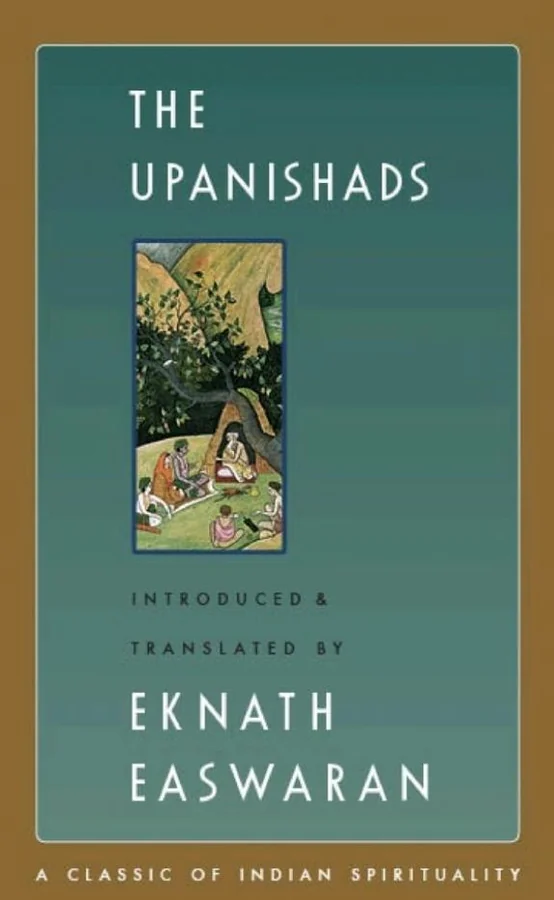
The Upanishads
 84
84

The Upanishads
Easwaran's translation of the Upanishads offers a remarkably lucid entry into texts that have historically demanded considerable scholarly apparatus. The strength lies in its clarity; Easwaran prioritizes accessibility, making the dense philosophical arguments of the Brihadaranyaka and Chandogya Upanishads digestible without significant loss of core meaning. However, this very accessibility can sometimes feel like a simplification, potentially glossing over the subtler nuances that a more scholarly translation might preserve. The section exploring the concept of *Aham Brahmasmi* ('I am Brahman') is particularly well-rendered, capturing the profound realization at its heart. While it may not satisfy the most rigorous academic, for the earnest seeker of wisdom, this edition provides a solid foundation.
📝 Description
84
Composed centuries ago, the Upanishads mark a philosophical turn in Vedic tradition.
The Upanishads are foundational Hindu scriptures, forming the concluding part of the Vedas. These Sanskrit dialogues examine the nature of reality, consciousness, and the self, shifting focus from ritual to metaphysical inquiry. They are not a single text but a collection of treatises, each presenting distinct views on Brahman, the ultimate reality, and Atman, the individual soul.
This edition features a translation by Eknath Easwaran and an introduction by Michael N. Nagler, making it an accessible entry into Vedantic philosophy. It is suitable for those interested in comparative religion, ancient traditions, and the origins of meditation. Students of Eastern spirituality and individuals contemplating existential questions will find its insights valuable.
Originating in ancient India around the 8th century BCE, the Upanishads emerged during a period of intellectual and spiritual change. They departed from earlier Vedic focus on sacrificial rites, appearing alongside the rise of Jainism and Buddhism. The Upanishads later formed the basis for the Vedanta school of philosophy, significantly influencing thinkers like Adi Shankara.
The Upanishads are central to the Vedanta tradition, a major school of Hindu philosophy. They represent a move towards inner contemplation and the understanding of ultimate reality beyond external practices. Their exploration of the self's connection to the universal consciousness, and the nature of existence through concepts like karma and rebirth, positions them as key texts in understanding Indian esoteric thought. They laid the groundwork for later mystical and philosophical developments within Hinduism.
💡 Why Read This Book?
• Gain insight into the concept of *Atman* (the self) as presented in the Upanishads, understanding its connection to the universal consciousness, *Brahman*, as explored in texts like the *Mandukya Upanishad*. • Grasp the philosophical underpinnings of *Karma* and *Samsara*, learning how these concepts, central to the Upanishadic worldview, explain the cycle of existence and liberation. • Explore the allegorical narratives within the Upanishads, such as the dialogue between *Ushasta* and *Kahola* in the *Brihadaranyaka Upanishad*, to understand the methods used to convey abstract metaphysical truths.
⭐ Reader Reviews
Honest opinions from readers who have explored this book.
❓ Frequently Asked Questions
What is the origin of the Upanishads and when were they composed?
The Upanishads are ancient Sanskrit texts, considered the concluding part of the Vedas. Their composition spans a long period, with the earliest sections dating back to approximately the 8th century BCE, making them some of the oldest philosophical works in existence.
Who is Eknath Easwaran and what is his contribution to this translation?
Eknath Easwaran was an Indian spiritual teacher and author known for his clear, accessible translations and commentaries on Indian spiritual classics. His translation of the Upanishads aims to make these profound texts understandable to a modern, Western audience.
What is the primary philosophical concept discussed in the Upanishads?
A central concept is the identity of Atman (the individual self) and Brahman (the ultimate, universal reality). The Upanishads explore this relationship through various dialogues and allegories, aiming to reveal the oneness of all existence.
Are the Upanishads considered religious scriptures or philosophical texts?
They are both. The Upanishads are foundational scriptures within Hinduism, but their content is primarily philosophical and metaphysical, exploring the nature of reality, consciousness, and the self, which has influenced various spiritual and philosophical traditions.
What is the relationship between the Upanishads and the Vedas?
The Upanishads are the philosophical culmination of the Vedas, the oldest scriptures of Hinduism. They are often referred to as Vedanta, meaning 'the end or essence of the Vedas,' marking a transition from ritualistic to contemplative inquiry.
What does the concept of 'Maya' signify in the Upanishads?
Maya, often translated as illusion or cosmic deception, refers to the phenomenal world that conceals the true nature of reality, Brahman. The Upanishads suggest that our perception of a separate self and world is a product of Maya.
🔮 Key Themes & Symbolism
Atman and Brahman
The core teaching revolves around the non-duality of Atman, the individual soul or self, and Brahman, the supreme, universal consciousness. Texts like the *Mahavakya* 'Aham Brahmasmi' ('I am Brahman') from the *Brihadaranyaka Upanishad* encapsulate this profound realization. The exploration posits that the perceived separation between the individual and the cosmic is an illusion, leading to a unified understanding of existence that underpins much of subsequent Indian spiritual thought.
Maya and Illusion
The concept of Maya, often translated as illusion or cosmic deception, is crucial for understanding the Upanishadic view of the phenomenal world. This realm, with its multiplicity and apparent separateness, is seen as veiling the singular reality of Brahman. The texts suggest that our ordinary perception is conditioned by Maya, and liberation involves seeing through this veil to the underlying truth of existence, as depicted in dialogues concerning perception.
The Path to Liberation (Moksha)
The Upanishads outline the ultimate goal as Moksha, liberation from Samsara, the cycle of birth, death, and rebirth. This liberation is achieved through direct realization of the unity of Atman and Brahman, often facilitated by knowledge (jnana), meditation, and detachment. The texts emphasize that this is not merely an intellectual understanding but a transformative experience of oneness, achieved through dedicated practice and inquiry.
The Nature of Consciousness
Consciousness is examined not merely as a faculty of the individual mind but as the fundamental ground of all being. The *Mandukya Upanishad*, for instance, analyzes the states of consciousness (waking, dreaming, deep sleep) to reveal the underlying, unchanging awareness, Turiya. This perspective elevates consciousness from a subjective experience to the ultimate reality, Brahman, shaping mystical and philosophical traditions for centuries.
💬 Memorable Quotes
Direct passages from the work, attributed to the author.
“As a caterpillar secures itself to a leaf and then moves to a new leaf, so the soul secures itself to the body and then moves to a new body.”
— This analogy from the *Brihadaranyaka Upanishad* vividly illustrates the concept of reincarnation or transmigration of the soul. It highlights the soul's ability to transition from one physical form to another, akin to a caterpillar moving from one surface to the next, emphasizing continuity of consciousness.
“Verily, this self is the Lord of all beings, the king of all beings.”
— This statement from the *Brihadaranyaka Upanishad* asserts the supreme status of the Self (Atman). It suggests that the true, underlying Self is not merely a part of the cosmos but its sovereign ruler, embodying ultimate authority and interconnectedness with all existence.
“Where there is darkness, I am the light; where there is poverty, I am the wealth.”
— This represents an interpretation of the self's identification with Brahman, suggesting that the ultimate reality pervades and transcends all dualities. It implies that the divine essence brings illumination to ignorance and abundance to scarcity, reflecting its all-encompassing nature.
💡 Key Ideas
Editorial paraphrase of the work's core concepts — not direct quotes.
A man is literally what he thinks. His thinking shapes him.
This paraphrased concept from the Upanishads emphasizes the power of thought in shaping an individual's reality and identity. It suggests that one's internal mental landscape is not just a reflection but a formative force, guiding actions and defining one's character and destiny.
Let him worship the Self (Atman) as the world. For whatever is known is the Self.
This passage from the *Brihadaranyaka Upanishad* encourages the contemplation of the Self as the fundamental reality underlying all phenomena. It posits that true understanding arises from recognizing the Self as the source and essence of everything that can be known or perceived.
🌙 Esoteric Significance
Tradition
The Upanishads are foundational to the Vedanta tradition within Hinduism, which itself possesses strong esoteric dimensions. They are considered the philosophical culmination of the Vedas, moving beyond ritual to explore the nature of ultimate reality. Within a broader esoteric context, they align with perennialist philosophies that seek universal spiritual truths, exploring themes of consciousness, liberation, and the divine immanent in all existence, predating and influencing later esoteric movements.
Symbolism
Key symbols include the syllable 'Om' (Aum), representing the primordial sound and the totality of consciousness, encompassing waking, dreaming, and deep sleep states (as analyzed in the *Mandukya Upanishad*). The concept of the *Hamsa* (swan or goose) symbolizes the pure, transcendent Self, capable of moving between realms. Fire (Agni) often symbolizes transformation and purification, a conduit for spiritual insight and sacrifice.
Modern Relevance
Contemporary Western esoteric traditions, particularly those influenced by Theosophy and New Age spirituality, frequently reference Upanishadic concepts like Brahman, Atman, and Maya. Modern yoga philosophy and mindfulness practices draw heavily from the Upanishads' contemplative techniques and metaphysical frameworks. Thinkers exploring consciousness studies and comparative mysticism also engage with these texts for their insights into non-dual awareness and the nature of reality.
👥 Who Should Read This Book
• Students of comparative religion and philosophy seeking to understand the origins of major Eastern spiritual concepts like Karma and reincarnation. • Individuals interested in contemplative practices and meditation, looking to explore the philosophical underpinnings of mindfulness and self-awareness found in the Upanishads. • Seekers of existential wisdom who are questioning the nature of reality, consciousness, and the self, and are drawn to ancient texts for profound philosophical exploration.
📜 Historical Context
The Upanishads emerged during a dynamic period in ancient India, roughly between 800 and 200 BCE, a time marked by profound philosophical inquiry and the concurrent rise of heterodox traditions like Jainism and Buddhism. They represent a significant departure from the ritualistic focus of the earlier Vedic Samhitas and Brahmanas. This era saw intellectual currents questioning established Brahmanical orthodoxy, leading to the development of diverse schools of thought. The Upanishads themselves became the bedrock of the Vedanta system, profoundly influencing later philosophers such as Adi Shankara. Their reception was not monolithic; while foundational to Hinduism, their contemplative nature contrasted with the ritualistic practices of the time, and their philosophical depth would later be debated and interpreted across various sub-schools of Vedanta, including Vishishtadvaita and Dvaita.
📔 Journal Prompts
The concept of *Brahman* as the singular reality underlying all phenomena.
Reflections on the *Atman* and its perceived relationship with the external world.
Allegories used in the Upanishads to explain complex philosophical ideas.
The role of *Maya* in shaping our perception of reality.
The understanding of consciousness presented in the *Mandukya Upanishad*.
🗂️ Glossary
Brahman
The ultimate, unchanging reality or absolute consciousness that is the source and sustainer of the universe. It is considered the supreme being in Vedanta philosophy.
Atman
The individual self or soul. In Upanishadic thought, it is ultimately identical with Brahman, representing the true, eternal essence of a being.
Maya
Cosmic illusion or deception that conceals the true nature of reality (Brahman). It creates the appearance of a diverse and separate world.
Samsara
The continuous cycle of birth, death, and rebirth, driven by karma. It is a state of existence from which liberation (Moksha) is sought.
Moksha
Liberation or release from the cycle of Samsara. It is achieved through spiritual knowledge, realization of the Self, and detachment.
Karma
The law of cause and effect, where actions (karma) in this life and past lives determine future consequences and rebirths.
Om (Aum)
A sacred syllable representing the primordial sound of the universe and the totality of consciousness, encompassing the three states of waking, dreaming, and deep sleep.
🔮 Readers Also Liked
Browse all →








More Free Occult Philosophy Books
View all →