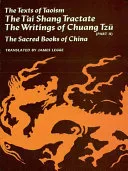
The Texts of Taoism
 79
79

The Texts of Taoism
James Legge's translation of "The Texts of Taoism" remains a significant, albeit dated, scholarly achievement. Its strength lies in the sheer volume of original Chinese text provided alongside the English, offering a rigorous scholarly presentation that few modern translations replicate. The meticulous footnotes, though sometimes reflecting 19th-century biases, provide invaluable context for understanding classical Chinese thought. However, the language, while precise for its time, can feel archaic and less fluid than contemporary translations, occasionally obscuring the poetic and intuitive qualities of the Tao Te Ching and Zhuangzi. The work's primary limitation for the modern esoteric reader is its academic distance; it prioritizes philological accuracy over accessible spiritual guidance. Nonetheless, for those seeking a scholarly confrontation with the source material, particularly Legge's rendering of Zhuangzi's paradoxical parables, this volume is essential. It serves as a critical reference point in the study of Taoism, even as newer interpretations offer different pathways.
📝 Description
79
James Legge's translation of the Tao Te Ching and Zhuangzi first appeared in English in the 1890s.
This volume contains James Legge's English translation of two central texts in Taoism: the Tao Te Ching and the writings of Zhuangzi. Legge, a prominent 19th-century scholar of Chinese, completed this work as part of a larger project to make classical Chinese literature available to a Western audience. His translations, initially published in the late 1800s and later collected, include substantial annotations and scholarly notes, aiming for textual accuracy. These texts are not simplified introductions but rather primary sources for those seeking a deep understanding of Taoist philosophy and spirituality.
The collection is intended for serious students of philosophy, comparative religion, and esoteric thought. It suits readers who prefer to engage directly with foundational texts rather than relying solely on secondary analysis. Scholars, translators, and practitioners interested in the original sources of Taoist principles will find value in Legge's meticulous approach. The material demands dedicated study rather than casual reading, offering a resource for in-depth engagement with these ancient Chinese writings.
Legge's translations made accessible core texts of Taoism, a tradition that has influenced various esoteric practices and philosophies in the West. The concepts within the Tao Te Ching and Zhuangzi, such as the ineffable Tao and the principle of Wu Wei, resonated with Western thinkers interested in alternative spiritual paths and philosophical systems outside the Abrahamic traditions. This work provided a direct conduit to ideas that informed later developments in Western esotericism, including certain interpretations of alchemy, meditation techniques, and holistic philosophies that sought a connection to a fundamental cosmic principle.
💡 Why Read This Book?
• Engage directly with the Tao Te Ching and the Book of Chuang Tzu as rendered by James Legge, offering a scholarly yet accessible entry point into foundational Taoist philosophy, allowing for a direct comparison with later translations. • Understand the historical reception of Taoist thought in the West by examining Legge's 19th-century translation, providing insight into how these texts were first interpreted by Western academia in the 1890s. • Explore the concept of Wu Wei through primary textual analysis, grasping its practical implications for living in harmony with natural principles as presented in the source material.
⭐ Reader Reviews
Honest opinions from readers who have explored this book.
❓ Frequently Asked Questions
When was James Legge's translation of The Texts of Taoism first published?
James Legge's comprehensive translation of "The Texts of Taoism," which includes the Tao Te Ching and the writings of Zhuangzi, was first published in volumes in the 1890s.
What are the main texts included in James Legge's The Texts of Taoism?
This volume primarily contains the Tao Te Ching, attributed to Lao Tzu, and the Book of Chuang Tzu, the foundational texts of philosophical Taoism.
Is James Legge's translation suitable for beginners in Taoism?
While a scholarly work, Legge's translation can serve as a starting point for dedicated beginners. Its academic nature and archaic language may require additional context from secondary sources.
What is the significance of the Tao Te Ching and the Book of Chuang Tzu?
The Tao Te Ching is a seminal work on the nature of the Tao and virtuous living, while the Book of Chuang Tzu explores these ideas with wit, paradox, and allegorical stories.
Does this translation include original Chinese text?
Yes, James Legge's translation typically includes the original Chinese script alongside the English translation and extensive annotations, making it a valuable resource for textual study.
How does Legge's translation compare to modern Taoist texts?
Legge's translation is more literal and academic, reflecting 19th-century scholarship. Modern translations often aim for greater fluidity and may emphasize different aspects of the text's meaning.
🔮 Key Themes & Symbolism
The Ineffable Tao
The core of Taoist philosophy, the Tao, is presented not as a deity but as the fundamental, unnamable, and ineffable principle that underlies and governs all reality. Legge's translation grapples with conveying this concept, which is beyond ordinary description. The texts emphasize that the Tao can be understood through intuition and direct experience rather than intellectual definition, a concept central to many esoteric traditions seeking direct apprehension of ultimate truth beyond dogma.
Wu Wei: Effortless Action
Central to living in accordance with the Tao is the practice of Wu Wei, often translated as 'non-action' or 'effortless action.' This is not about passivity but about acting in alignment with the natural flow of things, without forcing or striving. The texts illustrate Wu Wei through examples of nature and the actions of sages. For esoteric practitioners, it represents a mode of being that minimizes ego-driven interference and maximizes harmony with universal forces.
The Sage and Naturalness
The ideal figure in these texts is the Sage, who embodies the principles of the Tao. Such an individual lives with extreme simplicity, humility, and naturalness (Tzu-jan). They are free from artificial desires and societal conditioning, acting spontaneously and effectively. Legge's translation reveals how the Sage's wisdom lies in understanding and aligning with the fundamental patterns of existence, a model for spiritual attainment in many mystical paths.
Paradox and Transformation
Especially within the writings of Zhuangzi, the texts employ paradox, allegory, and humor to challenge conventional thinking and reveal deeper truths. They explore the relativity of perspectives, the fluidity of identity, and the transformative power of embracing change. This approach mirrors esoteric methods that use koan-like questions or mind-bending narratives to break down rigid mental constructs and open the mind to subtler realities.
💬 Memorable Quotes
Direct passages from the work, attributed to the author.
“The Tao that can be told is not the eternal Tao.”
— This opening statement from the Tao Te Ching immediately establishes the ineffable nature of the ultimate principle. It suggests that any attempt to define or articulate the Tao in words is inherently limited and cannot capture its true, eternal essence.
“When the world knows beauty as beauty, there is ugliness.”
— This illustrates the Taoist concept of relativity and the artificiality of dualistic judgments. By creating distinctions between 'beauty' and 'ugliness,' humanity imposes a construct that generates the very thing it seeks to avoid, obscuring a more holistic understanding.
“The best warrior is the one who wins without fighting.”
— This highlights the principle of Wu Wei. True strength and effectiveness are achieved not through overt conflict or force, but through strategic alignment with circumstances, achieving goals with minimal resistance and effort.
“To know that one knows not is the highest wisdom.”
— This paradox emphasizes intellectual humility. True wisdom is not the accumulation of facts, but the recognition of the vastness of one's own ignorance, which opens the mind to learning and genuine understanding.
💡 Key Ideas
Editorial paraphrase of the work's core concepts — not direct quotes.
The universe and I were born at the same time. As to the universe, I have not yet had enough of it.
This quote from Zhuangzi expresses a profound sense of unity with the cosmos and a joyful, unburdened engagement with existence. It suggests a state of being where the self is not separate from the universe, living fully in the present moment.
🌙 Esoteric Significance
Tradition
While not strictly within a Western esoteric lineage like Hermeticism or Kabbalah, "The Texts of Taoism" are foundational to the esoteric understanding of Chinese cosmology and spiritual practice. They inform traditions such as internal alchemy (Neidan), Qigong, and various schools of Chan (Zen) Buddhism that migrated to China. The work's significance lies in its articulation of principles like the Tao and Wu Wei, which are central to many mystical paths seeking direct experience of the divine or ultimate reality beyond empirical observation.
Symbolism
Key symbols include the 'uncarved block' (Pu), representing original simplicity and the unadulterated state before societal conditioning. Water is a potent symbol of the Tao, embodying flexibility, yieldingness, and the ability to overcome hardness through persistence. The Sage, often depicted as a figure of quiet wisdom, symbolizes the ideal practitioner who embodies Taoist principles, living in harmony with the natural order.
Modern Relevance
Contemporary thinkers and practitioners in fields ranging from mindfulness and meditation to martial arts and environmental philosophy draw heavily on Taoist principles found in these texts. Modern interpreters like Alan Watts popularized Taoist concepts for Western audiences, and contemporary Qigong masters and internal martial artists continue to study these scriptures for guidance on cultivating vital energy (Qi) and achieving energetic balance. The emphasis on naturalness and non-interference appeals to current discussions on sustainability and holistic living.
👥 Who Should Read This Book
• Students of comparative philosophy and religion seeking to engage with primary source material on one of the world's most influential spiritual traditions. • Practitioners of contemplative arts, such as meditation, yoga, or martial arts, interested in the philosophical underpinnings of Eastern disciplines. • Scholars and translators working on Chinese philosophy or the history of Western engagement with Eastern thought, requiring a foundational 19th-century translation.
📜 Historical Context
James Legge's translation of "The Texts of Taoism" emerged from the intellectual milieu of the late 19th century, a period marked by intense Western scholarly interest in comparative religion and philosophy. Legge, a Scottish sinologist, spent decades translating the Confucian Classics and other key Chinese works, aiming to present them to a Western audience with scholarly rigor. His Taoist translations, published around 1891, arrived at a time when Eastern thought, including Buddhism and Hinduism, was increasingly discussed in Europe and America, influencing thinkers from the Transcendentalists to early Theosophists. While Legge's work was a major contribution, it stood within a broader landscape where German scholars like Richard Wilhelm would later offer influential translations that engaged more directly with the mystical and esoteric dimensions of Chinese philosophy. Legge's translations were primarily academic, intended for universities and serious scholars, and their reception was largely within these circles, laying groundwork for later, more popular interpretations.
📔 Journal Prompts
The concept of Wu Wei, or effortless action, in relation to daily responsibilities.
The Sage's detachment from worldly acclaim as described in the Tao Te Ching.
Zhuangzi's transformation into a butterfly and the nature of reality.
Reflecting on the Tao as an unnamable force governing existence.
The symbolic meaning of water in achieving harmony with the Tao.
🗂️ Glossary
Tao (Dao)
The fundamental, ineffable principle and source of all existence in Taoism. Often translated as 'The Way,' it represents the natural order and the underlying reality of the universe.
Wu Wei
A core Taoist principle meaning 'non-action' or 'effortless action.' It signifies acting in harmony with the natural flow of the Tao, without force or undue striving.
Pu (The Uncarved Block)
A symbol representing original simplicity, naturalness, and the state of pure potential before being shaped by external influences or desires.
Tzu-jan
Literally 'self-so' or 'naturalness.' It describes the state of spontaneous being and action that is in accord with the Tao, free from artificiality.
Sage
An enlightened individual who embodies the principles of the Tao, living with wisdom, humility, and naturalness, acting in harmony with the cosmic order.
Yin and Yang
Though not always explicitly named as such in these texts, the concept refers to complementary, interdependent forces (e.g., dark/light, passive/active) whose dynamic balance constitutes the functioning of the universe.
Qi (Chi)
Vital life force or energy that flows through all things. Practices like Qigong aim to cultivate and balance Qi for health and spiritual development.















![BHAGAVAD GITA WIE SIE IST [GERMAN LANGUAGE].](/img/thumb/bhagavad-gita-wie-sie-ist-german-language-ac-bhaktivedanta-swami-prabhupada-691655.webp)
