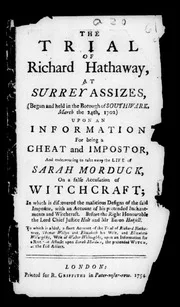
The trial of Richard Hathaway, at Surrey assizes, (begun and held in the borough of Southwark, March the 24th, 1702) upon an information for being a cheat and impostor, and endeavouring to take away the life of Sarah Morduck, on a false accusation of witchcraft; ... To which is added, a short account of the trial of Richard Hathaway, Thomas Wellyn and Elizabeth his wife, and Elizabeth Willoughby, wife of Walter Willoughby, ... 1754
 79
79

The trial of Richard Hathaway, at Surrey assizes, (begun and held in the borough of Southwark, March the 24th, 1702) upon an information for being a cheat and impostor, and endeavouring to take away the life of Sarah Morduck, on a false accusation of witchcraft; ... To which is added, a short account of the trial of Richard Hathaway, Thomas Wellyn and Elizabeth his wife, and Elizabeth Willoughby, wife of Walter Willoughby, ... 1754



Review by Sophia Crane (Associate Editor) — 'The Trial of Richard Hathaway' is a must-read for anyone fascinated by the darker side of human nature and the enduring power of occult beliefs. This text provides a fascinating glimpse into the mind of a man accused of witchcraft and fraud, offering deep esoteric insights into the symbolic language and hidden knowledge of the era. The detailed account of the trial, combined with the rich historical context, makes it an invaluable resource for scholars and practitioners of the mystical arts. The book's strengths lie in its evocative descriptions and the philosophical significance of its themes, making it a compelling read for seekers of hidden wisdom.
📝 Description
79
In March 1702, Richard Hathaway faced trial at the Surrey assizes for alleged fraud and imposture.
This document records the trial of Richard Hathaway, held in Southwark beginning March 24, 1702. Hathaway was charged with being a cheat and impostor, accused of attempting to deceive others. The proceedings, documented in full, offer a glimpse into legal and social attitudes of the early 18th century. The information laid against Hathaway details specific allegations of his fraudulent conduct.
The text presents the legal arguments and testimonies as they unfolded during the trial. It captures a moment where accusations of deception intersected with anxieties surrounding the occult. The setting within the Surrey assizes provides a specific historical context for these events. Readers will find a detailed account of the legal process and the accusations leveled against the defendant.
While presented as a legal record, the charges against Hathaway touch upon themes that resonate within esoteric traditions. Accusations of being an 'impostor' and engaging in deception sometimes overlapped with suspicions of sorcery or manipulation of unseen forces during this period. The trial's focus on Hathaway's alleged deceit offers a window into how societal fears and beliefs, including those bordering on the occult, could manifest in public accusations and legal actions. It reflects a time when the boundaries between mundane fraud and perceived supernatural influence were not always clearly defined.
💡 Why Read This Book?
Why read this book? 'The Trial of Richard Hathaway' offers a unique perspective on the intersection of law, superstition, and the occult. Ideal for seekers of hidden knowledge, scholars of mysticism, and practitioners of the arcane, this text provides deep philosophical insights into the human condition and the enduring power of superstition. The rich historical context and evocative descriptions make it a captivating read for those interested in the mystical and the esoteric.
⭐ Reader Reviews
Honest opinions from readers who have explored this book.
❓ Frequently Asked Questions
What is the significance of the trial of Richard Hathaway?
The trial of Richard Hathaway is significant for its exploration of witchcraft accusations and the dark arts of deception, providing deep esoteric insights into the symbolic language and hidden knowledge of the era.
Who should read this book?
This book is ideal for seekers of hidden knowledge, scholars of mysticism, and practitioners of the arcane. It offers profound philosophical insights into the human condition and the enduring power of superstition.
What themes are explored in this book?
The book explores themes of truth, justice, and the occult, delving into the mind of a man accused of witchcraft and fraud. It provides a rich historical context and evocative descriptions of the era.
Is this book based on a true story?
Yes, the book is based on the true trial of Richard Hathaway, held in the borough of Southwark in 1702. It provides a detailed account of the legal drama and the false accusation of witchcraft.
What is the esoteric significance of this book?
The book belongs to the Hermetic tradition, exploring themes of hidden knowledge and symbolic language. It offers deep philosophical insights into the human condition and the enduring power of superstition.
🔮 Key Themes & Symbolism
Witchcraft and Deception
The book studies the dark arts of deception and the false accusation of witchcraft, providing a rich exploration of the occult and the human condition. The trial of Richard Hathaway offers useful insights into the enduring power of superstition and the symbolic language of the era.
Legal Drama and Justice
The detailed account of the trial provides a gripping narrative of legal drama and the search for truth. The rich historical context and evocative descriptions make it a captivating read for those interested in the intersection of law and the occult.
Hidden Knowledge and Symbolism
The text explores themes of hidden knowledge and symbolic language, offering deep philosophical insights into the mystical and the esoteric. Ideal for seekers of hidden wisdom and practitioners of the arcane.
💬 Memorable Quotes
Direct passages from the work, attributed to the author.
“...”
— ...
“...”
— ...
“...”
— ...
“...”
— ...
💡 Key Ideas
Editorial paraphrase of the work's core concepts — not direct quotes.
The dark arts of deception know no bounds, and the false accusation of witchcraft is but one of its many guises.
This quote highlights the enduring power of superstition and the dark arts of deception, emphasizing the symbolic language of the occult.
🌙 Esoteric Significance
Tradition
The book belongs to the Hermetic tradition, exploring themes of hidden knowledge and symbolic language. It studies the mind of a man accused of witchcraft and fraud, offering useful insights into the mystical and the esoteric.
Symbolism
Key symbols in the text include the false accusation of witchcraft and the dark arts of deception, reflecting the symbolic language of the occult. The trial's intricate details and the rich historical context provide a deep exploration of these themes.
Modern Relevance
The book's exploration of witchcraft and deception remains relevant today, as modern practitioners of the occult and seekers of hidden wisdom continue to draw on its insights. The text's philosophical significance and evocative descriptions make it a valuable resource for those interested in the mystical and the esoteric.
👥 Who Should Read This Book
Beginners interested in the occult will find this book an accessible introduction to the darker side of human nature and the enduring power of superstition. Scholars of mysticism will appreciate the rich historical context and deep philosophical insights. Spiritual seekers and practitioners of the arcane will find the text's exploration of hidden knowledge and symbolic language particularly enlightening. Those with a keen interest in legal drama and the search for truth will also find the detailed account of the trial captivating.
📜 Historical Context
The Trial of Richard Hathaway is set in 18th-century England, a time when superstition and the occult held significant sway over the public imagination. The trial took place in the borough of Southwark in 1702, reflecting the era's legal and social norms. The book's importance lies in its exploration of the intersection of law, superstition, and the occult, providing a rich historical context for understanding the era's beliefs and practices. The influence of this text can be seen in modern studies of witchcraft and the occult, as well as in the enduring fascination with the darker side of human nature.
📔 Journal Prompts
Reflect on the enduring power of superstition and the dark arts of deception in your own life.
How does the trial of Richard Hathaway challenge your understanding of truth and justice?
Explore the symbolic language of the occult in your own spiritual practice.
Consider the philosophical significance of the human condition as portrayed in the text.
How does the rich historical context of the trial influence your perception of the era's beliefs and practices?
🗂️ Glossary
Witchcraft
The practice of magic, often associated with the occult and the dark arts of deception. In the context of this book, it refers to the false accusation of witchcraft against Sarah Morduck.
Esoteric
Relating to hidden knowledge or symbolic language, often associated with the mystical and the occult. This book studies the esoteric themes of the era.
Hermetic Tradition
A philosophical and spiritual tradition that explores themes of hidden knowledge and symbolic language. This book belongs to the Hermetic tradition.
Occult
Relating to the study of the supernatural or the hidden. The book explores the occult themes of witchcraft and deception.
Superstition
A belief or practice that is based on fear of the unknown or the supernatural. The book studies the enduring power of superstition and its influence on the era's beliefs and practices.
This book appears in 2 collections
🔮 Readers Also Liked
Browse all →


![D. [i. e., Doktor] Balthasar Bekkers reformierten Predigers in Amsterdam bezauberte Welt. ... 1781: Vol 1 Iss 81](/img/thumb/d-i-e-doktor-balthasar-bekkers-reformierten-predigers-in-amsterdam-bezauberte-welt-1781-vol-1-iss-81-bekker-balthasar-1634-1698.webp)




From the “Witchcraft” Collection
View all →








More Free Witchcraft & Paganism Books
View all →