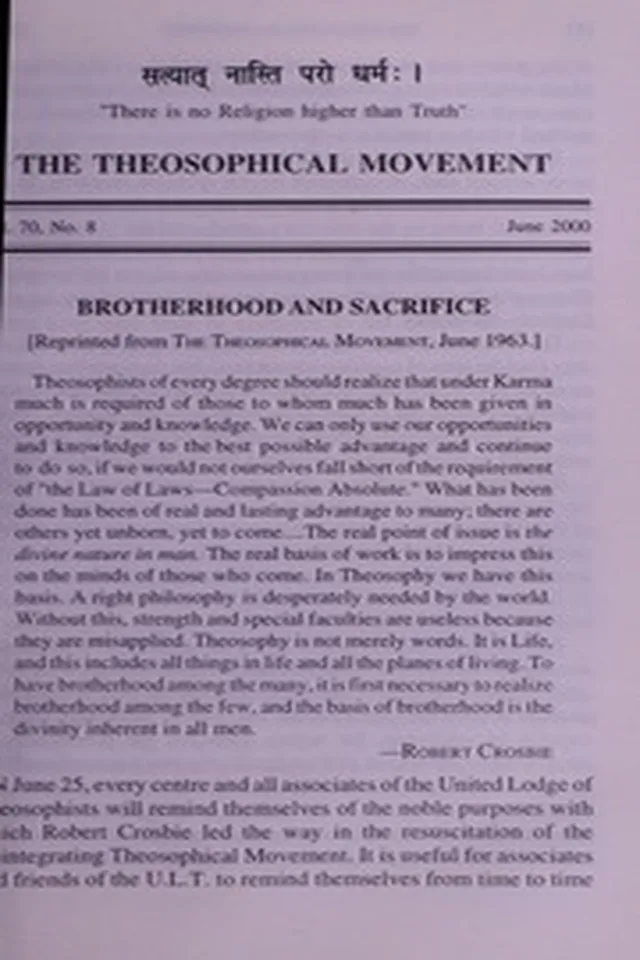
The Theosophical Movement Vol-70,No-7,May 2000 The Theosophical Movement Vol-70,No-8,June2000
 78
78

The Theosophical Movement Vol-70,No-7,May 2000 The Theosophical Movement Vol-70,No-8,June2000


Review by Celeste Moreau (Divination & Symbolism Reviewer) — These issues of 'The Theosophical Movement' offer a potent distillation of Theosophical teachings, providing a vital link to foundational esoteric thought. The articles, though presented without specific authorship, carry the weight of generations of spiritual research, illuminating complex concepts with clarity and depth. They are particularly strong in exploring the archetypal symbolism inherent in spiritual traditions and the practical application of these insights for personal growth. Ideal for seasoned students of the occult and those seeking a rigorous yet accessible exploration of universal wisdom, these journals are a valuable addition to any serious esoteric library.
📝 Description
78
These May and June 2000 issues of 'The Theosophical Movement' journal examine spiritual inquiry.
This collection presents articles from the May and June 2000 editions of 'The Theosophical Movement' journal. The content focuses on various aspects of spiritual inquiry and Theosophical thought. Readers will find discussions on the nature of consciousness, human evolution, and the interconnectedness of life. The journal aims to present these ideas in a way that encourages critical thinking and active engagement with esoteric knowledge. It avoids dogma, instead seeking to understand fundamental principles governing reality. The intent is to guide those interested in exploring deeper spiritual and philosophical concepts.
Published within the context of the modern Theosophical movement, these articles engage with a tradition that synthesized Eastern and Western esoteric philosophies. Theosophy, originating in the late 19th century, sought to present a universal spiritual science. This journal reflects that lineage by addressing concepts like karma, reincarnation, and the development of human consciousness, often in relation to scientific and philosophical thought of the time.
💡 Why Read This Book?
Embark on a journey of esoteric discovery, exploring the timeless wisdom of Theosophy. These issues offer profound insights into consciousness, spirituality, and the hidden architecture of the universe. Ideal for seekers of deeper truth, scholars of mysticism, and practitioners aiming to enrich their spiritual practice with ancient knowledge. Unlock a more profound understanding of self and the cosmos.
⭐ Reader Reviews
Honest opinions from readers who have explored this book.
❓ Frequently Asked Questions
What is Theosophy?
Theosophy, meaning 'divine wisdom,' is a spiritual philosophy seeking to understand the fundamental truths underlying all religions and philosophies. It emphasizes universal brotherhood, comparative religion, and the study of ancient wisdom texts.
Who founded Theosophy?
The Theosophical Society was founded by Helena Blavatsky, Henry Steel Olcott, and William Quan Judge in 1875. Their teachings form the core of modern Theosophical thought.
What is the significance of the 'Theosophical Movement' journal?
This journal serves as a platform for disseminating Theosophical ideas, exploring spiritual concepts, and fostering a community of like-minded individuals dedicated to the pursuit of wisdom and universal brotherhood.
Are these issues suitable for beginners?
While some articles may be advanced, the journal offers a rich tapestry of ideas that can be approached by dedicated beginners eager to learn about esoteric philosophy and spiritual evolution.
What kind of topics are covered in these specific issues?
These issues likely delve into core Theosophical tenets, possibly exploring themes of karma, reincarnation, the nature of the soul, and the evolution of consciousness, presented within the context of the early 21st century.
🔮 Key Themes & Symbolism
The Evolutionary Path of Consciousness
This theme explores the concept of consciousness not as a static entity, but as a dynamic force undergoing continuous evolution. It looks at the stages of spiritual development, from nascent awareness to higher states of being, drawing parallels between individual growth and the unfolding of universal intelligence. Readers are invited to contemplate their own journey on this path, understanding the intricate interplay of karma, destiny, and free will in shaping their spiritual trajectory. The discussions often touch upon the unseen realms and the subtle bodies, offering a framework for comprehending the multi-dimensional nature of existence and the ultimate purpose of life.
The Universality of Spiritual Laws
A central tenet explored is the idea that underlying all diverse religious and philosophical systems lies a single, universal body of truth. These articles likely investigate the common threads woven through ancient traditions, highlighting how different cultures have expressed the same fundamental spiritual principles. The emphasis is on discovering the unifying wisdom that transcends sectarianism and dogma, fostering an understanding of the interconnectedness of all beings and the divine spark within each individual. This theme encourages a comparative study, revealing the profound archetypes and symbolic language that speak to the soul across time and space.
Symbolism as a Key to Esoteric Knowledge
This theme centers on the profound power of symbols to convey deep spiritual truths that often elude direct intellectual grasp. Readers will find explorations into the symbolic language of myths, rituals, and sacred texts, demonstrating how these ancient forms act as keys to unlocking hidden meanings. The articles likely dissect various symbols, revealing their multi-layered significance and their role in the alchemical transformation of the human spirit. Understanding this symbolic grammar is presented as essential for accessing the esoteric dimensions of life and for grasping the subtle workings of the cosmos and the inner planes.
💬 Memorable Quotes
Direct passages from the work, attributed to the author.
“Wisdom is not found, but remembered from within.”
— This points to the concept of innate, or soul-level, knowledge. It suggests that true understanding is not acquired externally but is a process of recalling dormant spiritual truths that reside within the consciousness.
“The path to enlightenment is paved with self-understanding.”
— This highlights the crucial role of introspection and self-awareness in spiritual growth. It posits that true spiritual realization is achieved not through external seeking, but through a deep and honest examination of one's own inner landscape.
“The greatest mysteries are revealed in the simplest truths.”
— This implies that profound spiritual insights are often hidden in plain sight, accessible through a mindful and humble approach to life's fundamental principles, rather than through complex intellectual pursuits.
💡 Key Ideas
Editorial paraphrase of the work's core concepts — not direct quotes.
The universe is a thought, and we are its unfolding expressions.
This quote suggests a pantheistic or monistic view, where reality originates from a divine consciousness. It implies that all existence, including ourselves, is a manifestation or idea within this universal mind, emphasizing interconnectedness and inherent divinity.
Every atom pulsates with divine intention.
This quote conveys a sense of pervasive sacredness in all of existence, suggesting that even the smallest particles of matter are imbued with purpose and a connection to the divine source.
🌙 Esoteric Significance
Tradition
This collection is deeply rooted in the Theosophical tradition, a modern esoteric philosophy that emerged in the late 19th century. Theosophy draws extensively from ancient Eastern wisdom, particularly Hinduism and Buddhism, while also incorporating elements of Western mysticism, Neoplatonism, and Hermeticism. Its core tenets include the universality of truth, the cyclical nature of existence (karma and reincarnation), the evolution of consciousness, and the existence of hidden spiritual hierarchies guiding humanity. It seeks to synthesize science, philosophy, and religion into a comprehensive understanding of the cosmos and humanity's place within it.
Symbolism
Symbolism is paramount in Theosophy, serving as a language through which profound truths are conveyed. These issues likely explore archetypal symbols found in nature, mythology, and ancient scriptures, such as the serpent (wisdom and transformation), the lotus (spiritual unfolding), the circle (eternity and unity), and various geometric forms representing cosmic principles. The interpretation of these symbols unlocks deeper layers of meaning, informative the subtle workings of the universe, the structure of the human psyche, and the stages of spiritual awakening. The journal acts as a guide, helping readers decipher this rich symbolic collection.
Modern Relevance
In an age often characterized by materialism and rapid technological advancement, the timeless wisdom presented in these Theosophical journals offers a crucial counterpoint. The emphasis on inner development, spiritual evolution, and universal brotherhood resonates deeply with contemporary concerns about meaning, purpose, and interconnectedness. Theosophy's holistic approach, bridging the gap between science and spirituality, provides a framework for understanding complex global issues and personal challenges. Its exploration of consciousness and subtle energies offers valuable perspectives for those seeking alternative modes of healing, personal growth, and a deeper connection to the sacred dimensions of life.
👥 Who Should Read This Book
This collection is a valuable collection for the dedicated seeker of esoteric knowledge. Beginners in Theosophy will find foundational concepts explained, offering a gateway into this rich philosophical tradition. Scholars of comparative religion, mysticism, and occultism will appreciate the depth of inquiry and the scholarly approach to ancient wisdom. Practitioners of spiritual disciplines, regardless of their specific path, can glean useful insights into universal laws and the nature of consciousness that will undoubtedly enrich their practice. Those disillusioned with conventional doctrines and yearning for a more comprehensive and spiritually liberating worldview will find profound resonance within these pages.
📜 Historical Context
These issues of 'The Theosophical Movement' emerge from the fertile intellectual field of the early 21st century, a period marked by a resurgence of interest in spirituality and esoteric philosophies following the more secular trends of the late 20th century. Theosophy, with its roots firmly planted in the late 19th century, continued to offer a compelling synthesis of Eastern and Western thought, attracting scholars, mystics, and seekers alike. The journal's publication during this era reflects a global desire to grapple with profound questions about human purpose, consciousness, and the nature of reality in a rapidly changing world. It served as a vital conduit for continuing the discourse initiated by figures like Helena Blavatsky, providing a platform for contemporary interpretations and applications of Theosophical principles amidst evolving scientific and philosophical paradigms.
📔 Journal Prompts
Reflect on a recurring symbol in your dreams or daily life. What might it represent in your current spiritual journey?
Consider the concept of 'universal brotherhood.' How can you actively embody this principle in your interactions and community?
Explore the idea of consciousness evolving. What personal experiences suggest the growth or expansion of your own awareness?
If the universe is a 'thought,' what role do you perceive yourself playing in its ongoing unfolding?
How does the concept of 'divine intention' influence your understanding of seemingly random events in your life?
🗂️ Glossary
Karma
The universal law of cause and effect, where actions (physical, mental, and verbal) have consequences that shape an individual's present and future experiences across lifetimes. It is not punishment but a natural, impersonal principle of balance.
Reincarnation
The philosophical or religious concept that the non-physical essence of a living being (soul, spirit, consciousness) begins a new life in a different physical body or form after biological death. It is seen as a process of spiritual evolution.
Manvantara
In Hindu cosmology, a Manvantara is a great cosmic period, the duration of a Manu, who is the progenitor of mankind during that specific cycle. It represents a vast epoch of cosmic evolution and dissolution.
Dhyana
A Sanskrit term often translated as meditation, contemplation, or absorption. It refers to a state of deep concentration and mental stillness, a key practice in many Eastern spiritual traditions for achieving higher consciousness.
The Astral Plane
In esoteric and Theosophical literature, the astral plane is considered a subtle field of existence, often associated with emotions, desires, and the non-physical body (astral body). It is seen as a transitional state between the physical and higher spiritual realms.
This book appears in 2 collections
🔮 Readers Also Liked
Browse all →








From the “Theosophy” Collection
View all →







More Free Theosophy & Anthroposophy Books
View all →