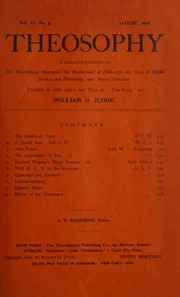
Theosophy Vol-63,No-8,June 1975

 80
80

Theosophy Vol-63,No-8,June 1975


Review by Alaric Kestrel (Metaphysical Studies Reviewer) — This particular issue of Theosophy magazine, Volume 63, Number 8, from June 1975, serves as a potent distillation of esoteric thought. It offers a compelling exploration of theosophical principles, weaving together ancient wisdom with contemporary relevance. The articles within are characterized by their intellectual rigor and spiritual depth, providing invaluable insights for those seeking a deeper understanding of occult science and universal laws. This is essential reading for committed students of theosophy and serious practitioners of spiritual disciplines, offering clarity and inspiration.
📝 Description
80
The June 1975 issue of Theosophy magazine, Vol-63 No-8, addresses the subtle planes of existence.
This issue of Theosophy magazine, published in June 1975, presents several articles focused on esoteric philosophy. It invites readers to consider the nature of consciousness and the interconnectedness of life. The content encourages quiet contemplation on philosophical questions and the use of symbolic language to express spiritual ideas. The aim is to offer insights into the soul's evolutionary path and the structure of the cosmos, moving beyond ordinary perception. It is intended for those interested in metaphysics and mysticism who seek deeper spiritual understanding.
Published during a period of renewed interest in Eastern philosophies and spiritual movements, this 1975 issue of Theosophy magazine fits within the broader context of the Theosophical Society's long history. Theosophy itself, founded by Helena Blavatsky in the late 19th century, sought to synthesize ancient wisdom traditions with modern scientific and philosophical thought. This particular issue likely continues that tradition, addressing concepts like karma, reincarnation, and the spiritual hierarchy, which are central to Theosophical teachings and were influential on subsequent esoteric movements.
💡 Why Read This Book?
This issue is a vital portal for those drawn to the mysteries of existence. It offers a unique opportunity to engage with profound Theosophical teachings, providing essential knowledge for spiritual seekers, scholars of comparative religion, and practitioners of esoteric arts. Uncover timeless wisdom and expand your consciousness with this illuminating collection.
⭐ Reader Reviews
Honest opinions from readers who have explored this book.
❓ Frequently Asked Questions
What is Theosophy?
Theosophy is a spiritual philosophy that seeks to understand the divine wisdom underlying all religions and sciences, emphasizing universal brotherhood and the evolution of consciousness through reincarnation and karma.
Who was Helena Blavatsky?
Helena Blavatsky was a co-founder of the Theosophical Society and a pivotal figure in modern esotericism, authoring foundational texts like 'The Secret Doctrine'.
What is the significance of reincarnation in Theosophy?
Reincarnation is a core tenet, explaining the soul's cyclical journey through multiple lives to learn spiritual lessons and evolve towards self-realization and ultimate unity.
How does Theosophy relate to science?
Theosophy posits a harmonious relationship between true spirituality and science, suggesting that the universe is governed by laws that can be understood through both empirical investigation and intuitive wisdom.
Where can I find more issues of Theosophy magazine?
Many libraries and online archives, including Esoteric Library, offer access to past issues of Theosophy magazine for research and personal study.
🔮 Key Themes & Symbolism
The Astral Body and its Functions
This theme explores the subtle, non-physical body that is believed to be the vehicle of consciousness and emotion. It explores its relationship with the physical form, its role in dreams, out-of-body experiences, and its energetic connection to the macrocosm. The articles illuminate the intricate workings of this vital component of the human constitution, offering insights into its purification and conscious direction for spiritual growth and understanding.
The Law of Karma and Reincarnation
Central to Theosophical thought, this theme meticulously examines the immutable law of cause and effect, known as Karma, and its inseparable companion, Reincarnation. It unravels how past actions shape present circumstances and future destinies, illustrating the soul's continuous journey through successive lives. This exploration provides a profound framework for understanding life's challenges and opportunities, fostering personal responsibility and spiritual evolution.
The Hierarchy of Masters and Spiritual Evolution
This section illuminates the concept of a guiding spiritual Hierarchy, comprised of advanced beings who have traversed the evolutionary path. It discusses their role in guiding humanity's progress and the principles of spiritual evolution that individuals can emulate. The articles offer a glimpse into the higher domains of consciousness and the aspiration toward spiritual attainment, inspiring readers to recognize their own latent potential for enlightenment and service.
💬 Memorable Quotes
Direct passages from the work, attributed to the author.
“Every atom hums with the divine.”
— This speaks to the universal presence of the divine, implying that consciousness and a spiritual essence permeate all matter, from the smallest particle to the grandest cosmic structure.
“The path inward is the journey outward.”
— This aphorism highlights the paradox of spiritual growth, where self-discovery and introspection lead to a broader understanding and connection with the external universe.
“Wisdom is not given, but earned through experience.”
— This emphasizes the active role of the individual in acquiring true understanding, suggesting that profound knowledge is the result of lived experiences and diligent study, not passive reception.
“The silent mind hears the cosmic symphony.”
— This poetic statement illustrates the power of stillness and mental quietude in perceiving the subtle, harmonious energies and intelligences that govern the universe.
💡 Key Ideas
Editorial paraphrase of the work's core concepts — not direct quotes.
The veil between worlds is thin for the diligent seeker.
This quote suggests that consistent effort and sincere intention in spiritual practice can lead to perceptions of realities beyond the ordinary physical senses.
🌙 Esoteric Significance
Tradition
This issue is firmly rooted in the Western Esoteric Tradition, specifically within the Theosophical movement founded by Helena Blavatsky. It draws heavily upon ancient Eastern philosophies, particularly Hinduism and Buddhism, synthesizing them with Western Hermeticism and Gnosticism to form a unique spiritual philosophy aimed at universal brotherhood and the exploration of hidden realities.
Symbolism
The content likely employs detailed symbolism drawn from various spiritual traditions. Expect references to cosmic cycles, archetypal figures, the elements, and the subtle energy centers within the human form (chakras). These symbols serve as vehicles for conveying profound, often ineffable, spiritual truths that transcend literal interpretation, inviting contemplation and intuitive understanding.
Modern Relevance
In contemporary times, the Theosophical ideas presented here offer a vital counterpoint to rampant materialism and fragmented worldviews. The emphasis on interconnectedness, universal ethics, and the evolutionary nature of consciousness remains profoundly relevant for reading through the complexities of modern life and fostering a more compassionate and sustainable global society.
👥 Who Should Read This Book
This issue is indispensable for dedicated students of Theosophy and comparative religion, offering deep dives into foundational principles. Spiritual seekers yearning for a comprehensive metaphysical framework will find clear insights into the nature of reality and their own soul's journey. Scholars of esoteric history and philosophy will appreciate its historical context and intellectual rigor. For practitioners of meditation, yoga, or other spiritual disciplines, it provides a rich theoretical underpinning and inspiration for their inner work.
📜 Historical Context
Published in June 1975, this issue of Theosophy magazine emerges during a period of significant global shifts and burgeoning interest in alternative spiritualities. The mid-1970s witnessed a growing disillusionment with materialistic paradigms and a resurgence of interest in Eastern philosophies, mysticism, and esoteric traditions. The Theosophical movement, with its roots in the late 19th century, continued to offer a comprehensive framework for understanding the universe and humanity's place within it, appealing to those seeking deeper meaning beyond conventional societal structures. This era provided fertile ground for the dissemination of Theosophical ideas, which offered a synthesis of ancient wisdom, scientific inquiry, and spiritual philosophy.
📔 Journal Prompts
Reflect on a time you felt a profound sense of interconnectedness with nature or others. What did this experience reveal about the subtle energies of life?
Consider the concept of karma in your own life. How have your past actions influenced your present circumstances, and what lessons can you glean for future choices?
If you could communicate with a spiritual guide or a more evolved being, what fundamental questions about existence would you ask?
Explore the symbolism of light and darkness in your personal spiritual journey. Where do you perceive these forces at play within yourself and the world?
How can the principle of universal brotherhood be actively cultivated in your daily interactions and community?
🗂️ Glossary
Astral Body
The subtle, non-physical body believed to be the seat of emotions, desires, and consciousness, capable of independent activity from the physical form.
Karma
The universal law of cause and effect, where every action generates a corresponding reaction that influences an individual's present and future experiences.
Reincarnation
The cyclical process of the soul being born into new physical bodies after death, undergoing a series of lives to learn spiritual lessons and evolve.
Macrocosm
The universe as a whole, often seen as a reflection or larger counterpart to the microcosm (the individual human being).
Esotericism
Teachings or practices that are intended only for a select group of people who are initiated or possess a specialized knowledge, often concerning spiritual or mystical subjects.
This book appears in 2 collections
🔮 Readers Also Liked
Browse all →





From the “Theosophy” Collection
View all →






More Free Theosophy & Anthroposophy Books
View all →