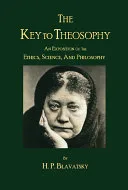
The Key to Theosophy by H. P. Blavatsky
 74
74

The Key to Theosophy by H. P. Blavatsky
Blavatsky's 'The Key to Theosophy' offers a direct, if sometimes dense, primer on the philosophical architecture of her movement. Unlike the veiled pronouncements of later occultists, Blavatsky confronts her audience head-on, structuring the book as a Q&A to anticipate and address common queries. This directness is its signal strength, cutting through potential mystification. However, the prose can be exacting; a reader unfamiliar with the era's specific philosophical jargon might find themselves frequently consulting external resources. A particularly illuminating section discusses the nature of 'Devachan,' the post-mortem state of bliss, which Blavatsky delineates with remarkable specificity, contrasting it with the karmic re-embodiment. While the book's advocacy is clear, its historical significance as a foundational text for a global spiritual movement is undeniable. It remains a vital, if challenging, window into early Theosophy.
📝 Description
74
Helena Petrovna Blavatsky published "The Key to Theosophy" in 1888 to explain her movement's core beliefs.
Published in 1888, "The Key to Theosophy" presents Helena Petrovna Blavatsky's basic teachings on her spiritual philosophy. Blavatsky wrote this book as a direct answer to public questions about the Theosophical Society's doctrines. It covers topics such as the nature of the Masters, the principles of reincarnation and karma, and the idea that all religions share a common root. The book uses a question-and-answer format, which makes its complex ideas easier to grasp compared to some of Blavatsky's other works.
This text is for anyone interested in the origins of the Theosophical Society and its main ideas. Students of comparative religion, esoteric philosophy, and those studying spiritual movements of the late 1800s will find it useful. It serves as a good starting point for understanding concepts like karma, reincarnation, and universal brotherhood as seen through the Theosophical viewpoint. The book requires a willingness to think about philosophical questions and what is termed spiritual science.
This book appeared in London in 1888, a time when Westerners were increasingly interested in Eastern religions and occult philosophies. The Theosophical Society, founded by Blavatsky and Henry Steel Olcott in 1875, aimed to bridge Eastern spiritual traditions with Western esotericism. "The Key to Theosophy" was Blavatsky's effort to clarify the Society's mission and its teachings on spiritual evolution and the unity of existence, responding to public curiosity and skepticism.
💡 Why Read This Book?
• Understand the Theosophical concept of Karma: Learn how Blavatsky explains the law of cause and effect as a guiding principle for reincarnation and soul evolution, offering a framework for personal accountability. • Grasp the role of the Mahatmas: Discover Blavatsky's description of the enlightened Masters who purportedly guide the Theosophical movement, as detailed in her answers to public inquiries. • Explore the Septenary Constitution of Man: Gain insight into the Theosophical model of human nature, which posits seven distinct principles or bodies, from the physical to the spiritual.
⭐ Reader Reviews
Honest opinions from readers who have explored this book.
❓ Frequently Asked Questions
What is the main purpose of 'The Key to Theosophy' by H. P. Blavatsky?
The book's primary purpose is to provide a clear and accessible explanation of the fundamental principles of Theosophy, as conceived by Helena Blavatsky and the Theosophical Society, answering common questions about its doctrines and aims.
When was 'The Key to Theosophy' originally published?
The original publication date for 'The Key to Theosophy' was 1888, making it a foundational text from the early years of the Theosophical movement.
Who are the 'Mahatmas' discussed in the book?
The Mahatmas, or Masters, are described in the book as highly evolved spiritual beings who are believed to guide the Theosophical movement and provide esoteric teachings, with Blavatsky claiming to be their messenger.
Does the book explain reincarnation?
Yes, 'The Key to Theosophy' extensively explains the Theosophical view of reincarnation as a process of continuous soul evolution across multiple lifetimes, governed by the law of karma.
Is 'The Key to Theosophy' suitable for beginners in esoteric studies?
Yes, due to its Q&A format, the book is designed to be more approachable for newcomers to esoteric philosophy than some of Blavatsky's other works, though some concepts require careful study.
What is the 'Great White Brotherhood' according to this book?
The 'Great White Brotherhood' is presented as a fraternity of enlightened spiritual teachers from various traditions who work for the spiritual evolution of humanity, a core tenet Blavatsky sought to introduce.
🔮 Key Themes & Symbolism
Theosophical Doctrine
This work serves as an accessible exposition of the core doctrines Blavatsky sought to establish. It defines concepts such as the septenary nature of man, the cyclical nature of existence, and the interconnectedness of all life. The book emphasizes the universality of spiritual truth, suggesting that Theosophy provides a unifying framework for understanding diverse religious and philosophical systems, aiming to reveal the underlying wisdom common to all.
Karma and Reincarnation
Central to Theosophical thought, karma and reincarnation are explained as the twin laws governing human existence. Blavatsky details karma not as arbitrary fate, but as an impersonal, unerring principle of cause and effect, where actions in one life determine the conditions of subsequent lives. Reincarnation is presented as the mechanism through which the soul learns and evolves, progressing through numerous existences until spiritual perfection is attained.
The Masters and Theosophical Society
The book addresses the nature and role of the Mahatmas, or Masters, who are depicted as highly advanced human beings guiding humanity's spiritual progress. Blavatsky clarifies the objectives of the Theosophical Society, founded in 1875, which include promoting universal brotherhood, studying comparative religion and philosophy, and investigating the unexplained laws of nature and the powers latent in humanity.
Esoteric Psychology and Cosmology
Blavatsky outlines a complex model of human consciousness and the universe. The septenary constitution of man, comprising physical, vital, astral, lower mental, higher mental, spiritual, and absolute principles, is explored. The book touches upon a cosmology that views the material universe as a manifestation of divine thought, emphasizing the interconnectedness of the microcosm (human) and the macrocosm (universe).
💬 Memorable Quotes
Direct passages from the work, attributed to the author.
“Karma is the unerring law which underlies all circumstances.”
— This highlights the fundamental Theosophical principle of karma as an inescapable, governing force that shapes every aspect of existence, emphasizing its role in cosmic and individual destiny.
“Reincarnation is the journey of the soul through successive physical existences.”
— This interpretation captures the essence of the book's explanation of reincarnation, framing it as a continuous process of soul evolution across multiple lifetimes rather than a singular event.
💡 Key Ideas
Editorial paraphrase of the work's core concepts — not direct quotes.
The Theosophical Society has been founded with three objects: Universal Brotherhood, Study of Comparative Religion, and investigation of the unexplained laws of Nature.
This quote succinctly outlines the three primary aims Blavatsky and her associates established for the Theosophical movement, highlighting its focus on unity, knowledge, and the exploration of the unknown.
Man is not a single being, but a composite of seven principles.
This paraphrased concept points to the Theosophical doctrine of the septenary nature of humanity, suggesting a multi-layered existence beyond the physical body and its immediate psychological functions.
The Masters are highly evolved beings who guide humanity.
This statement summarizes Blavatsky's explanation of the Mahatmas, portraying them as advanced spiritual teachers dedicated to fostering human spiritual development and progress.
🌙 Esoteric Significance
Tradition
This work is foundational to the Theosophical tradition, a syncretic spiritual philosophy that draws heavily from Hinduism, Buddhism, Hermeticism, and Neoplatonism. Blavatsky sought to present Theosophy as the 'ancient wisdom religion,' a universal spiritual science underlying all exoteric faiths. 'The Key to Theosophy' serves as an accessible entry point, articulating the movement's unique interpretations of karma, reincarnation, and the nature of spiritual evolution, departing from traditional Western religious frameworks.
Symbolism
The book frequently references the 'Lotus' as a symbol of spiritual unfolding and the divine potential within humanity, mirroring its appearance in Eastern traditions. The concept of the 'Seven Principles' of man functions symbolically, representing levels of consciousness and being, from the gross physical to the pure spiritual essence. The 'Great White Brotherhood' itself acts as a potent symbol of enlightened guidance and spiritual hierarchy, representing attainable perfection.
Modern Relevance
Contemporary spiritual seekers, particularly those interested in comparative religion, Eastern mysticism, and Western esoteric traditions, continue to engage with Blavatsky's work. New Age movements, modern occultists, and students of consciousness often cite Theosophy as a significant influence. Thinkers exploring the perennial philosophy or seeking alternative frameworks for understanding existence frequently return to 'The Key to Theosophy' for its comprehensive overview of these complex ideas.
👥 Who Should Read This Book
• Aspiring students of Theosophy: Individuals beginning their exploration of Helena Blavatsky's philosophy will find this book an essential primer for understanding its core concepts and terminology. • Researchers of 19th-century esotericism: Scholars and enthusiasts interested in the intellectual and spiritual movements of the Victorian era will gain context on the origins and aims of the Theosophical Society. • Seekers of comparative religious understanding: Those looking to bridge the gap between Eastern and Western spiritual traditions will appreciate the book's emphasis on universal truths and its syncretic approach.
📜 Historical Context
In 1888 London, 'The Key to Theosophy' emerged as a crucial text for the burgeoning Theosophical movement, founded by Helena Blavatsky and Henry Steel Olcott in 1875. This era was marked by a widespread fascination with spiritualism, Eastern philosophies, and occult sciences, a countercurrent to Victorian materialism. Blavatsky's work sought to synthesize these interests, offering a structured esoteric philosophy. It appeared amidst intellectual currents influenced by figures like Madame Blavatsky's own writings, as well as contemporary spiritualist and occult authors. The Society itself faced scrutiny, notably from critics like Richard Hodgson, whose report for the Society for Psychical Research questioned the authenticity of Blavatsky's claims, making 'The Key to Theosophy' an important statement of the movement's principles and a defense against such skepticism.
📔 Journal Prompts
The concept of karma as an unerring law requires careful consideration.
Reflecting on the septenary constitution of man.
The role of the Masters in guiding humanity's evolution.
The universality of the Great White Brotherhood's aims.
Understanding Devachan as a state of consciousness.
🗂️ Glossary
Mahatma
A Sanskrit term meaning 'Great Soul,' used in Theosophy to refer to highly evolved spiritual beings or Masters who guide humanity's spiritual evolution and transmit esoteric wisdom.
Karma
The universal law of cause and effect, governing all existence. In Theosophy, it explains the consequences of actions across multiple lifetimes, influencing reincarnation and spiritual development.
Reincarnation
The doctrine that the soul passes through a cycle of successive physical existences, learning and evolving through each life according to the law of karma.
Septenary
Pertaining to the number seven. In Theosophy, it refers to the seven principles or bodies that constitute the human being, ranging from the physical to the purely spiritual.
Devachan
A Sanskrit term often translated as 'heaven-world' or 'state of bliss.' It refers to the post-mortem state of rest and assimilation of experiences gained during the preceding physical life, before rebirth.
Theosophical Society
An international organization founded in 1875 by Helena Blavatsky, Henry Steel Olcott, and others, dedicated to promoting universal brotherhood, studying ancient wisdom, and investigating the laws of nature.
Universal Brotherhood
A core principle of Theosophy, advocating for the recognition of the fundamental unity and equality of all humanity, irrespective of race, creed, sex, or condition.