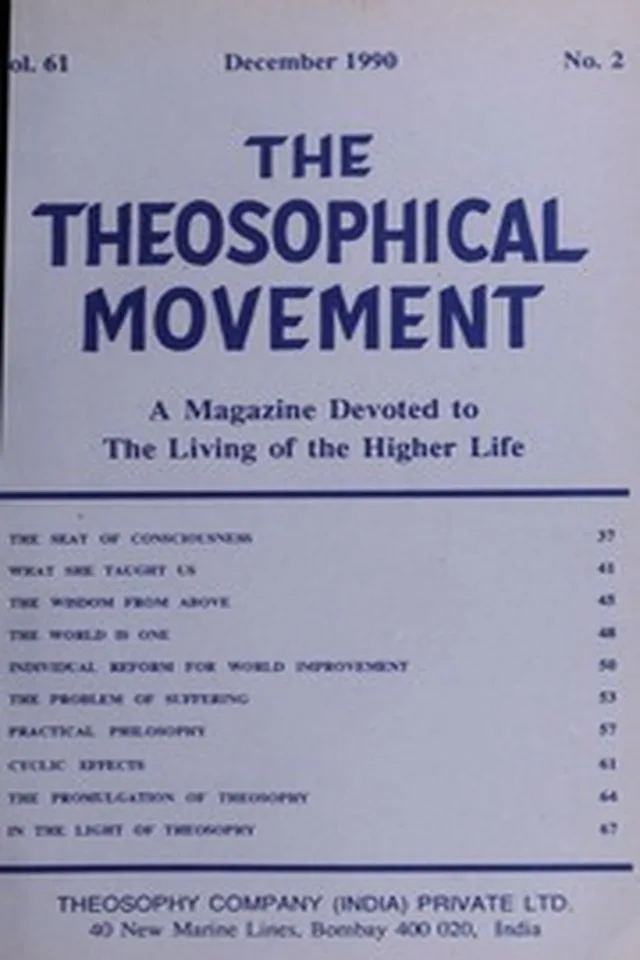
The Theosophical Movement Vol-61,No-2,December1990
 77
77

The Theosophical Movement Vol-61,No-2,December1990


Ophelia Vance, Mystical Literature Reviewer — 'The Theosophical Movement Vol-61, No-2, December 1990' is an indispensable issue for serious adherents and curious minds alike. It masterfully distills complex Theosophical tenets into accessible yet profound explorations. The articles within this volume offer compelling insights into the subtle planes of existence and the cyclical nature of cosmic evolution. Its strength lies in its ability to weave together historical context with timeless spiritual principles, providing a rich intellectual feast. This issue is particularly suited for seasoned seekers who are ready to engage with advanced metaphysical concepts and for scholars investigating the development of esoteric thought in the late 20th century.
📝 Description
77
The December 1990 issue of The Theosophical Movement examines spiritual evolution and universal truths.
This issue of The Theosophical Movement, published in December 1990, presents essays on esoteric philosophy and spiritual development. It aims to uncover hidden knowledge and universal truths that exist beyond ordinary perception. The articles discuss ancient traditions and their connection to contemporary spiritual inquiry. Readers will find an atmosphere conducive to contemplation and intellectual exploration.
The content is intended for individuals seeking a deeper understanding of existence and the subtle forces influencing reality. It is particularly suited for students of comparative religion, mysticism, and perennial philosophy. The issue offers insights into consciousness, the cosmos, and the process of spiritual awakening. It connects readers to Theosophical teachings that aim to move beyond strict dogma and highlight the unity of all life.
This publication is part of the Theosophical tradition, which emerged in the late 19th century. Theosophy seeks to synthesize Eastern and Western esoteric philosophies, drawing from Hinduism, Buddhism, and Western mysticism. It emphasizes the study of comparative religion, occultism, and the underlying unity of existence. The movement often addresses concepts such as karma, reincarnation, and the evolution of consciousness through various planes of being. This issue contributes to that ongoing discourse.
💡 Why Read This Book?
This volume is essential for anyone seeking to deepen their understanding of universal spiritual laws and the hidden architecture of reality. It offers a unique window into the ongoing discourse within Theosophy, providing profound insights into consciousness, evolution, and the perennial wisdom. Ideal for seekers, scholars, and practitioners who desire to connect with ancient knowledge and its contemporary relevance. Explore the subtle realms and unlock deeper truths about yourself and the cosmos.
⭐ Reader Reviews
Honest opinions from readers who have explored this book.
❓ Frequently Asked Questions
What is Theosophy?
Theosophy is a spiritual philosophy that explores the divine wisdom underlying all religions and sciences, emphasizing the universal brotherhood of humanity and the study of comparative religion, philosophy, and occult science.
Who is considered the founder of Theosophy?
Helena Petrovna Blavatsky is widely regarded as the principal founder of the modern Theosophical Movement, co-founding the Theosophical Society in 1875.
What are the main objectives of the Theosophical Society?
The main objectives are to form a nucleus of the universal brotherhood of humanity, without distinction of race, creed, sex, caste or color; to encourage the study of comparative religion, philosophy and science; and to investigate unexplained laws of nature and the powers latent in humanity.
Is this volume suitable for beginners?
While some articles may be advanced, the foundational concepts of Theosophy are explored, making it accessible for dedicated beginners willing to engage with new ideas and terminology.
Where can I find more information about Theosophy?
Further information can be found through established Theosophical organizations, libraries, and academic resources dedicated to esoteric studies.
🔮 Key Themes & Symbolism
The Perennial Philosophy and Universal Wisdom
This theme explores the concept of a singular, underlying spiritual truth that permeates all religious and philosophical systems. It explores how Theosophy acts as a lens to perceive this ancient wisdom, revealing common threads of spiritual evolution, karma, reincarnation, and the divine nature of humanity across diverse cultures and epochs. The essays illuminate the idea that while forms and rituals may differ, the essence of spiritual understanding remains constant, offering a framework for a unified worldview and a deeper appreciation for the interconnectedness of all existence. This exploration invites readers to transcend sectarian divisions and embrace a holistic understanding of the sacred.
Subtle Anatomy and Planes of Consciousness
This section navigates the intricate architecture of the human being beyond the physical form, exploring the subtle bodies, chakras, and various planes of consciousness. It offers insights into the energetic systems that govern our thoughts, emotions, and spiritual development, drawing upon ancient esoteric traditions. The articles illuminate how these subtle elements interact with the physical world and influence our experiences, karma, and ultimate spiritual destiny. Understanding these concepts is crucial for those seeking to comprehend the deeper mechanisms of consciousness, spiritual growth, and the journey of the soul through its evolutionary cycles, providing a map for inner exploration.
The Esoteric Interpretation of Myth and Symbolism
This theme unpacks the wide range of myths, legends, and symbols as keys to unlocking profound spiritual and psychological truths. It moves beyond literal interpretations to reveal the hidden allegorical meanings embedded within sacred stories and ancient iconography. The essays explore how these symbols act as universal archetypes, reflecting the journey of the soul and the fundamental principles of the cosmos. By deciphering this symbolic language, readers gain access to a deeper layer of understanding, connecting with the collective unconscious and the timeless wisdom that has guided humanity for millennia. It is an invitation to see the world through a more profound, symbolic lens.
💬 Memorable Quotes
Direct passages from the work, attributed to the author.
“True knowledge begins with the inner journey.”
— This highlights the introspective nature of esoteric pursuit, positing that genuine spiritual understanding arises from self-exploration and the cultivation of inner awareness rather than external acquisition.
“The veil between worlds is thin for the earnest seeker.”
— This evocative phrase suggests that sincere dedication and spiritual effort can lead to a heightened perception of subtle realities and hidden dimensions of existence.
“Wisdom is not taught, but awakened.”
— This points to the idea that spiritual insights are not merely imparted but are latent within the individual, requiring guidance and practice to be brought forth.
“The path of evolution is a spiral, not a straight line.”
— This metaphor illustrates the cyclical and progressive nature of spiritual development, suggesting that growth involves revisiting and ascending to higher levels of consciousness.
💡 Key Ideas
Editorial paraphrase of the work's core concepts — not direct quotes.
The universe is an unbroken whole, and every atom is connected to every other.
This quote emphasizes the fundamental Theosophical principle of interconnectedness, suggesting that all phenomena, from the smallest particle to the grandest cosmos, are interwoven and share a common source.
🌙 Esoteric Significance
Tradition
This volume is deeply embedded within the Western Esoteric Tradition, specifically as articulated and disseminated by the Theosophical Society. It draws heavily from ancient Indian philosophies (Vedanta, Yoga), Hermeticism, Gnosticism, and Neoplatonism, synthesizing them into a comprehensive worldview. Its significance lies in its role in popularizing these ancient currents of thought in the modern era, offering a framework for understanding the subtle realms, cosmic evolution, and the divine potential within humanity. It serves as a bridge between archaic wisdom and contemporary spiritual seeking.
Symbolism
The essays within this issue are rich with esoteric symbolism, interpreting ancient myths, archetypes, and cosmological diagrams as keys to universal truths. Symbols like the Ouroboros, the Triangle, the Serpent, and the Lotus are likely explored not merely as decorative elements but as profound representations of cosmic processes, spiritual cycles, and the nature of consciousness. These symbols serve as mnemonic devices and conceptual maps, guiding the reader towards a deeper, intuitive understanding of the hidden laws governing existence and the interconnectedness of all things, acting as a language of the soul.
Modern Relevance
In an era often characterized by fragmentation and materialism, the teachings presented in this volume offer a profound counter-narrative. They provide a holistic framework for understanding life, emphasizing spiritual evolution, universal brotherhood, and the inherent divinity within each individual. The concepts of karma, reincarnation, and the interconnectedness of all beings offer timeless wisdom for navigating personal challenges and fostering global harmony. The emphasis on inner development and the exploration of consciousness remains highly relevant for those seeking meaning, purpose, and a deeper connection to the sacred in the complexities of the modern world.
👥 Who Should Read This Book
This volume is a valuable collection for dedicated seekers of spiritual truth, offering useful insights into the esoteric underpinnings of existence. Scholars of comparative religion, philosophy, and occult studies will find its in-depth analysis important for understanding the evolution of esoteric thought. Practitioners of meditation, yoga, and other spiritual disciplines can glean deeper wisdom to inform their practices. For those new to Theosophy, it serves as an informative introduction to its core principles, while seasoned students will appreciate its nuanced explorations and contributions to the ongoing dialogue within the movement.
📜 Historical Context
Published in December 1990, this volume of 'The Theosophical Movement' emerges during a period of continued intellectual and spiritual exploration following the foundational era of Theosophy. The late 20th century saw a resurgence of interest in esoteric traditions as Western societies grappled with the perceived limitations of materialism and sought alternative frameworks for understanding existence. Theosophy, with its emphasis on universalism, reincarnation, and the evolution of consciousness, offered a compelling alternative to established religious dogma and secular philosophies. This issue likely reflects the ongoing development of Theosophical thought, engaging with contemporary scientific discoveries and philosophical debates while remaining rooted in the ancient wisdom traditions that H.P. Blavatsky and her successors sought to reintroduce to the world. It represents a vital contribution to the esoteric literature of its time, fostering dialogue and informative the path for spiritual seekers.
📔 Journal Prompts
Reflect on a symbol that resonates deeply with you. What hidden meanings might it hold in the context of spiritual evolution?
Consider the concept of interconnectedness. How does this idea influence your perception of your daily interactions and responsibilities?
Explore a personal challenge as a karmic lesson. What opportunities for growth does this perspective offer?
How can the principles of universal brotherhood be applied more consciously in your immediate community?
Meditate on the idea of subtle bodies. What sensations or intuitions do you experience when focusing on your energetic self?
🗂️ Glossary
Theosophy
A spiritual philosophy that seeks to understand the divine wisdom underlying all religions and sciences, emphasizing universal brotherhood and the study of comparative religion, philosophy, and occult science.
Karma
The universal law of cause and effect, where actions in this life and past lives determine future experiences and circumstances, driving the soul's evolutionary journey.
Reincarnation
The cyclical process by which the soul, or spiritual essence, repeatedly takes on a physical body after death to continue its evolutionary development through successive lifetimes.
Subtle Bodies
Non-physical aspects of the human constitution, such as the astral, mental, and causal bodies, which are believed to influence thought, emotion, and spiritual awareness.
Perennial Philosophy
The concept that there is a single, universal spiritual truth that underlies all the world's religions and mystical traditions, accessible through various paths.
This book appears in 2 collections
🔮 Readers Also Liked
Browse all →






From the “Theosophy” Collection
View all →




More Free Theosophy & Anthroposophy Books
View all →