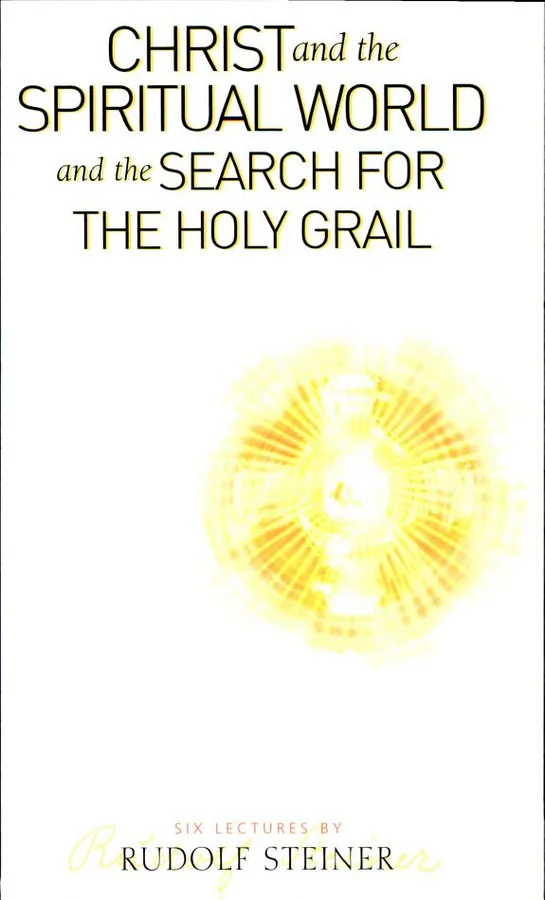
Christ and the Spiritual World and the Search for the Holy Grail
 71
71

Christ and the Spiritual World and the Search for the Holy Grail
Rudolf Steiner's "Christ and the Spiritual World and the Search for the Holy Grail" presents a dense, yet often illuminating, cosmological perspective on human history. Steiner's ability to connect the incarnation of Christ with the unfolding of human consciousness and the symbolism of the Holy Grail is particularly strong. He masterfully links the legend of Parsifal to a broader narrative of spiritual evolution, referencing the "stellar script" as a cosmic influence. However, the work's highly specific Anthroposophical framework can be challenging for those unfamiliar with Steiner's broader teachings, requiring significant prior knowledge or supplementary reading to fully grasp the intricate connections he draws. A notable passage involves his interpretation of how Gnostic insights relate to the Grail mysteries, offering a novel perspective on ancient Christian heresies. The book's primary limitation is its inherent esoteric language, which can obscure its core message for the uninitiated.
Ultimately, this is a vital text for understanding Steiner's unique Christology and its integration with Western esoteric traditions.
📝 Description
71
Rudolf Steiner published "Christ and the Spiritual World and the Search for the Holy Grail" in 1913.
Rudolf Steiner's "Christ and the Spiritual World and the Search for the Holy Grail" examines the spiritual significance of Christ's incarnation and its connection to human consciousness. He traces the origins of the Holy Grail legend, viewing it as a symbol of humanity's spiritual quest. Steiner connects this quest to cosmic events, suggesting celestial influences on earthly spiritual development.
The book discusses the historical importance of Gnostic traditions and their relation to the Grail mysteries. It is intended for readers interested in the spiritual underpinnings of history and myth, particularly those studying Anthroposophy or seeking interpretations of the historical Jesus outside conventional theology. Those fascinated by esoteric Western spiritual traditions and the evolution of consciousness will find it relevant.
This work emerged from the early 20th-century milieu of spiritual science and esoteric research. Steiner engaged with interpretations of Christian history and mythology that differed from mainstream theology. He addressed a perceived spiritual vacuum in modernity, offering a framework for understanding humanity's cosmic place. His approach built upon, yet also critiqued, earlier movements like Theosophy, aiming for a more individualized spiritual path.
💡 Why Read This Book?
• Gain insight into Rudolf Steiner's unique interpretation of Christ's incarnation and its cosmic significance, understanding how he connects it to the "stellar script" that influences human spiritual development. • Explore the symbolic meaning of the Holy Grail legend and the figure of Parsifal as presented by Steiner, moving beyond simplistic interpretations to grasp their role in human evolution. • Comprehend the historical influence and spiritual principles of Gnosticism as analyzed by Steiner, appreciating its relevance to the perennial quest for spiritual knowledge.
⭐ Reader Reviews
Honest opinions from readers who have explored this book.
❓ Frequently Asked Questions
What is Rudolf Steiner's concept of the "stellar script" in relation to Christ?
Steiner posits the "stellar script" as the influence of cosmic and celestial events on earthly human spiritual development. In "Christ and the Spiritual World," he connects specific cosmic occurrences to the incarnation of Christ, suggesting a divinely orchestrated relationship between the cosmos and human destiny.
How does Steiner interpret the legend of the Holy Grail?
Steiner views the Holy Grail legend not merely as a medieval romance but as a profound symbolic expression of humanity's spiritual quest. He links it to the search for divine knowledge and the development of consciousness, particularly through the archetype of Parsifal.
What is the significance of Gnostic religion according to Steiner in this book?
In "Christ and the Spiritual World," Steiner examines Gnosticism as a historical spiritual impulse that carried profound insights into the nature of Christ and the spiritual realms. He sees its influence interwoven with the development of Western spirituality and the Grail mysteries.
Who were the Sibyls in the context of Steiner's work?
Steiner references the Sibyls as ancient figures who possessed prophetic and spiritual knowledge. He suggests their influence permeated human history, acting as conduits for spiritual understanding that relate to the broader themes of Christ and the spiritual world explored in the book.
When was "Christ and the Spiritual World and the Search for the Holy Grail" first published?
The work by Rudolf Steiner, "Christ and the Spiritual World and the Search for the Holy Grail," was first published in 2008, bringing his lectures and writings on these themes to a modern audience.
What is the core connection Steiner makes between Christ and human history?
Steiner connects Christ's incarnation to a pivotal turning point in human evolution, marking a new phase of spiritual development. He argues that this event profoundly impacted earthly and cosmic realities, shaping the course of human history and consciousness.
🔮 Key Themes & Symbolism
Christic Incarnation and Evolution
The book elaborates on Rudolf Steiner's view of Christ's incarnation not as a singular historical event but as a cosmic act that fundamentally altered the trajectory of human spiritual evolution. Steiner posits that this event introduced a new force into the earthly sphere, enabling humanity to develop greater self-awareness and freedom. The work traces how this spiritual impulse permeates history, influencing consciousness and offering a path toward higher spiritual development, moving beyond purely materialist understandings of existence.
The Holy Grail and the Seeker's Path
The Holy Grail is presented as a potent symbol for the human soul's quest for spiritual knowledge and union with the divine. Steiner connects the legend, particularly through the figure of Parsifal, to the development of inner faculties and the capacity to perceive spiritual realities. The "search" for the Grail signifies an inner transformation, a process of awakening consciousness to the spiritual dimensions of existence and the profound mysteries surrounding Christ's presence in the world.
Cosmic Influences and Stellar Script
Steiner introduces the concept of a "stellar script," suggesting that celestial bodies and cosmic events are not merely physical phenomena but carry spiritual significance that directly influences human life and destiny. This book explores how these cosmic rhythms and patterns are intrinsically linked to major spiritual events on Earth, including Christ's incarnation. Understanding this script is presented as key to deciphering the hidden forces shaping human history and individual spiritual journeys.
Gnosis and Ancient Wisdom
The book examines the role of Gnostic traditions within the broader spectrum of human spiritual seeking. Steiner views Gnosticism as a significant repository of knowledge concerning the spiritual world and the nature of Christ. He analyzes how Gnostic insights, often misunderstood or suppressed historically, contributed vital elements to the development of Western esoteric thought and are implicitly present in the symbolism of the Holy Grail.
💬 Memorable Quotes
Direct passages from the work, attributed to the author.
“The legend of the Holy Grail emerges in human history.”
— This statement highlights Steiner's perspective that the Grail legend is not arbitrary but arises organically from specific historical and spiritual needs of humanity, serving as a symbolic vehicle for profound spiritual truths.
“The "stellar script" relates to the secret of Parsifal.”
— This suggests a deep cosmic underpinning to the Grail quest narrative. Steiner implies that understanding the celestial influences and patterns ('stellar script') is essential to unlocking the deeper meaning and spiritual significance of Parsifal's journey.
“Reviewing human history in relation to the cosmic and earthly events of Christ's incarnation.”
— This frames the book's core endeavor: to provide a spiritual-scientific interpretation of history, centering the transformative impact of Christ's incarnation on both the terrestrial realm and the cosmos.
“The widespread influence of the Sibyls who, through ancient times, carried spiritual knowledge.”
— This points to Steiner's recognition of ancient spiritual traditions and their bearers, like the Sibyls, as crucial links in the chain of spiritual wisdom that informs later developments, including the Grail legend.
“Christ and the Spiritual World examines humanity's existential quest.”
— This emphasizes the book's focus on the fundamental human search for meaning, purpose, and connection to the spiritual, linking individual spiritual development to the broader historical and cosmic context.
🌙 Esoteric Significance
Tradition
This work is deeply rooted in the Anthroposophical tradition founded by Rudolf Steiner. It seeks to provide a spiritual-scientific exegesis of Christian events and Western esoteric symbols, departing from traditional theology by emphasizing cosmic dimensions and evolutionary processes. It builds upon but also refines earlier esoteric interpretations of Christ, Gnosticism, and Grail legends, aiming for a more individualized and inwardly-focused spiritual path.
Symbolism
Key symbols include the Holy Grail, representing the vessel of divine grace and the chalice of spiritual knowledge sought by humanity. Parsifal embodies the modern individual on the path of spiritual awakening, capable of perceiving the spiritual world. The "stellar script" symbolizes the intricate connection between cosmic forces and earthly spiritual development, suggesting a divinely ordered universe influencing human destiny.
Modern Relevance
Steiner's interpretations continue to influence practitioners of Anthroposophy and related spiritual movements. Contemporary thinkers in esoteric Christianity, comparative mythology, and depth psychology draw upon his unique Christology and symbolic analysis. His work remains relevant for those exploring alternative spiritual paths and seeking to understand the deeper meaning of historical events and myths in the context of ongoing human evolution.
👥 Who Should Read This Book
["• Students of Anthroposophy seeking to deepen their understanding of Steiner's Christology and esoteric interpretations of Western myths.", '• Researchers of comparative religion and esoteric traditions interested in alternative perspectives on Gnosticism and the Holy Grail legend.', '• Individuals engaged in personal spiritual development who are exploring the connections between cosmic events, human consciousness, and historical spiritual impulses.']
📜 Historical Context
Rudolf Steiner's "Christ and the Spiritual World and the Search for the Holy Grail" emerged from his extensive work in spiritual science during the early 20th century. Published posthumously in 2008, its ideas stem from lectures given decades earlier, reflecting a period of intense interest in esoteric Christianity and the reinterpretation of ancient myths. Steiner's approach stood in contrast to both orthodox theology and prevailing materialistic philosophies. His work sought to provide a spiritual-scientific understanding of Christ's significance, integrating it with human evolution and cosmic events. He engaged with currents from Theosophy but sought to establish a distinct path through Anthroposophy. While Steiner himself was a prolific lecturer, the specific reception of these particular lectures in their original context is less documented than major published works, but they contributed to a growing body of esoteric literature questioning traditional religious dogma.
📔 Journal Prompts
The "stellar script" as a force in human history; what patterns might it reveal?
Parsifal's quest for the Grail; how does this archetype resonate with contemporary spiritual searching?
The influence of Gnostic ideas on Western spirituality; where can these echoes be found today?
Christ's incarnation as a turning point; reflect on its perceived impact on human consciousness.
Sibyls and ancient wisdom; consider the transmission of spiritual knowledge across epochs.
🗂️ Glossary
Anthroposophy
A spiritual philosophy founded by Rudolf Steiner, aiming to understand the spiritual nature of the human being and the cosmos through spiritual perception and scientific inquiry.
Christic Incarnation
Refers to the event of Christ taking on human form on Earth. Steiner interprets this event as a cosmic-spiritual act with wide implications for human evolution and the spiritual balance of the Earth.
Gnosis
In a spiritual context, refers to direct, intuitive knowledge of spiritual truths, often associated with early Christian movements that emphasized inner knowing over dogma.
Holy Grail
A legendary vessel, often associated with the Last Supper or the blood of Christ, symbolizing spiritual attainment, divine grace, and the object of a profound quest.
Parsifal
A central figure in Arthurian legend, often depicted as the pure fool or innocent knight who achieves the quest for the Holy Grail.
Sibyls
In antiquity, women believed to possess prophetic powers and divine inspiration, acting as oracles and conduits of spiritual knowledge across different cultures.
Stellar Script
A concept suggesting that celestial bodies and cosmic events carry spiritual intelligence and influence, shaping earthly occurrences and human destiny in a divinely ordered manner.
This book appears in 1 collection
🔮 Readers Also Liked
Browse all →



From the “Anthroposophy” Collection
View all →






More Free Theosophy & Anthroposophy Books
View all →