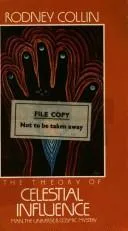
The theory of celestial influence
 75
75

The theory of celestial influence
Rodney Collin’s *The Theory of Celestial Influence* attempts a bold synthesis, framing esoteric cosmology not as mysticism but as a system governed by discernible principles. Collin argues convincingly for a universe where celestial bodies are not passive observers but active participants in Earth’s unfolding. His strength lies in the systematic presentation of his ideas, drawing parallels between astronomical cycles and terrestrial events with an almost scientific rigor. However, the book's dense argumentation and its reliance on a specific, often unstated, metaphysical framework can present a significant barrier to entry. A particularly striking section details the potential influence of planetary bodies on biological processes, moving beyond simple astrological signifiers to propose a more direct, physical interaction. While its detailed analysis is commendable, the lack of accessible definitions for some of its more specialized concepts can leave readers adrift. It is a challenging but rewarding text for those willing to engage with its unique worldview.
📝 Description
75
Rodney Collin's 1984 book, The Theory of Celestial Influence, proposes a mechanistic view of cosmic forces impacting Earth.
First published in 1984, The Theory of Celestial Influence by Rodney Collin presents a detailed argument for the tangible impact of celestial bodies on human consciousness and earthly events. Collin moves beyond traditional symbolic astrology to suggest a dynamic system where astronomical mechanics directly correlate with the evolution of life and awareness on this planet. He posits that planetary and stellar bodies exert a measurable influence, affecting everything from biological development to individual psychology. This work is written for those interested in a systematic and almost scientific understanding of occult principles, particularly the connections between astronomy and esoteric thought. It offers a departure from purely symbolic interpretations, favoring a more structured, mechanistic approach to cosmology and comparative religion.
Collin's theories draw on earlier traditions but are framed within a modern intellectual structure. He attempts to bridge ancient cosmological ideas with a contemporary intellectual framework, distinguishing his work from many popular occult writings of his time. The book is aimed at serious students of esoteric philosophy who seek a deeper understanding of the relationship between the cosmos and terrestrial life. Readers will find value in its detailed argumentation and its effort to provide a systematic account of celestial influence.
Rodney Collin's work emerged during a late 20th century resurgence of interest in esoteric thought, offering a counterpoint to purely materialistic scientific views. While popular astrology often focused on personality, Collin's approach was cosmological and systemic. His theories are rooted in earlier traditions but are presented with a systematic, almost scientific, discourse. This effort to frame ancient ideas within a modern intellectual structure aimed to bridge the gap between esoteric wisdom and contemporary understanding, setting it apart from many contemporary occult writers.
💡 Why Read This Book?
• Gain a systematic understanding of celestial mechanics as proposed by Collin, moving beyond common astrological interpretations to explore a proposed physical basis for cosmic influence, as detailed in his discussions on planetary cycles. • Explore the concept of cosmic cycles and their potential correlation with terrestrial events, learning how Collin connects astronomical phenomena to historical patterns and biological evolution. • Discover a unique esoteric perspective on the universe that attempts to bridge ancient wisdom with a more structured, almost scientific, framework, providing alternative models for understanding consciousness and cosmic order.
⭐ Reader Reviews
Honest opinions from readers who have explored this book.
❓ Frequently Asked Questions
What is the primary thesis of Rodney Collin's The Theory of Celestial Influence?
The book's central argument is that celestial bodies exert a direct, measurable influence on Earth, affecting consciousness, biological processes, and societal events, proposing a systematic, mechanistic model of cosmic interaction.
When was The Theory of Celestial Influence first published?
The Theory of Celestial Influence was first published in 1984, placing it within the late 20th-century resurgence of esoteric interest.
Does this book explain traditional astrology?
While it discusses celestial bodies, the book moves beyond traditional astrological interpretations to propose a more systemic and mechanistic theory of influence, focusing on cosmic cycles and their tangible effects.
What kind of reader would benefit most from this book?
Serious students of esoteric philosophy, cosmology, and comparative religion who seek a structured, less symbolic approach to understanding the cosmos and its impact on Earth will find it valuable.
What distinguishes Collin's approach from popular occultism?
Collin's approach is characterized by its detailed argumentation and its attempt to frame esoteric principles within a systematic, almost scientific discourse, rather than relying on purely symbolic or intuitive methods.
Are there practical applications suggested for the theories presented?
The book primarily focuses on theoretical cosmology and the underlying principles of celestial influence, rather than offering direct practical applications for divination or personal transformation.
🔮 Key Themes & Symbolism
Cosmic Cycles and Terrestrial Correlation
Collin posits that recurring patterns in celestial movements are directly mirrored in terrestrial events, from biological evolution to the rise and fall of civilizations. This theme moves beyond simple astrological correlations to suggest a fundamental, underlying mechanism. The work meticulously examines historical epochs and natural phenomena, seeking to demonstrate how shifts in cosmic energies precipitate corresponding changes on Earth, offering a framework for understanding history not as random occurrences but as part of a grander, predictable cosmic rhythm.
The Mechanics of Celestial Influence
This theme explores the 'how' of cosmic influence, proposing that planetary and stellar bodies exert forces that are tangible and measurable, akin to physical laws. Collin attempts to articulate a system where these influences operate through specific channels, impacting consciousness, life forms, and geological processes. It’s an exploration of a universe governed by dynamic, interconnected forces, where the macrocosm actively shapes the microcosm, challenging purely materialistic explanations by reintroducing a cosmic dimension to scientific inquiry.
Consciousness and Cosmic Resonance
The book explores the idea that human consciousness is not isolated but is deeply attuned to the rhythms and forces emanating from the cosmos. Collin suggests that our psychological states, collective moods, and even evolutionary leaps are influenced by celestial configurations. This perspective frames consciousness as a receiver or participant in a larger cosmic dialogue, where understanding these influences can lead to a deeper comprehension of human nature and its place within the universal order, suggesting a form of cosmic symbiosis.
Systematic Esoteric Cosmology
Collin's work is an endeavor to construct a coherent, logical system of esoteric cosmology. It aims to provide a framework that explains the apparent order and interconnectedness of the universe through observable celestial phenomena. By departing from purely symbolic interpretations, he seeks to offer a more grounded, almost scientific, understanding of occult principles, presenting a unified vision where the physical and metaphysical realms are intrinsically linked through the demonstrable power of celestial bodies.
💬 Memorable Quotes
Direct passages from the work, attributed to the author.
“The influence of the planets is not a matter of arbitrary designation but of definite, physical forces.”
— This statement expresses Collin's core thesis: celestial bodies exert tangible, measurable power, challenging traditional views that might see planetary effects as purely symbolic or astrological.
“Human consciousness is a sensitive instrument within the larger cosmic orchestra.”
— This interpretation conveys Collin's view that our minds and awareness are not separate from the universe but are interconnected with and influenced by its grand movements and forces.
“Understanding celestial mechanics provides a key to understanding terrestrial events.”
— This interpretation emphasizes the predictive and explanatory power Collin attributes to studying astronomical patterns, suggesting they offer a scientific or quasi-scientific basis for comprehending worldly affairs.
💡 Key Ideas
Editorial paraphrase of the work's core concepts — not direct quotes.
Cosmic rhythms dictate the ebb and flow of terrestrial life.
This paraphrased concept highlights the book's emphasis on cyclical patterns in the universe and their direct correlation with events and life on Earth, suggesting a predictable cosmic order.
The structure of the heavens mirrors the structure of life on Earth.
This paraphrased concept suggests a principle of correspondence, where the macrocosm (celestial) has a direct relationship and similarity to the microcosm (terrestrial and human), a common theme in esoteric thought.
🌙 Esoteric Significance
Tradition
Collin's work can be situated within the broader Hermetic and Neoplatonic traditions, which emphasize cosmic interconnectedness and the influence of celestial bodies on the terrestrial realm. It departs from purely symbolic interpretations often found in Pythagorean or Kabbalistic systems by attempting to articulate a more mechanistic, almost physical, basis for these influences. While acknowledging ancient wisdom, he seeks to present it within a framework that could resonate with modern scientific discourse, creating a unique synthesis.
Symbolism
While not primarily a book of symbolic interpretation, *The Theory of Celestial Influence* implicitly engages with the symbolism of celestial bodies as representatives of specific cosmic forces. The Sun and Moon, for instance, are not merely astronomical objects but are viewed as potent centers of energy influencing life cycles and consciousness. Planets are seen as distinct energetic nodes within a complex system, their positions and movements indicative of underlying cosmic processes that shape terrestrial reality.
Modern Relevance
Collin's attempt to bridge esoteric cosmology with scientific reasoning finds resonance with contemporary thinkers exploring areas like consciousness studies, quantum physics, and systems theory. His work is relevant to modern practitioners and researchers in fields like subtle energy research, integral spirituality, and those seeking to understand the universe as a dynamically interconnected whole, moving beyond reductionist paradigms.
👥 Who Should Read This Book
• Students of esoteric cosmology seeking a systematic, mechanistic explanation for celestial influence beyond standard astrological interpretations. • Researchers in comparative religion and philosophy interested in how ancient ideas about cosmic order have been reinterpreted in the late 20th century. • Individuals drawn to theories that propose a tangible, physical connection between the cosmos and life on Earth, offering a more structured worldview.
📜 Historical Context
Rodney Collin's *The Theory of Celestial Influence*, first published in 1984, emerged during a period of heightened interest in esoteric subjects and a growing dissatisfaction with the limitations of purely materialistic science. While the mid-20th century saw figures like Dane Rudhyar reinterpreting astrology through a psychological lens, Collin took a different path. He sought to establish a more mechanistic and systematic framework for understanding cosmic forces, drawing parallels with physics and biology. His work can be seen as an intellectual counterpoint to the New Age's often more diffuse spirituality, attempting to ground esoteric principles in a structured cosmology. He engaged with ideas circulating within various esoteric schools but strived to present them with a logical rigor that appealed to a more academic or scientifically-minded reader. The book’s detailed approach distinguished it from contemporary popular occult literature, positioning it as a significant, albeit challenging, contribution to esoteric cosmology.
📔 Journal Prompts
The proposed mechanics of celestial influence as detailed by Collin.
Correlations between cosmic cycles and terrestrial events discussed in the book.
The concept of consciousness as a sensitive instrument within the cosmic orchestra.
Personal reflections on any observed terrestrial events that seem to align with celestial patterns.
The interconnectedness of macrocosm and microcosm in Collin's theory.
🗂️ Glossary
Celestial Influence
The theory that astronomical bodies exert a direct, tangible, and measurable effect on Earth, influencing biological processes, consciousness, and societal events.
Cosmic Cycles
Recurring patterns and rhythms in the movements and configurations of celestial bodies, believed by Collin to correlate directly with terrestrial phenomena and historical progressions.
Mechanistic Model
An approach that seeks to explain phenomena through physical laws and tangible forces, as opposed to purely symbolic or spiritual interpretations.
Macrocosm
The universe as a whole, often contrasted with the microcosm (the individual or Earth), emphasizing the principle that the larger contains and influences the smaller.
Microcosm
The individual human being or the Earth, seen as a smaller reflection or representation of the greater universe (macrocosm).
Consciousness Resonance
The idea that human consciousness is attuned to and affected by cosmic energies and rhythms, acting as a receiver or participant in universal processes.
Tangible Forces
Energies or influences that are believed to be physical or quasi-physical in nature, capable of direct interaction and measurement, rather than purely abstract or symbolic.
🔮 Readers Also Liked
Browse all →






More by Rodney Collin
All books →
More Free Theosophy & Anthroposophy Books
View all →