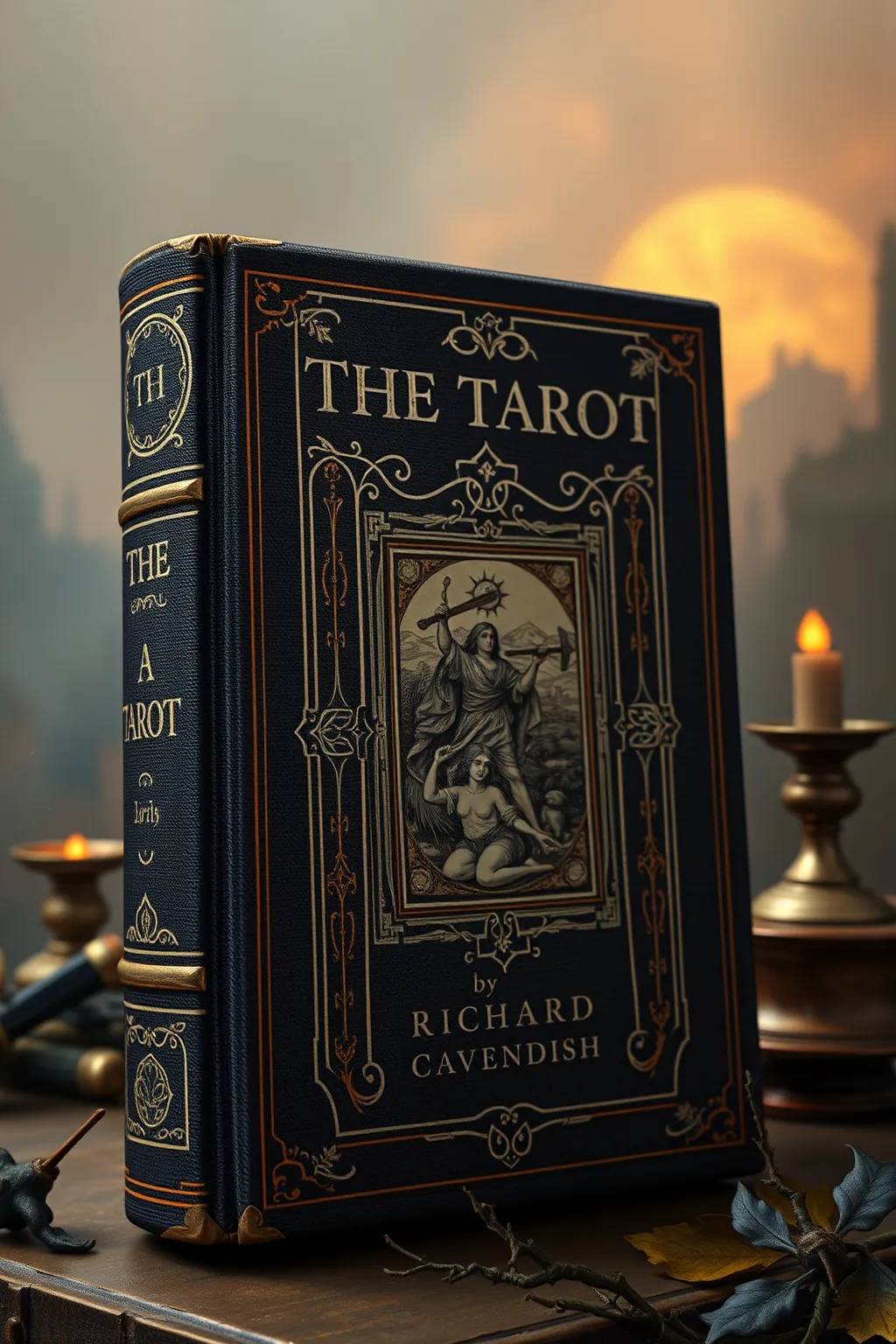
The Tarot
 74
74

The Tarot
Cavendish's "The Tarot," first published in 1986, avoids the sensationalism often accompanying discussions of the cards, opting instead for a scholarly yet accessible approach. He meticulously details the evolution of the deck, particularly its transformation from a Renaissance game to a cornerstone of modern occultism. A strength lies in his clear exposition of the Golden Dawn's contributions, particularly their systematic layering of Kabbalistic and astrological meanings onto the cards. However, the book occasionally feels constrained by its original publication date, lacking engagement with later, more nuanced academic or practical Tarot scholarship. The section detailing the alleged Egyptian origins, while historically important to discuss, could benefit from modern archaeological perspectives. Ultimately, Cavendish provides a solid, historically grounded introduction for those seeking to understand the Tarot's esoteric lineage.
📝 Description
74
Richard Cavendish's 1983 book examines the 78-card Tarot deck's origins and occult practices.
Richard Cavendish's "The Tarot" offers a detailed look at the famous 78-card deck. The book traces the Tarot's history from its roots in Renaissance Europe through its development within occult and divinatory traditions. Cavendish presents the Tarot not just as a tool for predicting the future, but as a rich symbolic system. He discusses its adaptation by various esoteric groups over time. This work is for serious students of Western esotericism, occult history, and symbol studies. Readers who want to understand the Tarot's archetypal language beyond simple fortune-telling will find it valuable. It also suits those interested in the historical connections between art, magic, and philosophy. The book situates the Tarot's development within the late 19th and early 20th centuries, a time of great occult interest. It acknowledges earlier influences from 15th-century Italian Tarocchi cards. Cavendish focuses on how these cards were later given Kabbalistic and astrological meanings by occultists.
Cavendish's study places the Tarot firmly within the Western esoteric tradition, particularly its revival and reinterpretation in the 19th and 20th centuries. He connects the deck to key figures and movements like Eliphas Lévi and the Hermetic Order of the Golden Dawn, who infused the cards with Kabbalistic, astrological, and alchemical symbolism. The book acknowledges the earlier history of the Tarocchi but emphasizes how these cards became a vehicle for occult philosophy and spiritual development, moving them beyond mere games or fortune-telling devices into a complex symbolic language.
💡 Why Read This Book?
• Gain a foundational understanding of the Tarot's historical trajectory from 15th-century Italy to its occult systematization by groups like the Hermetic Order of the Golden Dawn. • Learn about the specific Kabbalistic and astrological correspondences assigned to the Major Arcana by influential figures in early 20th-century esotericism. • Understand the symbolic evolution of the Minor Arcana suits and their connection to elemental and numerological frameworks discussed by Cavendish.
⭐ Reader Reviews
Honest opinions from readers who have explored this book.
❓ Frequently Asked Questions
When was Richard Cavendish's "The Tarot" first published?
Richard Cavendish's "The Tarot" was first published in 1986, marking its entry into the discourse on occultism and divination during a period of renewed interest in these subjects.
What historical period does Cavendish focus on regarding Tarot development?
While acknowledging the Tarot's 15th-century Italian origins, Cavendish primarily focuses on the late 19th and early 20th centuries, detailing its transformation into an esoteric system by occultists.
Does Cavendish discuss the Golden Dawn's influence on the Tarot?
Yes, a significant portion of the book explores the Hermetic Order of the Golden Dawn's systematic integration of Kabbalistic and astrological meanings into the Tarot deck.
What is the main difference between the Major and Minor Arcana according to Cavendish?
Cavendish presents the Major Arcana as representing archetypal stages of spiritual or psychological progression, while the Minor Arcana are linked to elemental forces and everyday life events.
Are the Egyptian origins of the Tarot discussed in this book?
The book addresses the historical claims regarding the Tarot's Egyptian origins, situating these theories within the context of 19th-century occult research and symbolism.
Is "The Tarot" by Richard Cavendish suitable for beginners?
It is suitable for beginners with a serious interest in the historical and esoteric aspects of the Tarot, but it assumes some familiarity with occult concepts rather than being a simple 'how-to' guide.
🔮 Key Themes & Symbolism
Evolution of the Deck
Cavendish meticulously charts the Tarot's metamorphosis from its origins as a game in 15th-century Italy, exemplified by decks like the Visconti-Sforza, to its radical reinterpretation as a tool for occultism. He highlights how subsequent generations, particularly during the 19th and 20th centuries, layered complex symbolic systems – Kabbalistic, astrological, and alchemical – onto the existing imagery, transforming the cards into a 'Book of Wisdom' for esoteric practitioners.
Major Arcana as Archetypal Narrative
A central theme is the Major Arcana's function as a symbolic representation of the soul's journey or a universal pattern of human experience. Cavendish explores interpretations that view the Fool's journey as a path through various spiritual and psychological initiations, connecting each card to potent archetypes and philosophical concepts prevalent in Western esotericism. This section often draws parallels with initiatory structures found in other traditions.
Minor Arcana and Elemental Correspondences
The book studies the structure of the Minor Arcana, explaining how the four suits (Wands, Cups, Swords, Pentacles) are associated with the four classical elements (Fire, Water, Air, Earth) and often further linked to specific letters of the Tetragrammaton and astrological influences. Cavendish clarifies how these correspondences provide a framework for understanding the mundane events and energies represented by the numbered cards.
Theories of Origin and Influence
Cavendish engages with the popular, albeit debated, theories concerning the Tarot's ancient Egyptian or Kabbalistic origins. While critically examining these claims, he acknowledges their significant impact on how the Tarot was perceived and utilized by occultists like A.E. Waite and members of the Hermetic Order of the Golden Dawn, who sought to legitimize the deck by associating it with older, more mystical traditions.
💬 Memorable Quotes
Direct passages from the work, attributed to the author.
“The Tarot cards were originally devised as playing cards.”
— This statement underscores the book's historical grounding, emphasizing that the deck's divinatory and occult significance evolved over time, rather than being its initial purpose. It serves as a factual anchor for understanding its later transformations.
“The Golden Dawn gave the Tarot a new lease of life, enriching it with Kabbalistic and astrological lore.”
— This highlights the key role of the Hermetic Order of the Golden Dawn in shaping the modern esoteric understanding of the Tarot. It points to their systematic infusion of complex symbolic systems, which became foundational for many subsequent Tarot traditions.
“The Major Arcana can be seen as a path of initiation.”
— This interpretation captures the archetypal narrative structure often attributed to the 22 Major Arcana cards. It suggests viewing the sequence not just as individual symbols but as a progressive journey of spiritual or psychological development.
“Each suit of the Minor Arcana corresponds to an element.”
— This expresses a core concept for understanding the Minor Arcana. It explains the elemental association (Wands-Fire, Cups-Water, Swords-Air, Pentacles-Earth) that provides a framework for interpreting the numbered cards.
“Claims of ancient Egyptian origins for the Tarot are largely unsubstantiated.”
— Cavendish addresses popular myths surrounding the Tarot's antiquity. This interpretation reflects his critical approach, distinguishing between historical fact and speculative esoteric theories that nevertheless influenced the deck's reception.
🌙 Esoteric Significance
Tradition
Cavendish's work primarily engages with the Western Esoteric Tradition, particularly the lineage influenced by Hermeticism, Kabbalah, and Renaissance occult philosophy. It fits within this tradition by tracing the Tarot's adoption and adaptation by key occult orders, most notably the Hermetic Order of the Golden Dawn. The book serves as a bridge, explaining how these esoteric interpretations transformed a historical artifact into a system for spiritual development and divination.
Symbolism
Key symbols explored include the Fool's Journey, representing the archetypal path of initiation and self-discovery through the Major Arcana. The four suits of the Minor Arcana—Wands (Fire), Cups (Water), Swords (Air), and Pentacles (Earth)—are central, symbolizing different energetic forces and areas of experience. The integration of Hebrew letters from the Kabbalistic Tree of Life onto the Major Arcana is also discussed as a method for deepening symbolic meaning.
Modern Relevance
Contemporary practitioners and scholars of Western Esotericism continue to reference Cavendish's work for its historical overview and foundational explanations of Tarot symbolism. His clear articulation of the Golden Dawn's system remains influential for those studying the development of modern magical orders and their specific Tarot practices. The book's approach to symbolism is relevant to modern Jungian psychology and archetypal studies that utilize Tarot imagery.
👥 Who Should Read This Book
• Students of Western Esotericism seeking a historical and symbolic grounding in the Tarot's occult development. • Comparative religion scholars interested in the intersection of symbolism, divination, and philosophical systems in European history. • Tarot enthusiasts who wish to move beyond practical application to understand the historical context and intellectual currents that shaped the deck's esoteric meanings.
📜 Historical Context
Published in 1986, Richard Cavendish's "The Tarot" emerged during a period of burgeoning interest in esoteric subjects, following the counter-cultural explorations of the 1960s and 70s. The book engaged with a scholarly tradition that had been developing since the late 19th century, particularly the work of occultists like Eliphas Lévi and the systematic approach taken by the Hermetic Order of the Golden Dawn. Cavendish's work provided a more structured and historically informed perspective compared to some contemporary popularizations. It appeared in a landscape where Tarot was increasingly discussed not just for divination but as a complex symbolic language. Contemporaries like Gareth Knight were also exploring similar esoteric paths, though often with a more personal, psychological focus. The book's reception was generally positive among those seeking a grounded overview of the Tarot's occult lineage, avoiding fringe theories while acknowledging the historical significance of figures like A.E. Waite.
📔 Journal Prompts
The Fool's Journey as an initiatory path: How might the archetypal sequence of the Major Arcana reflect personal growth stages?
Reflect on the elemental correspondences of the Minor Arcana suits. Which element currently feels most prominent in your life, and why?
Consider the historical shift from Tarot as a game to an esoteric tool. What does this transformation reveal about evolving human needs for meaning?
Examine the symbolism of the Court Cards. How do the Knight and Page archetypes manifest differently in contemporary social dynamics?
What role did figures like Eliphas Lévi or the Hermetic Order of the Golden Dawn play in shaping the esoteric interpretation of the Tarot?
🗂️ Glossary
Major Arcana
The set of 22 trump cards in a Tarot deck, typically depicting allegorical figures and concepts, often interpreted as representing significant life events or spiritual stages.
Minor Arcana
The 56 cards of a Tarot deck, divided into four suits (Wands, Cups, Swords, Pentacles), which are generally seen as representing more mundane events, situations, and energies.
Hermetic Order of the Golden Dawn
A late 19th and early 20th-century magical order that significantly influenced modern Western esotericism, particularly in its systematic integration of Kabbalah, astrology, and Tarot symbolism.
Kabbalah
A system of Jewish mysticism that explores the nature of God and the universe through symbolic interpretation of scripture and esoteric doctrines, notably the Tree of Life.
Astrological Correspondences
The practice of linking Tarot cards, particularly the Major Arcana, to specific planets, signs, and houses within the framework of Western astrology.
Cartomancy
The practice of divination using playing cards or, more specifically, Tarot cards. It encompasses various methods of interpretation and prediction.
Tarocchi
The historical Italian name for the early form of the Tarot deck, primarily used for playing games during the Renaissance before its adoption for occult purposes.
🔮 Readers Also Liked
Browse all →







More by Richard Cavendish
All books →



More Free Divination & Tarot Books
View all →