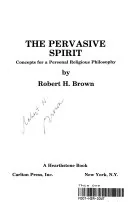
The Pervasive Spirit
 77
77

The Pervasive Spirit
Robert Harold Brown's "The Pervasive Spirit" attempts a grand synthesis, presenting the universe as animated by a singular, unifying consciousness. The work's strength lies in its ambitious scope, drawing parallels between disparate metaphysical ideas. However, Brown's prose can sometimes become dense, obscuring the very clarity he seeks to provide. A particularly illustrative passage is his discussion of the "Law of Resonance," where he argues for its influence on everything from material attraction to psychic phenomena. While the concept is intriguing, the explanation risks becoming overly abstract without sufficient concrete examples for the uninitiated. The book is a dedicated exploration for those already steeped in esoteric thought, though its accessibility for newcomers is debatable.
📝 Description
77
Robert Harold Brown's 1992 book, The Pervasive Spirit, proposes a single animating principle behind all existence.
The Pervasive Spirit, published in 1992, argues for a unifying force Robert Harold Brown calls the "pervasive spirit." This spirit, he claims, is the animating principle that underlies all of creation, influencing everything from human consciousness to the structure of the cosmos. The book examines how this force manifests in different aspects of reality, seeking to connect the individual psyche with the larger universal order.
Brown's work is aimed at readers interested in metaphysics, hermeticism, and comparative religion who are looking beyond materialistic explanations. It will appeal to those who question conventional views and desire a more integrated understanding of the world. The text offers substantial material for contemplation on consciousness, energy, and universal laws, particularly for those drawn to spiritual traditions that highlight interconnectedness and immanent divinity.
Published in the early 1990s, a time of renewed interest in New Age and alternative spiritualities, The Pervasive Spirit emerged as a more philosophical and systematic work. Unlike many contemporaries who focused on specific practices or channeled material, Brown's book aimed to synthesize insights from diverse traditions. It presented a unifying framework for understanding esoteric principles, distinguishing itself from writings focused solely on occult practices and offering a broader metaphysical perspective.
💡 Why Read This Book?
• Understand the "Law of Resonance" as presented by Brown, offering a framework for comprehending interconnectedness beyond conventional physics. • Grasp the concept of "Spiritual Alchemy" as an internal process of purification and transformation, distinct from its alchemical origins. • Explore the "Threefold Nature of Man," providing a model for self-understanding that bridges the physical, mental, and spiritual aspects of being.
⭐ Reader Reviews
Honest opinions from readers who have explored this book.
❓ Frequently Asked Questions
What is the central idea of Robert Harold Brown's "The Pervasive Spirit"?
The central idea is that a single, animating "pervasive spirit" underlies all existence, connecting consciousness, matter, and the cosmos, and influencing reality through principles like resonance.
When was "The Pervasive Spirit" first published?
The book was first published in 1992, a period of renewed interest in metaphysical and esoteric subjects.
Does "The Pervasive Spirit" discuss alchemy?
Yes, it discusses "Spiritual Alchemy" not as the transmutation of metals, but as a metaphor for the inner transformation and purification of the human soul.
What esoteric traditions does the book draw upon?
The book draws upon a range of esoteric traditions, including Hermeticism, and explores concepts related to universal consciousness, vital force, and spiritual laws.
Is "The Pervasive Spirit" suitable for beginners in metaphysics?
While it offers foundational concepts, the book's philosophical depth and abstract nature may be more suited for those with some prior exposure to esoteric or metaphysical thought.
What does the "Law of Resonance" refer to in the book?
The "Law of Resonance" in the book suggests that like influences like, and that the pervasive spirit operates through sympathetic vibrations that connect all things.
🔮 Key Themes & Symbolism
The Pervasive Spirit
Brown posits a singular, omnipresent animating principle that unifies all existence. This "pervasive spirit" is not a distant deity but an immanent force, the source of consciousness and vitality in the universe. It suggests that everything, from the smallest atom to the largest galaxy, is infused with this same energetic essence, challenging materialistic views and highlighting the interconnectedness of all things. The work encourages readers to perceive this spirit in their own lives and the world around them.
Law of Resonance
This principle explains how the pervasive spirit operates and manifests. Brown suggests that the universe functions on sympathetic vibrations, where similar energies attract and influence each other. This applies to thoughts, emotions, and even physical matter. Understanding the Law of Resonance, according to the book, is key to influencing one's reality and aligning with the universal currents of the pervasive spirit, moving beyond mere chance to intentional creation.
Spiritual Alchemy
Beyond its alchemical origins of metal transmutation, Brown reinterprets "Spiritual Alchemy" as the inner process of transforming the human being. It involves purifying the lower aspects of the self—physical desires, negative emotions, limited intellect—to allow the higher, spiritual nature, illuminated by the pervasive spirit, to emerge. This inner work is presented as essential for realizing one's true potential and achieving spiritual evolution.
The Threefold Nature of Man
Brown outlines the human being as a microcosm reflecting the macrocosm, possessing a "threefold nature": physical, mental, and spiritual. Each level is seen as a different manifestation or density of the pervasive spirit. Understanding and harmonizing these three aspects is crucial for spiritual growth. The work suggests that imbalances at any level can hinder the full expression of the spirit within the individual, impacting their connection to the universal whole.
💬 Memorable Quotes
Direct passages from the work, attributed to the author.
“The pervasive spirit is the breath of God in all things.”
— This statement emphasizes the divine, animating quality of the universal force. It suggests that life itself, in all its forms, is a direct expression of this spiritual essence, linking the concept of a pervasive spirit to traditional theological ideas of divine immanence.
“Resonance is the bridge between the seen and the unseen.”
— This highlights the functional role of the Law of Resonance. It acts as the connecting principle that allows the subtle, energetic influence of the pervasive spirit to manifest and be perceived in the material, observable world.
“The threefold nature of man demands integration, not division.”
— This interpretation stresses the importance of wholeness. It advocates for balancing and harmonizing the physical, mental, and spiritual aspects of being, rather than allowing them to remain separate or in conflict, for true spiritual development.
“All consciousness stems from the one pervasive source.”
— This asserts the monistic nature of consciousness as described by Brown. It posits that individual awareness is not separate but a facet of a single, universal consciousness, the pervasive spirit itself.
💡 Key Ideas
Editorial paraphrase of the work's core concepts — not direct quotes.
Inner alchemy transforms the lead of the ego into the gold of the spirit.
This paraphrased concept illustrates Spiritual Alchemy as a process of self-mastery. It describes the journey from identifying with the limited, material self (ego, represented by lead) to realizing one's higher, spiritual nature (gold).
🌙 Esoteric Significance
Tradition
The work is deeply rooted in Western Esotericism, particularly Hermeticism and Neoplatonism, emphasizing the concept of a singular, immanent divine principle. It departs from purely theological doctrines by focusing on the direct experience and observable manifestations of this "pervasive spirit" in the material world. Brown attempts to bridge philosophical idealism with a practical understanding of universal laws, offering a coherent metaphysical system that informs both inner transformation and outer perception.
Symbolism
Key symbols include the "Breath of God," representing the pervasive spirit as the animating force of life, directly linking to concepts of divine inspiration and existence. The "Threefold Nature of Man" (physical, mental, spiritual) symbolizes the microcosm reflecting the macrocosm, a fundamental Hermetic principle. The concept of "Spiritual Alchemy" uses the alchemical transformation of base metals into gold as a metaphor for the soul's purification and ascent towards spiritual perfection.
Modern Relevance
Contemporary thinkers and practitioners in fields like consciousness studies, integral spirituality, and even some quantum metaphysics draw on similar concepts of universal interconnectedness and immanent consciousness. Brown's work provides a foundational text for understanding these ideas, resonating with modern interests in mindfulness, energetic healing, and holistic worldviews that seek to integrate science and spirituality.
👥 Who Should Read This Book
• Students of Hermeticism and comparative religion seeking a philosophical framework for universal unity. • Metaphysical explorers interested in understanding consciousness as an inherent property of existence, not merely a product of the brain. • Individuals undertaking inner work who wish to explore "Spiritual Alchemy" as a path to self-transformation and spiritual realization.
📜 Historical Context
Published in 1992, "The Pervasive Spirit" emerged during a period of significant interest in holistic thought and esoteric philosophy, following the peak of the New Age movement. The intellectual climate was receptive to ideas challenging conventional materialism, influenced by earlier movements like Theosophy and Anthroposophy. Brown's work offered a more philosophical synthesis compared to some of the more channeled or practice-oriented texts popular at the time. While figures like Helena Blavatsky had explored similar concepts of universal unity earlier in the 20th century, Brown's approach sought to articulate these ideas within a framework that acknowledged contemporary metaphysical discourse. The book positioned itself as a unifying perspective on spiritual laws and consciousness, distinct from the more occult-focused writings that often dominated the esoteric publishing scene.
📔 Journal Prompts
Reflect on moments where you felt a connection to a larger, animating force, considering if this aligns with the "pervasive spirit."
Analyze a personal challenge through the lens of the "Law of Resonance"; what energies might you be attracting or projecting?
Consider your "threefold nature"—physical, mental, and spiritual—and identify areas where integration is most needed.
Explore how the concept of "Spiritual Alchemy" might apply to a current personal habit or belief you wish to transform.
How does the idea of a "pervasive spirit" challenge or affirm your current understanding of the universe?
🗂️ Glossary
Pervasive Spirit
The central concept of the book, referring to a singular, animating, and omnipresent force that underlies and connects all of existence, consciousness, and matter.
Law of Resonance
A principle positing that like energies attract and influence each other, explaining how the pervasive spirit manifests and how individuals can consciously interact with universal forces.
Spiritual Alchemy
The inner process of purifying and transforming the human being—specifically the ego and lower nature—to realize one's higher spiritual potential, analogous to the alchemical transmutation of metals.
Threefold Nature of Man
The concept that human beings are composed of physical, mental, and spiritual aspects, representing a microcosm of the universal order and requiring integration for holistic development.
Vital Force
The tangible expression or energy of the pervasive spirit that animates living beings and processes, often discussed in relation to life energy.
Akashic Records
A hypothetical universal library or repository of all knowledge, thoughts, and experiences, believed to be imprinted on the etheric plane and accessible through spiritual means.
Microcosm/Macrocosm
The Hermetic principle that the smaller world (microcosm, e.g., the human being) reflects the structure and nature of the larger world (macrocosm, e.g., the universe).
This book appears in 1 collection
🔮 Readers Also Liked
Browse all →







From the “Soul Travel” Collection
View all →







More Free Occult Philosophy Books
View all →