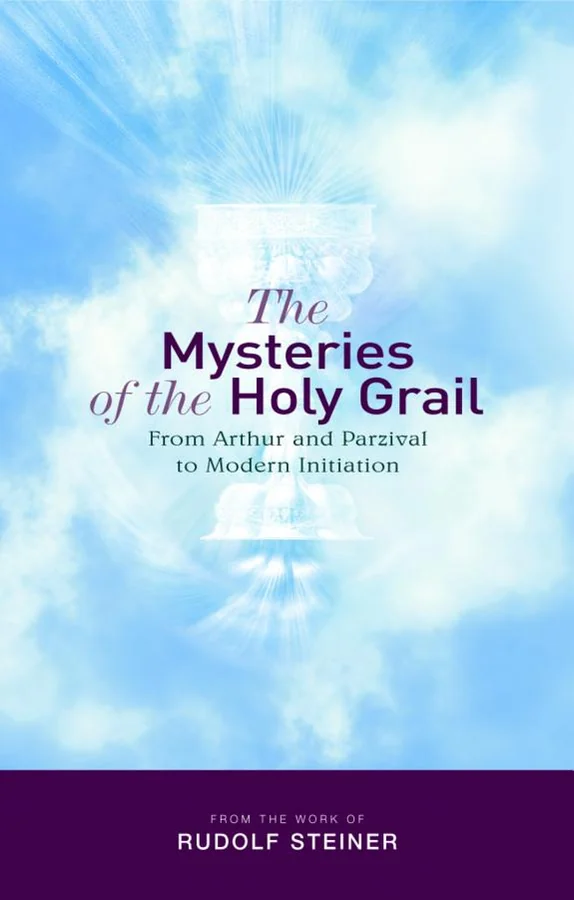
The Mysteries of the Holy Grail
 72
72

The Mysteries of the Holy Grail
Rudolf Steiner’s "The Mysteries of the Holy Grail" offers a unique, albeit demanding, lens through which to view the enduring legend. Eschewing historical or archaeological approaches, Steiner grounds his interpretation firmly in spiritual science. He posits the Grail not as a cup, but as a spiritual substance, a vessel for etheric nourishment connected to the Christ impulse, which is a compelling reorientation for those accustomed to conventional Grail scholarship. A particular strength lies in his detailed exegesis of Wolfram von Eschenbach's "Parzival," which he uses to illustrate the evolution of consciousness and the spiritual challenges inherent in human development. However, the book's esoteric framework demands a significant prior understanding of Anthroposophical concepts, potentially alienating readers unfamiliar with Steiner's specific terminology and cosmology. The dense, lecture-derived prose, while characteristic of Steiner, can also present a hurdle. Nonetheless, for dedicated students of his work, it provides a profound, if esoteric, pathway into the deeper spiritual currents underlying Western mythology. Steiner's analysis of the Grail as a symbol of spiritual evolution rather than a relic remains its most potent contribution.
📝 Description
72
Rudolf Steiner interpreted the Holy Grail legend not as history, but as a spiritual science.
Rudolf Steiner's "The Mysteries of the Holy Grail," published in 2010, examines the Grail saga through a spiritual-scientific lens. He does not treat it as simple folklore or historical account, but rather as a reflection of spiritual realities and human development. Steiner proposed that the Grail is a vessel for spiritual sustenance and a focal point for consciousness growth, linking ancient spiritual traditions to future possibilities.
The book traces the Grail motif through Arthurian legends and medieval romances. Steiner interprets these narratives as symbolic accounts of spiritual quests. He highlights the challenges humanity faces in its movement toward self-awareness and spiritual connection. The work is aimed at serious students of esoteric philosophy, especially those familiar with Steiner and Anthroposophy. It will appeal to readers seeking a non-materialistic grasp of myths and legends, viewing them as coded spiritual teachings.
This work fits within the tradition of Anthroposophy, Rudolf Steiner's spiritual philosophy. Steiner sought to bridge the material sciences with spiritual insights, viewing ancient myths and legends as containing profound spiritual truths. He believed these narratives offered pathways for understanding human evolution and the development of inner faculties. His approach contrasts with purely historical or literary analyses, focusing instead on the underlying spiritual dynamics and cosmic processes he believed were encoded within these stories.
💡 Why Read This Book?
• Understand the Grail legend as a spiritual-scientific allegory for human consciousness evolution, as explored through Steiner's interpretation of Wolfram von Eschenbach's "Parzival." • Grasp the concept of the Grail as a spiritual substance, a vessel for etheric nourishment connected to the Christ impulse, offering an alternative to purely historical or material interpretations. • Discover how Steiner connects the Arthurian knights and their quests to specific stages of spiritual development and the ethical challenges faced by humanity, particularly concerning Luciferic and Ahrimanic influences.
⭐ Reader Reviews
Honest opinions from readers who have explored this book.
❓ Frequently Asked Questions
What is the Holy Grail according to Rudolf Steiner's interpretation?
Rudolf Steiner interprets the Holy Grail not as a physical object like a cup, but as a spiritual reality. It represents a vessel containing spiritual substance, specifically etheric nourishment, linked to the Christ impulse. This substance is crucial for the spiritual rejuvenation and evolution of human consciousness.
How does Steiner connect the Grail legend to human evolution?
Steiner views the Grail narratives, particularly Wolfram von Eschenbach's "Parzival," as symbolic representations of humanity's spiritual journey. The quests and characters illustrate the development of consciousness, the internal struggle against negative spiritual forces, and the path toward higher spiritual perception and self-awareness.
Is "The Mysteries of the Holy Grail" based on historical research?
No, this work is not based on historical or archaeological research. Rudolf Steiner's approach is spiritual-scientific. He analyzes the Grail legends as spiritual dramas and symbolic accounts of cosmic and human evolutionary processes, offering insights accessible through spiritual perception rather than empirical evidence.
What is the significance of King Arthur and his knights in Steiner's view?
In Steiner's interpretation, King Arthur and his knights are archetypal figures. They represent various stages of human consciousness and the collective striving for spiritual attainment. Their quests symbolize the internal battles individuals face in their spiritual development and the effort to connect with higher spiritual realities.
Does this book require prior knowledge of Anthroposophy?
While not strictly mandatory, prior familiarity with Rudolf Steiner's spiritual science and Anthroposophical concepts will greatly enhance understanding. The book uses specific terminology and presents complex spiritual ideas that are more readily grasped by those already acquainted with Steiner's worldview and his other works.
What is the difference between Steiner's Grail and traditional interpretations?
The primary difference lies in the Grail's substance. Traditional interpretations often focus on it being a physical cup (e.g., from the Last Supper or catching Christ's blood). Steiner, however, emphasizes its nature as a spiritual, etheric substance vital for spiritual development, transcending physical materiality.
🔮 Key Themes & Symbolism
Grail as Spiritual Substance
Steiner reinterprets the Grail not as a physical artifact but as a potent spiritual substance, a chalice holding etheric forces. This substance is vital for the rejuvenation and spiritual evolution of humanity, particularly connected to the Christ impulse. He argues that understanding the Grail in this way unlocks its true meaning as a source of spiritual nourishment and a catalyst for developing higher consciousness, moving beyond medieval notions of earthly treasure or relic.
Arthurian Legends as Evolutionary Allegory
The familiar tales of King Arthur and his knights are presented as profound allegories for the evolution of human consciousness. Steiner analyzes figures like Arthur, Parzival, and the other knights as representing different stages of spiritual development and the inherent challenges in humanity's path towards self-awareness. Their quests become symbolic representations of the inner battles fought to overcome material limitations and connect with spiritual realities.
The Christ Impulse and Spiritual Development
A central theme is the Grail's intimate connection to the Christ impulse. Steiner posits that the Grail represents a focal point for this impulse on Earth, offering humanity the potential for spiritual renewal and transformation. The pursuit of the Grail, therefore, becomes synonymous with the active engagement with Christ's spiritual legacy, fostering inner development and the capacity to perceive higher spiritual worlds.
Spiritual Battle Against Materialism
Steiner frames the Grail quest within a larger cosmic struggle, particularly against materialistic and destructive spiritual forces like those represented by Lucifer and Ahriman. The knights' struggles are symbolic of humanity's need to maintain spiritual integrity amidst the forces that seek to bind consciousness to the purely material realm. The Grail's attainment signifies the triumph of spiritual insight and ethical fortitude.
💬 Memorable Quotes
Direct passages from the work, attributed to the author.
“The Grail is not a chalice in the ordinary sense; it is a spiritual vessel.”
— This statement expresses Steiner's core reinterpretation of the Grail legend. It signifies a shift from a physical, historical object to a spiritual reality, emphasizing its role as a container for etheric forces essential for human spiritual evolution.
“The Arthurian knights represent the developing human soul seeking spiritual connection.”
— This interpretation highlights Steiner's view of the characters in Arthurian lore not as historical figures, but as archetypes. They embody the stages and struggles of human consciousness as it journeys from material awareness toward spiritual perception and understanding.
“The quest for the Grail is a quest for the Christ impulse in its etheric form.”
— This emphasizes the deep connection Steiner draws between the Grail and the spiritual influence of Christ. It suggests that engaging with the Grail legend spiritually is equivalent to actively seeking and integrating this transformative spiritual energy into one's life.
“We must recognize the spiritual forces behind the myths.”
— This is a call to action for the reader, urging them to look beyond the surface narrative of legends like the Grail. Steiner encourages a spiritual-scientific approach to uncover the hidden cosmic and human evolutionary truths encoded within these ancient stories.
💡 Key Ideas
Editorial paraphrase of the work's core concepts — not direct quotes.
The Grail contains substance that can spiritualize the human being.
This paraphrased concept points to the revitalizing and transformative power Steiner attributes to the Grail's spiritual essence. It suggests that by engaging with this essence, individuals can elevate their consciousness and achieve a more profound spiritual existence.
🌙 Esoteric Significance
Tradition
Steiner's work on the Grail fits within the broader Western Esoteric Tradition, particularly drawing from Hermeticism, Christian Mysticism, and Theosophy (from which Anthroposophy emerged). He departs from purely mystical interpretations by framing the Grail within his specific spiritual-scientific cosmology, focusing on its role in human evolution and consciousness development. Unlike Theosophy's often comparative mythological approach, Steiner's analysis is teleological, emphasizing the Grail's function in guiding humanity towards future spiritual capacities.
Symbolism
The primary symbols Steiner explores are the Grail itself, often depicted as a chalice or vessel, and the figures of the Grail knights, such as Parzival. The chalice symbolizes a receptacle for spiritual substance, capable of imparting etheric life and spiritual awakening. The knights represent the striving human soul, undertaking arduous inner journeys to overcome limitations and achieve spiritual enlightenment, reading through the challenges posed by opposing spiritual forces.
Modern Relevance
Contemporary practitioners of Anthroposophy continue to draw on Steiner's interpretation for understanding spiritual development. His ideas also find echoes in modern spiritual psychology and consciousness studies that explore archetypal symbolism in mythology. Thinkers and groups interested in the spiritual underpinnings of Western culture, the evolution of consciousness, and the esoteric interpretation of ancient legends often reference Steiner's unique perspective on the Grail.
👥 Who Should Read This Book
• Students of Rudolf Steiner and Anthroposophy seeking a deeper understanding of his spiritual-scientific interpretation of Western myths. • Researchers of comparative mythology and esoteric traditions interested in non-materialistic analyses of legendary figures and symbols. • Individuals exploring the evolution of human consciousness and the spiritual dimensions of archetypal narratives found in medieval literature.
📜 Historical Context
The legend of the Holy Grail emerged and evolved significantly during the High Middle Ages, a period (roughly 1100-1300 CE) characterized by intense religious fervor, the flourishing of courtly love, and the development of chivalric literature. Key figures like Chrétien de Troyes, who introduced the Grail in his unfinished romance "Perceval, le Conte du Graal" around 1180, and Wolfram von Eschenbach, whose "Parzival" (c. 1204-1214) offered a more complex, mystical interpretation, shaped its early narrative. These works were deeply embedded within a Christian framework but also drew upon earlier Celtic mythology and Gnostic undercurrents, reflecting a complex spiritual landscape. The Grail became a potent symbol of spiritual quest, divine grace, and the search for ultimate truth. Steiner's work, published much later in 2010, engages with this tradition by reinterpreting these medieval narratives through the lens of his spiritual science, offering a cosmic-evolutionary perspective that contrasted sharply with purely historical or theological analyses prevalent in his time and continuing today.
📔 Journal Prompts
The Grail as a vessel for etheric nourishment: how might this concept inform daily spiritual practice?
Parzival's journey: what internal obstacles must be overcome to achieve spiritual insight?
The Christ impulse's connection to the Grail: how does this spiritual influence manifest in human development?
Reflecting on Arthurian archetypes: which stage of consciousness do they represent for modern individuals?
Steiner's interpretation of the Grail's spiritual substance: what are its implications for understanding the human etheric body?
🗂️ Glossary
Etheric Body (or Life Body)
In Anthroposophy, the etheric body is considered the life-giving principle or formative forces that organize the physical body. Steiner links the Grail's substance to these etheric forces, crucial for spiritual renewal and the evolution of consciousness.
Christ Impulse
Steiner's term for the spiritual event of Christ's incarnation, death, and resurrection, which he believed infused the Earth with a powerful spiritual force intended to guide human evolution towards freedom and spiritual consciousness.
Luciferic Forces
Spiritual influences, according to Steiner, that lead to pride, egoism, spiritual illusion, and premature spiritual development, often associated with an inflated sense of self and detachment from earthly reality.
Ahrimanic Forces
Spiritual influences, according to Steiner, that lead to materialism, intellectualism devoid of spirit, hardening, and a denial of spiritual realities, anchoring consciousness solely in the physical world.
Spiritual Science (Anthroposophy)
Rudolf Steiner's term for his method of investigating the spiritual world through trained faculties of perception, aiming to provide verifiable knowledge of spiritual realities and their connection to the physical world.
Parzival
The central character in Wolfram von Eschenbach's epic poem, often considered a key figure in Grail literature. Steiner interprets Parzival's quest as a profound allegory for the development of human consciousness and spiritual attainment.
Archetype
In a spiritual or psychological context, an archetype is a fundamental, universal pattern or image that underlies human experience and expression. Steiner uses archetypes to understand figures and events in myths as representations of spiritual processes.
This book appears in 1 collection
🔮 Readers Also Liked
Browse all →








From the “Holy Grail” Collection
View all →








More Free Occult Philosophy Books
View all →