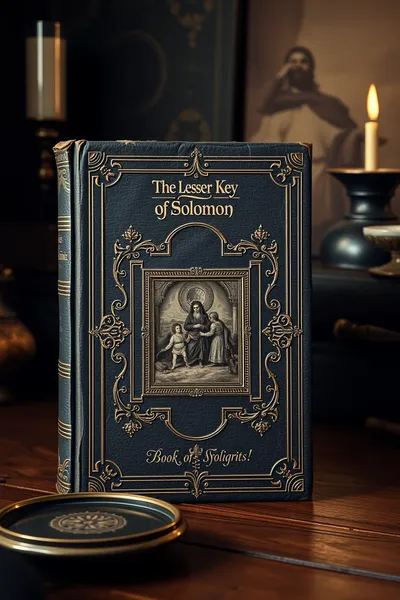
The Lesser Key of Solomon

 80
80

The Lesser Key of Solomon
The Lesser Key of Solomon presents a stark, unvarnished look at the mechanics of ceremonial demonology as understood in the 17th century. Its primary strength lies in the meticulous cataloging of the 72 demons within the Goetia, offering detailed descriptions and sigils that have become archetypal in occult circles. The translations by MacGregor Mathers and Aleister Crowley, while reflecting their respective eras and editorial choices, remain standard for many practitioners. However, the text's sheer density and the archaic nature of its rituals can be a significant hurdle. A passage describing the 'Square of the Wise Men' for finding treasure feels particularly archaic, highlighting the grimoire's practical, often materialistic, intent alongside its spiritual claims. While essential for historical context, its direct applicability requires significant interpretation and adaptation for modern use. It's a foundational text, but one best approached with critical historical awareness.
📝 Description
80
The Lesser Key of Solomon, compiled around 1655, details 72 demons summoned by King Solomon.
This 17th-century grimoire, known as the Lemegeton, focuses on demonology. Its most prominent section, the Goetia, lists 72 specific demons, purportedly bound by King Solomon. The text provides descriptions of these entities, their sigils or magical seals, and the necessary rituals and tools for their evocation. It is considered a significant text in Western esotericism, influencing later occult traditions.
The book is of particular interest to practitioners and scholars of Western ceremonial magic and demonology. It suits those who wish to engage directly with historical grimoire traditions. Readers interested in the history of occultism and the development of magical practices will also find it valuable. The material may not be suitable for casual readers or those uncomfortable with its darker subject matter.
Emerging around 1655, The Lesser Key of Solomon reflects a period of intense occult interest in Europe. It synthesized older magical texts into a structured system. Though attributed to King Solomon, it was compiled by anonymous authors. Its circulation in manuscript form preceded its wider print publication, establishing it as a key text in modern occultism.
The Lesser Key of Solomon belongs to the tradition of Solomonic magic, a body of magical literature attributed to the biblical King Solomon. This tradition, which flourished in Europe from the late Middle Ages through the early modern period, claims to grant practitioners the power to command spirits, particularly demons. It often involves detailed instructions for creating magical tools, performing rituals, and using specific incantations and seals to achieve control over supernatural entities for various purposes.
💡 Why Read This Book?
• Gain direct insight into the 72 demons cataloged in the Goetia, understanding their described ranks and sigils, which are foundational to Western ceremonial magic. • Study the specific ritualistic requirements, including the construction of magical circles and the use of divine names, as detailed in the text for summoning these entities. • Appreciate the historical lineage of Solomonic magic, tracing its influence through the compilation of this grimoire and its later adoption by figures like Aleister Crowley.
⭐ Reader Reviews
Honest opinions from readers who have explored this book.
❓ Frequently Asked Questions
What is the origin of The Lesser Key of Solomon?
The Lesser Key of Solomon is a 17th-century grimoire, compiled anonymously and attributed to King Solomon. It draws upon earlier magical texts and was first fully published around 1655, becoming a significant work in ceremonial magic.
Who translated The Lesser Key of Solomon?
The most widely known English translation of The Lesser Key of Solomon, particularly the Goetia section, was produced by Aleister Crowley and S. L. MacGregor Mathers, first published in 1904.
What is the Goetia section about?
The Goetia, the first book of The Lesser Key of Solomon, describes 72 demons that King Solomon allegedly summoned and controlled. It provides their descriptions, sigils, ranks, and the rituals for their evocation.
Is The Lesser Key of Solomon a religious text?
While it invokes divine names and authority, The Lesser Key of Solomon is primarily a magical text or grimoire, not a religious scripture. It details practices for commanding spirits within a specific occult framework.
What are sigils in The Lesser Key of Solomon?
Sigils are symbolic representations or magical seals associated with each of the 72 demons described in the Goetia. They are believed to be essential for identifying and invoking the specific entity.
Is this book suitable for beginners in occultism?
The Lesser Key of Solomon is a complex and historically dense text. While foundational, its practices require significant study and caution, making it more suitable for intermediate or advanced students of Western esotericism.
🔮 Key Themes & Symbolism
Solomonic Demonology
The central theme is the system of demonology attributed to King Solomon, as presented in the Goetia. This involves the belief that Solomon possessed the power to summon, bind, and command 72 specific demonic entities. The text details their hierarchical ranks (King, Duke, Marquis, etc.) and their purported abilities, offering a structured approach to interacting with the infernal hierarchy for magical purposes.
Ritualistic Evocation
A significant focus is placed on the practical application of ceremonial magic. The grimoire meticulously outlines the necessary preparations, tools (like wands, swords, and pentacles), protective circles, and specific incantations required to safely evoke and control these spirits. This emphasizes the disciplined and structured nature of the magical work described.
Sigils and Identification
Each of the 72 demons is represented by a unique sigil, a symbolic diagram meant to embody the entity's essence. These sigils are crucial for identification and invocation, serving as visual keys to accessing the spirit's power or knowledge. Their inclusion highlights the importance of symbolic language in the grimoire's magical system.
Spiritual Authority
The text operates under the premise that the magician can command spirits through the authority granted by divine names and powers. This reflects a common theme in Western esotericism where the practitioner channels or invokes higher powers to gain leverage over lower spiritual forces.
💬 Memorable Quotes
Direct passages from the work, attributed to the author.
“The conjuration of the King of the East...”
— This is an interpretation of the structure within the Goetia, highlighting the specific conjurations detailed for individual spirits, which are central to the practical magical instructions within the grimoire.
“The Serpent is the Devil; the Cat is the Witch; the Toad is the Devil; the Owl is the Devil.”
— This represents a common symbolic association found in older magical and folk traditions, linking specific animals to malevolent spiritual forces, reflecting the worldview informing some parts of the grimoire's context.
“The proper use of the pentacle is to make spirits obedient.”
— This highlights the function of a specific magical tool within the grimoire's system. The pentacle is presented as an instrument of control, essential for ensuring the compliance of summoned entities.
“There are 72 Spirits in number, the like whereof were not seen.”
— This statement emphasizes the unique and comprehensive nature of the list of spirits presented in the Goetia, underscoring its significance as a complete catalog of these entities.
💡 Key Ideas
Editorial paraphrase of the work's core concepts — not direct quotes.
The first part is called Goetia, and therein is contained a knowledge of the Banners of Wicked Spirits, their Shapes, Habits, Vertues, Offices, and Degrees.
This passage clearly defines the primary focus of the Goetia section, emphasizing its role as a directory for understanding and interacting with the described demonic entities and their attributes.
🌙 Esoteric Significance
Tradition
The Lesser Key of Solomon is deeply rooted in the Western Esoteric Tradition, specifically within the lineage of ceremonial magic and Solomonic magic. It draws heavily from Kabbalistic concepts, particularly in its hierarchical structuring of spirits and the use of divine names. It fits within the broader Hermetic and grimoire traditions, which seek to codify magical practices for interacting with the spirit world, often for practical or spiritual advancement.
Symbolism
Key symbols include the sigils, which are unique visual representations of each demon, acting as keys to their identity and power. The magical circle, often inscribed with divine names and symbols, represents a sacred space of protection and authority for the magician. The pentagram and hexagram are also employed, symbolizing cosmic forces and providing further protection and control.
Modern Relevance
Contemporary practitioners of ceremonial magic, particularly those within traditions like the Hermetic Order of the Golden Dawn and its offshoots, frequently engage with The Lesser Key. Modern occultists and demonologists study its structure and rituals, often adapting or reinterpreting the described entities and practices for personal magical work or comparative study.
👥 Who Should Read This Book
• Students of Western Ceremonial Magic: Those seeking to understand the historical underpinnings and specific ritualistic structures of traditional demonology will find the detailed descriptions of spirits and conjurations invaluable. • Scholars of Esotericism: Researchers interested in the history of occultism, demonology, and grimoire traditions will benefit from its primary source material and historical context. • Practicing Occultists: Individuals engaged in active magical work may use this text as a reference for understanding historical practices and potentially adapting them, with appropriate caution and study.
📜 Historical Context
The Lesser Key of Solomon emerged in mid-17th century England, a period rife with occult activity and intellectual ferment, bridging the late Renaissance and the burgeoning scientific revolution. This era saw widespread interest in magic, alchemy, and astrology, exemplified by figures like John Dee and the Rosicrucian movement. The grimoire synthesized older traditions, particularly medieval demonological texts and earlier magical compendia, attributing its contents to the legendary King Solomon to bolster its authority. It circulated in manuscript form before its first full publication around 1655. This period also witnessed growing skepticism; while figures like Robert Burton in his *The Anatomy of Melancholy* (1621) discussed such beliefs, the rise of Cartesian philosophy and empirical science began to challenge the foundations of esoteric thought. The Lesser Key stood in contrast to emerging rationalist viewpoints, representing a persistent current of magical practice and belief that would later be revived by occult revival movements in the 19th century.
📔 Journal Prompts
The descriptions of the 72 spirits in the Goetia section.
The construction and purpose of the magical circle as detailed.
The specific tools required for conjuration and their symbolic meaning.
The invocation of divine names to command spirits.
The practical applications attributed to each spirit's abilities.
🗂️ Glossary
Grimoire
A textbook of magic or occultism, typically containing instructions on how to create magical objects, perform rituals, and cast spells. The Lesser Key of Solomon is a prominent example.
Goetia
The first book of The Lesser Key of Solomon, focusing on the evocation and command of 72 demons, detailing their names, ranks, sigils, and purported abilities.
Sigil
A magical symbol or sign, often unique to a specific entity or purpose, used in ceremonial magic for identification, invocation, or representation of power.
Evocation
A magical ritual intended to summon a spirit or entity into the magician's presence or a scrying mirror, as opposed to invocation, which is drawing the spirit's essence into oneself.
Lesser Key of Solomon
A 17th-century grimoire compiled from various sources, famous for its Goetia section detailing 72 demons, and other sections on divination, planetary magic, and conjuration.
Pentacle
A magical tool, often a disc inscribed with symbols, used for protection, invocation, or commanding spirits in ceremonial magic. Mentioned in The Lesser Key.
Solomonic Magic
A tradition of magic attributed to the biblical King Solomon, characterized by the use of divine names and rituals to command angels or demons.
This book appears in 1 collection
🔮 Readers Also Liked
Browse all →









From the “Goetia” Collection
View all →


More Free Occult Philosophy Books
View all →