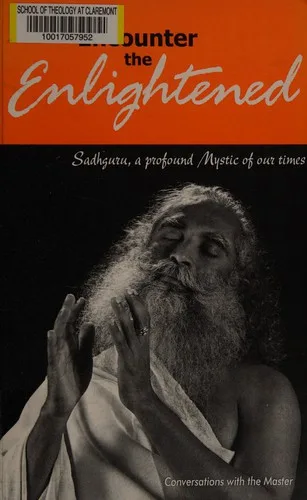
Encounter the Enlightened
 80
80

Encounter the Enlightened
Sadhguru's *Encounter the Enlightened* offers a direct, no-nonsense approach to spiritual exploration. Unlike many texts that rely on abstract philosophy, Sadhguru grounds his teachings in practical application, particularly evident in his discussions on the nature of the mind and the body as a device for experience. The strength lies in this accessibility; concepts that might otherwise remain esoteric are presented with a clarity that invites immediate contemplation. However, the book's conversational style, while engaging, occasionally skirts over deeper philosophical nuances that might satisfy a seasoned scholar. A notable passage concerning the illusion of past and future, urging a radical presence, exemplifies the book's power to reframe perception. It serves as a potent primer for those new to self-inquiry, though it may feel introductory to those well-versed in spiritual literature. A valuable, if direct, guide to inner transformation.
📝 Description
80
Sadhguru Jaggi Vasudev's *Encounter the Enlightened*, published in 2001, offers pragmatic spiritual practices.
First released in 2001, *Encounter the Enlightened* compiles teachings from Sadhguru Jaggi Vasudev focused on inner engineering and direct spiritual experience. The book moves beyond dogma, emphasizing conscious living and self-awareness as paths to inner peace. It addresses individuals seeking spiritual growth outside conventional religious structures, particularly those interested in meditation and practical methods for managing their inner state.
The work introduces readers to the mechanics of human consciousness and a non-dual perspective on reality. For those already familiar with Sadhguru's public talks, this volume provides a more structured overview of his core teachings on personal transformation. The approach is rooted in yogic science and Indian philosophy, distinguishing itself from more ritualistic or ascetic spiritual paths.
Published in 2001, *Encounter the Enlightened* arrived as Eastern spirituality and mindfulness gained wider Western acceptance. The book aligns with the yogic tradition, presenting concepts of inner transformation rooted in ancient Indian philosophy. It offers a path distinct from asceticism, emphasizing practical application of spiritual principles for everyday life. This work reflects a growing interest in non-dual perspectives and direct experiential knowledge in spiritual development.
💡 Why Read This Book?
• Learn practical methods for inner engineering, directly applicable to daily life, as presented in the book's framework for conscious living. • Understand the yogic perspective on the body-mind relationship, a core concept explored in the text, offering a unique lens on human experience. • Gain actionable insights into transcending psychological suffering by focusing on the present moment, a recurring theme exemplified in the book's discourse.
⭐ Reader Reviews
Honest opinions from readers who have explored this book.
❓ Frequently Asked Questions
When was Sadhguru Jaggi Vasudev's 'Encounter the Enlightened' first published?
The book 'Encounter the Enlightened' by Sadhguru Jaggi Vasudev was first published in 2001, marking its emergence during a period of increasing global interest in Eastern spiritual teachings.
What is the central philosophy behind 'Encounter the Enlightened'?
The central philosophy is 'inner engineering,' which posits that individuals can consciously design their inner experience through self-awareness and specific yogic practices, rather than relying on external conditions.
Does the book 'Encounter the Enlightened' require prior knowledge of yoga?
No, the book is designed to be accessible to individuals new to yoga or spiritual practices. Sadhguru explains concepts clearly, making them understandable for a broad audience.
What kind of practices are discussed in 'Encounter the Enlightened'?
The book discusses various yogic practices and meditations aimed at enhancing self-awareness, managing energy, and achieving inner well-being. Specific techniques are presented to facilitate direct experience.
Is 'Encounter the Enlightened' suitable for skeptics?
Yes, the book focuses on experiential truths and practical application rather than dogma, making it suitable for skeptics interested in exploring the mechanics of consciousness and well-being.
Where does Sadhguru's 'Encounter the Enlightened' fit within spiritual literature?
It fits within contemporary spiritual literature that bridges Eastern yogic traditions with modern psychological and self-help approaches, emphasizing personal responsibility for one's inner state.
🔮 Key Themes & Symbolism
Inner Engineering Principles
The core of the book lies in the concept of 'inner engineering,' presenting spirituality not as a belief system but as a technology for self-transformation. Sadhguru emphasizes that human beings have the innate capacity to engineer their internal states of being, independent of external circumstances. This involves a systematic approach to understanding and managing one's thoughts, emotions, and energy. The book provides practical guidance on how to achieve this, focusing on conscious awareness as the primary tool for creating a fulfilling life. It suggests that liberation and well-being are not sought externally but are cultivated from within.
Consciousness and Perception
Sadhguru looks at the nature of consciousness and perception, arguing that our experience of the world is a projection of our inner state. The book explores how limitations in perception create suffering and how expanding consciousness allows for a richer, more liberated experience of life. It challenges the reader to question their habitual ways of seeing and understanding, encouraging a shift from a reactive to a responsive way of living. The work posits that by becoming more conscious, individuals can move beyond the limitations of their conditioning and unlock their full potential.
The Nature of the Self
A significant theme is the exploration of the 'self' beyond the physical body and the conditioned mind. The book guides readers toward recognizing their essential nature, which is described as pure consciousness or awareness. It differentiates between the ego-driven self and the true, unbound self. By understanding this distinction, individuals can begin to dismantle the psychological structures that bind them to suffering and limitation. The work advocates for an experiential realization of the self, rather than intellectual understanding, as the path to genuine freedom.
Practical Spirituality
Unlike purely philosophical or devotional texts, *Encounter the Enlightened* champions a practical, experiential approach to spirituality. Sadhguru provides accessible tools and methods, often rooted in yogic science, that readers can integrate into their daily lives. The focus is on efficacy – what works to create lasting inner change and well-being. This pragmatic stance removes the perceived distance between spiritual ideals and everyday reality, making profound inner transformation seem achievable for anyone willing to engage with the practices offered.
💬 Memorable Quotes
Direct passages from the work, attributed to the author.
“The only way to experience life is from within.”
— This statement highlights the book's core message: true experience and understanding of life originate from one's internal state, not external events. It suggests that focusing inward is the key to unlocking genuine perception.
“The nature of life is such that the more you try to be happy, the more you will be miserable.”
— This seemingly paradoxical statement suggests that actively pursuing happiness as an external goal can be counterproductive. The work implies that happiness is a byproduct of inner states, not a destination to be chased.
“The most important thing is to be alive to life.”
— This emphasizes living fully in the present moment, engaging with life's experiences with full awareness. It's a call to move beyond rumination on the past or anxiety about the future to embrace the richness of the now.
“Your destiny is not written in the stars, but within your own being.”
— This reinforces the idea of personal agency and responsibility for one's life path. It suggests that external forces do not dictate fate; rather, our inner state and actions shape our destiny.
💡 Key Ideas
Editorial paraphrase of the work's core concepts — not direct quotes.
You are not your body, you are not your mind; you are the awareness that perceives both.
This quote points to the fundamental distinction between the physical and mental self and the deeper, unchanging consciousness that witnesses them. It's an invitation to identify with this awareness rather than fleeting thoughts or sensations.
🌙 Esoteric Significance
Tradition
The work draws heavily from the yogic traditions of India, particularly the path of Jnana Yoga (path of knowledge) and Kriya Yoga (path of action/energy). While not strictly Hermetic or Gnostic, it shares the esoteric goal of inner liberation and self-realization. It departs from some traditional lineages by emphasizing a contemporary, accessible presentation devoid of rigid ritual or sectarian dogma, focusing on the universal mechanics of consciousness applicable to any individual, regardless of background.
Symbolism
While the book is less reliant on overt symbolic language compared to classical esoteric texts, the concept of the 'body as a device' can be seen as a symbolic representation of the human form's potential as a tool for spiritual evolution. The 'inner engineering' metaphor itself functions symbolically, framing spiritual growth as a deliberate, skillful construction of one's inner life, akin to building a sophisticated mechanism.
Modern Relevance
Sadhguru's teachings, including those in *Encounter the Enlightened*, continue to influence contemporary wellness movements, mindfulness practices, and secularized spiritual exploration. His emphasis on practical tools for stress reduction and inner peace speaks to modern audiences seeking tangible results. Thinkers and practitioners in fields ranging from positive psychology to corporate wellness programs often reference or adapt principles found in his work, demonstrating its ongoing relevance in secular and spiritual contexts.
👥 Who Should Read This Book
• Seekers interested in practical spirituality: Individuals looking for actionable methods to cultivate inner peace and well-being beyond theoretical concepts will find the book's focus on 'inner engineering' directly beneficial. • Students of consciousness: Those curious about the nature of the mind, perception, and the self from a non-dualistic perspective will appreciate Sadhguru's direct exploration of these topics. • Followers of Sadhguru's teachings: Readers already familiar with Sadhguru's public discourses and seeking a more structured compilation of his core principles will find this book a valuable resource.
📜 Historical Context
Published in 2001, *Encounter the Enlightened* arrived during a global surge of interest in Eastern spirituality, meditation, and yoga, largely popularized by figures like the Dalai Lama and Maharishi Mahesh Yogi. Sadhguru Jaggi Vasudev, already a prominent spiritual teacher in India, was expanding his reach internationally. This period saw a growing Western audience seeking alternatives to traditional religious structures, embracing practices that offered personal transformation and well-being. The book emerged as a significant contribution from the yogic tradition, distinct from the more philosophical or devotional paths. While figures like Deepak Chopra were blending Eastern concepts with Western psychology, Sadhguru's approach remained more rooted in the direct experience and practices of classical yoga, offering a pragmatic, non-dogmatic path that appealed to a broad spectrum of seekers.
📔 Journal Prompts
The concept of 'inner engineering' as a conscious process.
Your personal definition of 'consciousness' beyond mere awareness.
Identifying limitations in your current perception of reality.
The distinction between the self and the mind as presented in the book.
Practicing being 'alive to life' in a mundane activity.
🗂️ Glossary
Inner Engineering
A term coined by Sadhguru, referring to the process of consciously designing one's inner experience and well-being through specific yogic practices and awareness techniques.
Consciousness
The fundamental awareness or sentience that underlies existence. In Sadhguru's teachings, it is seen as the essential nature of a human being, distinct from the body and mind.
Perception
The way in which something is regarded, understood, or interpreted. The book suggests that perception is subjective and can be consciously altered to change one's experience of life.
Karma
In yogic philosophy, karma refers to the accumulated impressions and tendencies from past actions that influence present experiences and future possibilities. It is seen as a mechanism that can be transcended.
Mind
The collection of thoughts, emotions, and memories. The book often distinguishes the mind as a tool or a process, separate from the deeper consciousness.
Yogic Science
The systematic study and application of yogic principles and practices for human well-being and spiritual evolution, encompassing physical, mental, and energetic dimensions.
Self-realization
The attainment of true knowledge of one's own being; the recognition of one's essential nature as consciousness, independent of the physical and mental structures.
🔮 Readers Also Liked
Browse all →







More by Sadhguru Jaggi Vasudev
All books →

More Free Occult Philosophy Books
View all →